
Co-LoRA Lets Rival AI Models Collaborate Without Sharing Raw Data
Seo et al. introduce Co-LoRA, a dimension-invariant adapter that lets federated clients with completely different model architectures share knowledge, plus DRAKE, the first multi-modal PFL benchmark with 40 tasks and temporal distribution shifts.
 Pro
Takeaways
- Seo et al. introduce Co-LoRA, a dimension-invariant LoRA module that enables federated knowledge sharing across models with completely different architectures.
- The full framework, FedMosaic, combines Co-LoRA with RELA (RELevance-guided Aggregation), which restricts knowledge sharing to clients working on related tasks to reduce parameter interference.
- Co-LoRA works by sharing only small square matrices P (r×r) and Q (r) whose size depends only on the LoRA rank, not the model's hidden dimension, making them architecture-agnostic.
- The paper also introduces DRAKE, the first multi-modal PFL benchmark with 40 diverse tasks and temporal distribution shifts, covering both static and dynamic data settings.
- FedMosaic consistently outperforms SFT and state-of-the-art PFL baselines on both LLaVA-Llama3.2-1B and 3B clients across DRAKE and HFLB benchmarks, with computation comparable to local fine-tuning.
- Key limitation: requires all clients to use LoRA-based fine-tuning and relies on gradient similarity signals shared with the server each round.
Co-LoRA, a new paper from Minhyuk Seo, Taeheon Kim, Hankook Lee, Jonghyun Choi, and Tinne Tuytelaars, tackles one of the most stubborn gaps between federated learning research and the real world: the assumption that every participant in a federation runs the same model architecture on similar data. In practice, that assumption almost never holds. A hospital running a 1B-parameter vision-language model and a research lab running a 3B one cannot simply average their weights together. Co-LoRA is built to fix that.
The gap between lab FL and real-world FL
As AI becomes more personal, particularly with the rise of agentic AI, there is an increasing need for personalizing models for various use cases. Personalized federated learning (PFL) enables each client to collaboratively leverage other clients' knowledge for better adaptation to the task of interest, without privacy risks. The catch is that the field has been working in a comfortable fiction.
Existing PFL methods remain confined to rather simplified scenarios where data and models are the same across clients. Real deployments look nothing like this. Most PFL studies overlook the heterogeneity inherent in real-world clients, where clients typically have distinct models depending on their computational resources (model heterogeneity) and deal with highly personalized data (data heterogeneity), as in agentic AI.
There are two distinct problems that need to be solved simultaneously:
- Data heterogeneity: clients work on different tasks (visual QA, multi-image reasoning, relation detection), so naively averaging their model weights causes parameter interference -- updates that help one task hurt another.
- Model heterogeneity: clients run different architectures with different hidden dimensions and layer depths, making direct weight averaging mathematically impossible.
Prior approaches like HETLoRA and FlexLoRA handle varying LoRA ranks through zero-padding/truncation and SVD-based redistribution, respectively. Although they address the varying rank sizes, both assume identical hidden dimensions and uniform depths across clients, limiting their applicability to heterogeneous architectures that differ in both.

FedMosaic: two components, one framework
The paper introduces a complete framework called FedMosaic, which addresses both forms of heterogeneity through two components working in tandem. To address real-world heterogeneities that hinder client collaborations in PFL, the authors propose FedMosaic, comprising RELA (RELevance-guided Aggregation) and Co-LoRA (Collaborative-LoRA). RELA mitigates data heterogeneity by restricting knowledge sharing to local models trained on related tasks, thus reducing interference during aggregation.
Here is how each component works:
- RELA (RELevance-guided Aggregation): On every round, the local Co-LoRA fine-tuned during local training and the sanitized last-layer gradient are uploaded from each client to the server. The last-layer gradient is extracted periodically from a small pre-trained model, then EMA-updated and sanitized. On the server, these sanitized gradients are used to measure client task relevance and to build a customized global Co-LoRA for each client, which is distributed and kept frozen. In short: the server computes gradient similarity between clients to figure out who is working on related tasks, then only shares knowledge between those clients.
- Co-LoRA (Collaborative-LoRA): Standard LoRA adapters have weight matrices whose dimensions are tied to the hidden size of the model they are inserted into -- a 1B and a 3B model cannot share them. Co-LoRA enables cross-architecture collaboration via dimension-invariant modules P (r x r) and Q (r), whose sizes depend only on the low-rank size r, independent of hidden dimension, making them directly shareable across heterogeneous models.

A benchmark built for the real world
One reason PFL research has stayed in simplified settings is that no suitable benchmark existed for realistic heterogeneous scenarios. The paper introduces DRAKE to fill that gap. DRAKE is a comprehensive benchmark for multi-modal PFL with 40 diverse tasks. Unlike prior works that simulate heterogeneity via non-i.i.d. splits of a single dataset, DRAKE assigns each client a distinct multi-modal task (e.g., visual question answering or visual reasoning), while also incorporating temporal distribution shifts inherent in the real world.
To the best of the authors' knowledge, this is the first benchmark for multi-modal FL that considers data heterogeneity as well as distribution shifts. The benchmark supports two evaluation modes:
- PFL-Static: client data distributions are fixed across rounds (i.i.d. within each client).
- PFL-Dynamic: clients experience intra-client distribution shifts over time, simulating streaming real-world data.

What the numbers show
Evaluated in multi-modal heterogeneous PFL-Dynamic and -Static setups where clients employ different architectures (LLaVA-Llama3-1B or 3B), FedMosaic consistently outperforms baselines on both clients' own tasks and others' tasks under static and dynamic distributions. The comparison baseline is supervised fine-tuning (SFT) -- each client training only on its own data with no cross-client sharing -- which represents the privacy-safe but knowledge-isolated approach most practitioners fall back on today.
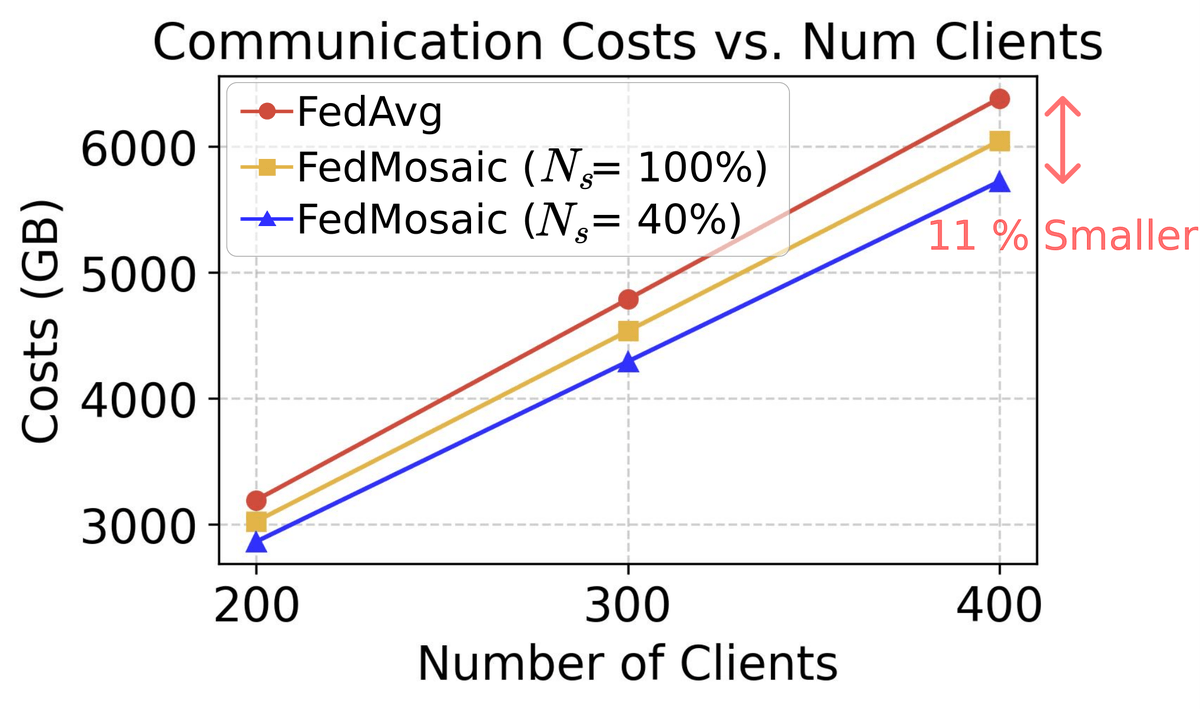
FedMosaic demonstrates higher personalization performance with computation comparable to SFT. That is a meaningful result: the collaboration overhead does not come at a significant compute cost. Extensive evaluation shows FedMosaic achieves superior personalization compared to local training, while improving generalizability and few-shot adaptation capabilities essential for future personalization.
Where it matters -- and where it does not
The most natural applications are anywhere you have a fleet of devices or institutions that each run their own model variant and cannot share raw data:
- Hospital networks where each site runs a different-sized vision-language model for medical imaging tasks
- Enterprise AI deployments where different teams fine-tune models of varying sizes on proprietary data
- Agentic AI systems where each agent has a personalized model adapted to its user's tasks
- Edge device federations (phones, robots) with heterogeneous hardware and therefore heterogeneous model sizes
There are real constraints to keep in mind. The RELA component relies on gradient similarity as a proxy for task relevance, which means it requires clients to share (sanitized) gradient information with the server each round -- this is a mild but non-zero privacy surface. The framework also currently assumes all clients use LoRA-based fine-tuning, so it does not apply to clients doing full fine-tuning or using entirely different adapter families. And like all federated methods, performance depends on having enough clients with related tasks for the relevance-guided aggregation to find useful neighbors.
The real breakthrough
The deeper contribution here is not just a new adapter trick. Co-LoRA reframes what "sharing" means in federated learning. Instead of sharing weight tensors (which requires identical shapes) or sharing logits on public data (which requires a shared public dataset and leaks information), it shares a small square matrix P and a vector Q whose size is set by the LoRA rank alone. This makes the shared object architecture-agnostic by construction.
Paired with DRAKE, the paper also provides the community with the infrastructure to actually measure progress on realistic heterogeneous PFL. The multi-modal PFL benchmark spans 40 distinct tasks with distribution shifts over time, and extensive experiments show the proposed method significantly outperforms state-of-the-art PFL methods under heterogeneous scenarios. Code is referenced as available via the OpenReview submission, with the full paper on arXiv and the ICLR proceedings version at the conference PDF.