
Co-Diffusion Beats Drug-Binding AI Collapse With 18.5% Better Accuracy
A two-stage latent diffusion approach tackles the cold-start problem in drug-target affinity prediction, cutting error 18.5% on out-of-sample PDBbind data.
 Pro
Takeaways
- Co-Diffusion reframes drug-target affinity prediction as a constrained latent denoising task for better cold-start generalization.
- Stage I anchors an affinity-aligned latent manifold; Stage II adds latent diffusion as a perturb-and-denoise regularizer.
- Beats six baselines on KIBA and Davis under Unseen Drug, Unseen Target, and Unseen Pair splits.
- Achieves 18.5% MSE improvement over PAIR-VAE on out-of-sample PDBbind entries with zero training overlap.
- Two-stage decoupling resolves the reconstruction-regression conflict that hobbles VAE-based DTA models.
- Uses 1D sequence inputs only; no 3D geometry, no public code repository referenced in the paper.
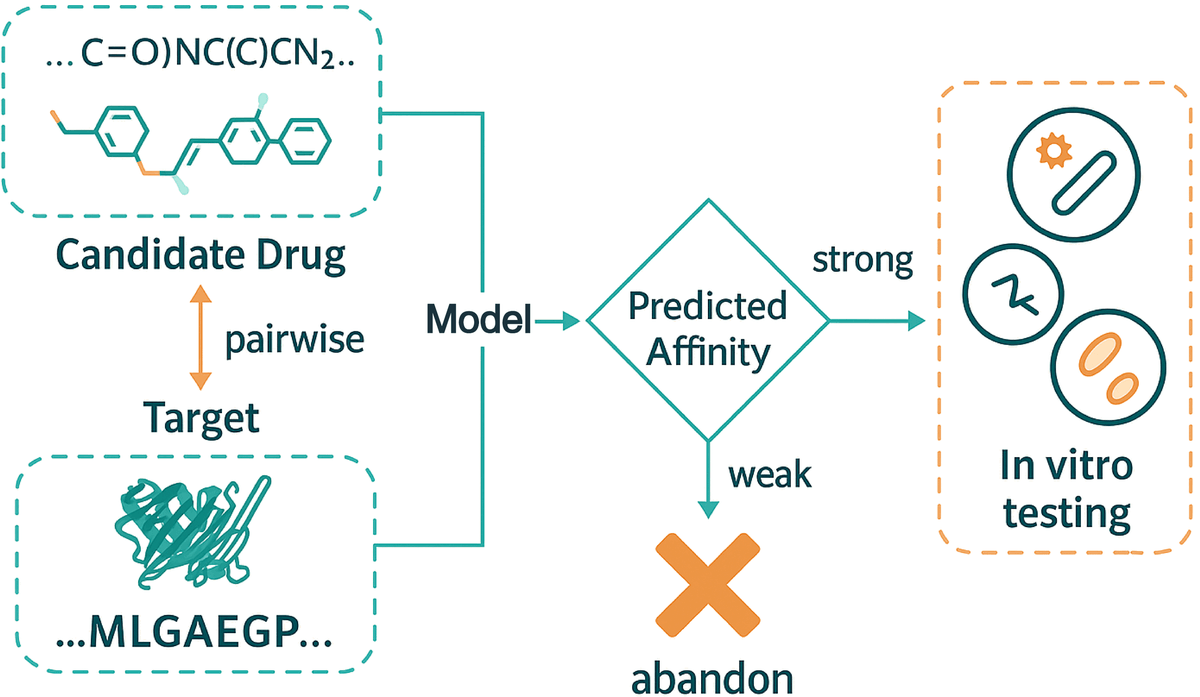
Predicting how tightly a small molecule binds to a protein target is the workhorse task behind virtual screening, but the deep models used today have a nasty habit: they excel on randomized test splits and collapse the moment you show them a drug or protein family they've never seen. A new framework called Co-Diffusion attacks that generalization gap by borrowing the latent diffusion machinery that powers image generators and repurposing it as a regularizer for affinity regression.
The reconstruction-regression tug-of-war
The authors frame drug-target affinity (DTA) prediction as a regression problem where values like the dissociation constant Kd or IC50 are log-transformed to stabilize learning because they span multiple orders of magnitude. The trouble starts when test compounds sit outside the training manifold. Purely discriminative architectures often learn brittle, pair-specific correlations rather than intrinsic, transferable binding determinants like conserved pharmacophores or binding site motifs, so their empirical success evaporates in cold-start scenarios.
The obvious fix has been generative regularization with VAEs, but that introduces its own headache. VAE-style designs often encounter a reconstruction-regression conflict where the heavy objective of reconstructing raw molecular structures or protein sequences dilutes the subtle affinity signals, leaving the latent space obsessed with structural fidelity rather than binding strength. Standard diffusion models have the opposite problem: they optimize for denoising fidelity, not binding supervision, so their expressive latents stay only weakly coupled to actual affinity.
Two stages, one manifold
Co-Diffusion sidesteps both traps by splitting training into two phases that never fight each other. Stage I establishes an affinity-steered latent manifold by aligning drug and target embeddings under an explicit supervised objective, ensuring the latent space serves as a semantic anchor for binding landscapes. Only then does Stage II bring in diffusion, which is used not to generate molecules but as a perturb-and-denoise regularizer that forces the model to recover consistent affinity semantics from noisy latents.
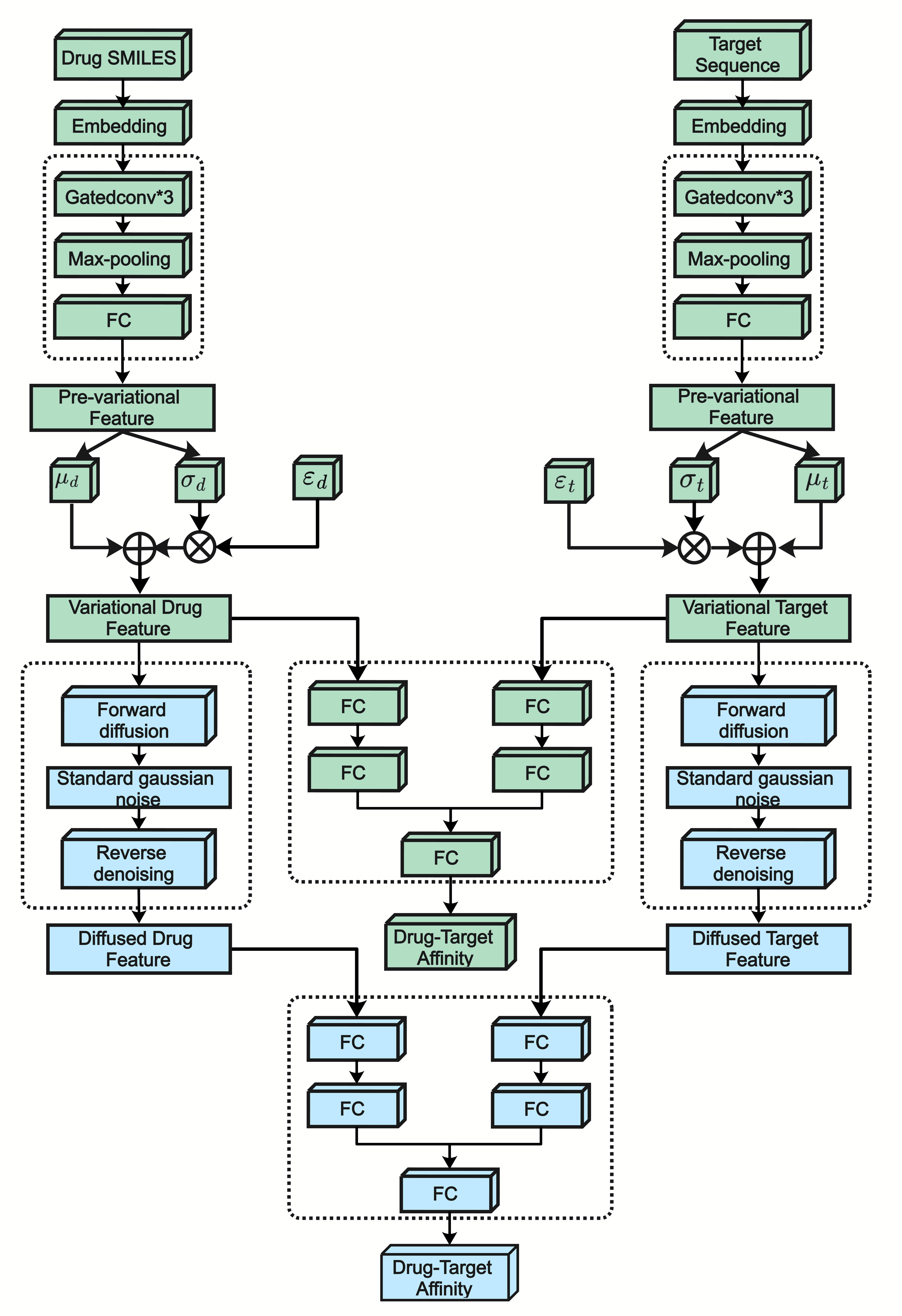
Concretely, the pipeline chains five components: tokenization and gated convolution feature extractors, variational encoders that produce Gaussian latents via the reparameterization trick, independent 1D UNet epsilon-prediction networks for drug and target branches, and two regression heads (one on the clean variational latents, one on the diffusion-reconstructed latents). Diffusion timesteps are encoded using sinusoidal positional embeddings and integrated into the UNet blocks via FiLM-style affine transformations, enabling time-conditioned denoising.
The training protocol is worth spelling out because the decoupling is what makes it work:
- Stage I trains the gated convolution extractors, variational encoders, and a regression head using only affinity supervision. Diffusion modules are inactive.
- Stage II freezes the Stage I encoders to preserve the affinity-aligned space, then trains the modality-specific UNets and a twin regression head on reconstructed latents.
Theoretically, the authors show the joint objective corresponds to a variational lower bound on the joint likelihood of drug structures, protein sequences, and binding strength, assuming factorized priors, mean-field posteriors, and conditionally independent diffusion trajectories for the two modalities.
Where the numbers land
The evaluation uses the two standard benchmarks in this space. KIBA contains 229 targets, 2111 drugs, and 118,254 binding pairs, while Davis has 442 targets, 68 drugs, and 30,056 pairs. More importantly, the authors carve out three cold-start splits, Unseen Drug, Unseen Target, and Unseen Pair, with the last being the hardest (novel drugs binding novel targets).
Against six baselines including DeepDTA, GraphDTA, Co-VAE, TransVAE-DTA, and PAIR-VAE, Co-Diffusion wins across most cold-start settings. In the most challenging Davis unseen-pair scenario, it achieves a 6.4% reduction in MAE compared to the second-best Co-VAE and a 2.6% improvement in rm-squared over AttentionDTA. The out-of-sample test on recently deposited PDBbind entries is more striking: Co-Diffusion reaches a mean squared error of 0.961 versus 1.179 for PAIR-VAE, an 18.5% improvement, on data with zero overlap with the training distribution.
Ablations confirm both design choices matter. Removing diffusion from either branch hurts, and the two-stage scheme consistently outperforms an end-to-end variant across both datasets because gradient pressure from the diffusion denoising objective otherwise dilutes affinity-relevant signals. A t-SNE visualization suggests why: the diffusion-refined embeddings do not merely replicate the originals but expand into sparse regions of the latent manifold, effectively interpolating the binding landscape rather than scattering as outliers.
When to reach for it, and what's missing
Co-Diffusion is aimed squarely at prospective screening scenarios where your candidate compounds share little scaffold overlap with known actives, or where you're targeting an under-studied protein family. For standard random-split benchmarking with heavy scaffold redundancy, the gains are smaller and existing graph or attention models remain competitive.
Some caveats to note before adopting it:
- The framework operates on 1D SMILES and amino acid sequences. It does not use 3D pocket geometry, so binding sites with high conformational plasticity may still be underserved.
- The diffusion horizon and noise schedule are fixed. Performance drops sharply when noise is too large, with rm-squared falling from 0.1491 to 0.0950 on Davis unseen-pair under an aggressive beta range.
- No public code repository is referenced in the paper, so reproducing the pipeline requires reimplementing the gated convolution encoders, the two-branch epsilon-UNet, and the two-stage training loop from the described hyperparameters (batch size 256, T=1000 steps, beta in [1e-4, 4e-4], 384-dimensional latents).
The broader takeaway is architectural rather than empirical. By treating diffusion as a regularizer on a pre-aligned latent space instead of a generative end in itself, the authors offer a template that could plausibly transfer to other regression-with-scarce-labels problems in biology, from protein-protein interaction strength to compound solubility, wherever the reconstruction objective would otherwise fight the prediction objective.