
CNRS Proves Deep Graph Neural Networks Hit Invisible Training Traps MLPs Don't
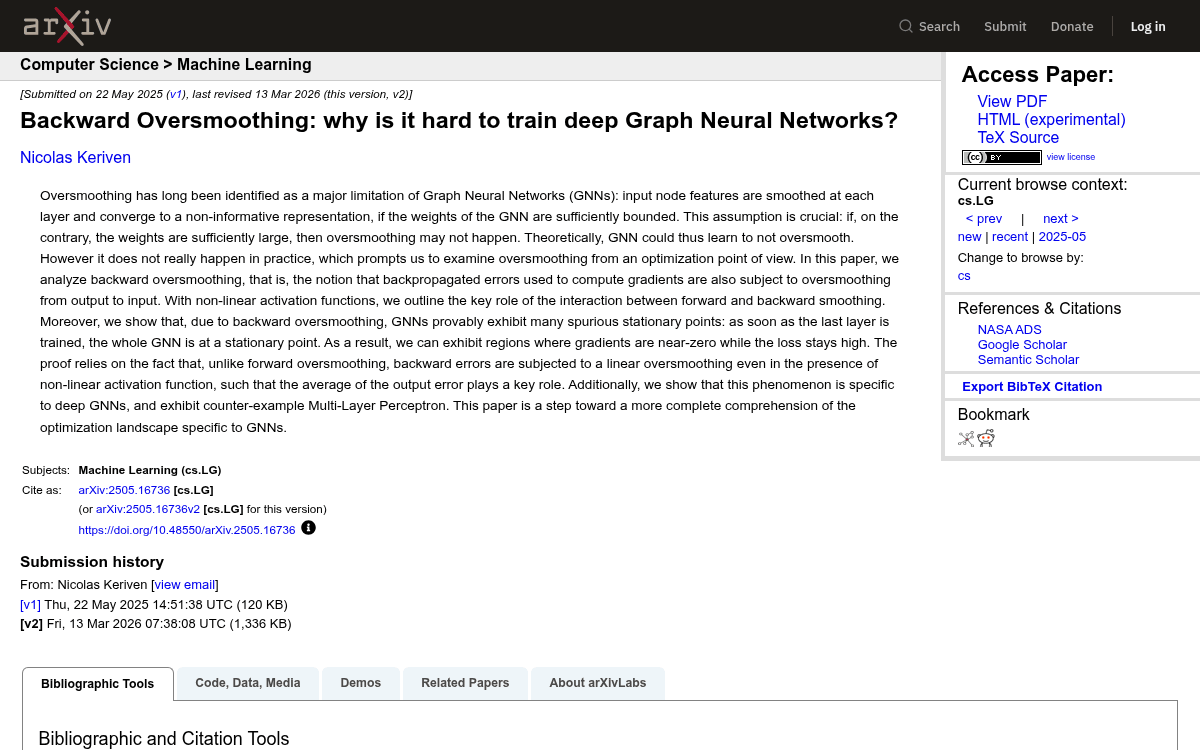
A new theoretical analysis explains why deep graph neural networks get stuck during training, revealing spurious stationary points unique to GNN architectures.
 Pro
Takeaways
- New theoretical analysis identifies backward oversmoothing as why deep GNNs are hard to train.
- Proves that once the last layer trains, the entire GNN sits at a near-stationary point.
- Constructs spurious flat regions where gradients vanish but loss stays close to label variance.
- Shows the pathology is specific to GNNs; a counter-example MLP satisfies all assumptions but still trains.
- Backward errors follow an almost-linear recursion even with nonlinear activations, enabling explicit limit characterization.
- Experiments on Cora, Citeseer, Pubmed, and WikiCS confirm the predicted plateauing behavior versus MLPs.
Deep graph neural networks have a reputation for being finicky to train. Stack too many layers and node representations collapse into a mush called oversmoothing. A new theoretical paper by Nicolas Keriven at CNRS pins down a second, more subtle reason deep GNNs stall out during optimization, and proves it is a phenomenon specific to graph networks that does not affect plain MLPs.
The oversmoothing puzzle nobody could solve with math alone
Oversmoothing is easy to describe. In a vanilla GNN, each layer averages a node's features with those of its neighbors through a propagation matrix P. Do this enough times and every node ends up looking the same, which kills the network's ability to distinguish them. Prior theoretical work has shown this convergence happens exponentially fast whenever the weight matrices are not too large.
Here is the twist that motivates the paper. If the weights are allowed to be large (spectral norm greater than 1/lambda, where lambda is roughly the second eigenvalue of P), oversmoothing does not have to happen. In principle a GNN could learn to expand its weights and escape the trap. In practice, it never does. That gap between what is theoretically possible and what actually happens during gradient descent is the mystery the paper attacks.
Errors get smoothed on the way back too
The central new object is what the author calls the backward signal, the quantity that flows through the network during backpropagation to compute gradients. The paper shows that this backward signal is subject to its own version of oversmoothing, running from the output layer down to the input.

What makes this analysis technically hard is the nonlinear activation. Most prior work on oversmoothing cheats by assuming a linear network because it makes the recursion tractable. Keriven shows something surprising: even with a nonlinear activation like softplus, the backward recursion becomes almost linear in the layers where the forward signal has already oversmoothed. The derivative of the activation is nearly constant across nodes in those regions, so backward errors follow a clean linear iteration governed by P transpose. That is what makes it possible to characterize the smoothed limit explicitly, something forward oversmoothing does not permit.
Why the last layer is a trap
The headline theorem is striking. Under mild assumptions, as soon as the last layer of a deep GNN reaches a stationary point, the entire network is at a near-stationary point. Every gradient across every layer becomes tiny.
The mechanism runs through the average output error. The paper shows that gradients throughout the network are bounded by two quantities: an exponentially small oversmoothing term, plus a term proportional to the average of the output error across nodes. When the last (linear) layer trains successfully, that average error collapses. And because the last layer is a simple linear regression on nearly-constant features (the forward signal is oversmoothed), it is trivially easy to fit. The network hits an easy stationary point long before it has actually learned anything useful.
A corollary makes the pathology concrete. For a centered regression problem with a sufficiently deep GNN, the paper constructs a flat region of near-stationary points where the loss stays close to the variance of the labels. These are spurious minima with arbitrarily high loss, and they are easy to fall into.
What makes this GNN-specific
The paper explicitly rules out the possibility that this is just a rehash of known local-minima results for deep networks. A companion proposition builds a counter-example MLP that satisfies every assumption of the main theorem, has a stationary last layer, and yet still has non-vanishing gradients at earlier layers. The trap is real for GNNs and does not exist for MLPs.
A few other subtleties worth flagging:
- This is not vanishing gradients. The paper constructs a GNN where the backward signal is oversmoothed but the gradient norm equals exactly 1. Small gradients are not automatic.
- P must be stochastic. The analysis uses row-stochastic irreducible matrices like the random walk P = D-1A. The symmetric normalized adjacency used in classic GCNs is technically not stochastic and converges to a different limit, a subtlety earlier work on backward oversmoothing missed.
- Middle layers oversmooth worst. The backward oversmoothing bound has two terms, one decaying in k and one in L-k, so smoothing bites hardest at layers halfway between input and output.
What was tested and what is missing
Empirical illustrations run on Cora, Citeseer, Pubmed, WikiCS, and two synthetic stochastic block model graphs, with 100-layer GNNs and MLPs using the random walk matrix and Leaky ReLU. The plots line up with the theory: deep GNNs quickly plateau at a high loss while their MLP counterparts continue to train. The effect is most pronounced when the second eigenvalue of P is small, which is exactly the regime the theorems predict.
There is no code release accompanying the paper and no proposed algorithm to fix the problem. The author is explicit that this is a diagnostic, not a remedy. Existing mitigations like skip connections and normalization are outside the scope of the current analysis, though the paper notes that skip connections in the forward pass induce skip connections in the backward pass too, and a proper theoretical treatment is left for future work. For anyone building deep GNNs today, the practical takeaway is that the usual tricks matter more than the theory previously justified, and vanilla deep GNNs are provably worse than they look.