
CNR-IMATI Maps Five Operator Families That Beat Standard Convolution
A new survey organizes the alternatives to convolution into five operator families, mapping trade-offs across locality, equivariance, and computational cost for practitioners.
 Pro
Takeaways
- Survey groups convolution alternatives into five families: decomposition, adaptive weighted, basis-adaptive, integral/kernel, and attention.
- Frames each family by which of four convolution properties it relaxes: linearity, equivariance, locality, uniform weighting.
- Density-function weighted convolution reports 6-7% PSNR gain, 7pp classification gain, roughly 7% GPU overhead.
- Recommends decomposition and basis-adaptive operators for denoising, adaptive weighted and attention for classification.
- Full taxonomy paper includes comparison table across cost, equivariance, and task suitability.
- Open problems: hybrid operator architectures, operator-level NAS, 3D volumetric extensions, hardware-aware operator co-design.
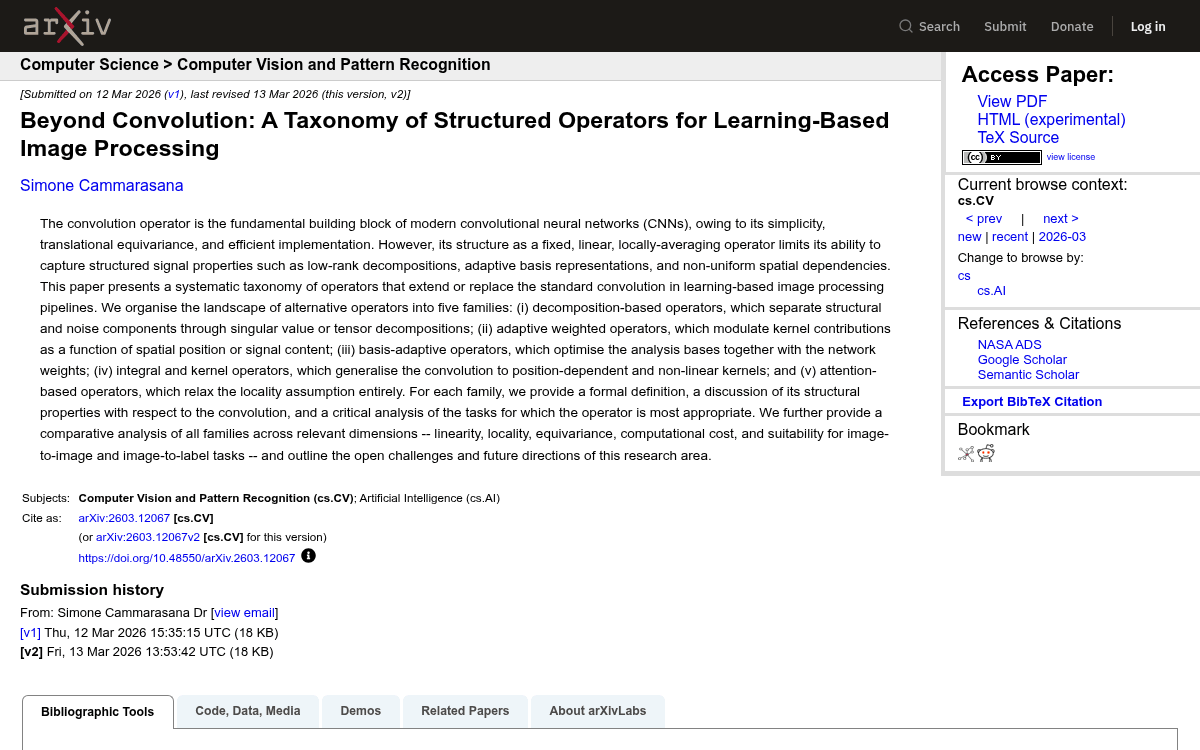
Convolution has been the workhorse of image models for decades, but a growing pile of papers keeps proposing operators that either enhance it or throw it out entirely. A new survey from CNR-IMATI tries to bring order to that chaos by grouping the alternatives into five families and mapping out where each one actually earns its keep.
The taxonomy paper starts from a simple observation: the convolution operator is fundamentally a weighted local average, applying a fixed linear combination to each neighbourhood of pixels and sharing the same weights across all spatial positions. That structure buys efficiency and translational equivariance, but it also locks in assumptions that many real signals violate.
Four properties, and what happens when you break them
The survey uses the standard convolution as a reference point defined by four structural properties: linearity, translational equivariance (the same kernel slides everywhere), locality (a small fixed receptive field), and uniform weighting (every neighbour treated equally regardless of content). Each of the five alternative families relaxes one or more of these properties, trading inductive bias for expressive power.
The concrete failure modes matter. The convolution treats all spatial positions uniformly, making it insensitive to local signal structure such as edges, textures, or noise patterns, its linear nature prevents it from performing operations that are inherently structural such as separating a signal into low-rank and high-rank components, and its fixed kernel size imposes a rigid locality prior that is inappropriate for tasks requiring global context or multi-scale reasoning.
The five families
- Decomposition-based operators. Use SVD or tensor factorisations on local patches to split structural (low-rank) content from noise. A learning-based extension replaces hand-crafted threshold selection with a network that predicts optimal thresholds from the singular values of each block, trained to minimise reconstruction error against the ground-truth image. Non-linear, content-adaptive, and expensive.
- Adaptive weighted operators. Keep the sliding kernel but modulate it. Density functions rescale kernel weights element-wise, dynamic convolution mixes several kernels with input-dependent attention, and deformable convolution learns to shift the sampling locations themselves.
- Basis-adaptive operators. Learn the analysis basis alongside the weights. Includes the F-transform with adaptive fuzzy membership functions, learnable wavelet and shearlet layers, and dictionary-learning layers built on K-SVD.
- Integral and kernel operators. Let the kernel depend on absolute position or global content. Covers non-local means, non-local neural networks, radial basis function networks, convolutional kernel networks, and CoordConv-style position encoding.
- Attention-based operators. The extreme case, where the kernel is entirely learned from the data and depends on the global content of the input, relaxing all four structural properties of the convolution. Self-attention, spatial and channel attention, and full ViT-style backbones live here.
The design trade-off, made explicit
Viewing the operators through the lens of the four structural properties reveals a clear design trade-off: moving from standard convolution toward attention-based operators, each property is progressively relaxed, first uniform weighting with adaptive weighted operators, then translational equivariance with basis-adaptive and integral operators, then locality with attention. This relaxation brings more expressive power along with higher computational cost and weaker inductive bias.
That framing produces a practical rule of thumb. Strong inductive biases help when data is scarce or when the signal genuinely has the structure the operator assumes; weak biases pay off when you have enough data to learn arbitrary dependencies. The survey's comparison table lines up each family across linearity, equivariance, locality, uniform weighting, content adaptivity, cost, and suitability for image-to-image versus image-to-label tasks.
What the numbers look like in practice
The adaptive weighted family is where the author's own density function work lands, and it comes with usable metrics. Density function optimisation improves convergence speed and final accuracy for both image-to-image tasks (denoising, PSNR improvement of 6 to 7 percent) and image-to-label tasks (classification, accuracy improvement of 7 percentage points) without increasing the number of trainable parameters, with a modest computational overhead of roughly 7 percent on GPU.
The optimisation is unusual: the inner loop trains kernel weights with SGD, while an outer loop searches for the density function using DIRECT-L, a derivative-free global optimiser. That two-level structure keeps the training signal for the network unchanged and treats the density function as a meta-parameter.
When to reach for what
The paper is fairly direct about task matching:
- Denoising and super-resolution. Decomposition-based and basis-adaptive operators, because natural images actually do have low-rank patch structure and multi-scale sparsity.
- Classification and detection. Adaptive weighted and attention-based operators, since global context matters more than local structural priors.
- Medical imaging and other data-scarce regimes. Structured operators that encode acquisition physics (ultrasound speckle, MRI k-space, anisotropic voxel grids) tend to beat pure attention, which needs a lot of data to overcome its weak inductive bias.
- Long-range dependencies. Non-local or attention operators, accepting the O(N squared) cost or using linear-attention approximations.
Where it falls short
This is a taxonomy, not a benchmark. There is no unified experimental comparison across the five families on a common dataset, and availability of data and materials states that no datasets were generated or analysed during the study. Coverage is 2D-centric, with 3D and volumetric extensions flagged as future work, and several of the cited operator advances come from the author's own prior papers, which shapes emphasis on density-function and F-transform methods.
The survey also leaves open questions that matter for anyone building systems: how to combine operator families in one architecture, whether operator selection can be folded into neural architecture search, and how to co-design operators with GPU memory hierarchies given that the theoretical 50 percent overhead of weighted convolution shrinks to about 7 percent in practice because of memory-level parallelism. Those gaps are honest, and they double as a reading list for anyone thinking about moving past a stack of 3x3 convs.