
CMU Slashes Distributed AI Training Communication by a Million Times
A new protocol slashes communication costs for distributed online learning, handling general ℓp loss functions that prior work could not touch.
 Pro
Takeaways
- New protocol achieves near-optimal regret for distributed online learning under general ℓp loss functions, the first to do so in the message-passing model.
- Communication cost drops from O(Ts) to O(s/R²) in the server term -- a factor-of-T improvement for large time horizons.
- Key trick: embeds ℓp norms into a max-finding problem using exponential random variable scaling, then uses a geometric mean estimator to control variance.
- Validated on the HPO-B benchmark (6.4M hyperparameter evaluations), treating models as experts and datasets as servers.
- Regret floor matches the information-theoretic lower bound: cannot do better than 1/(√T · polylog) regardless of communication budget.
- Full code available at github.com/samsonzhou/distributed-experts; paper on arXiv.
When you're running hyperparameter search across a cluster, or selecting among models trained on separate data shards, you're implicitly solving a problem theorists call online learning with expert advice: at each step, pick the best "expert" (model, policy, config) based on past performance, and do it while minimizing regret -- the gap between your cumulative loss and what the single best expert would have achieved. Now scale that to a distributed system where each expert's performance is spread across multiple servers, and you have the distributed experts problem. A new paper from Carnegie Mellon and Texas A&M delivers the first protocol that handles this problem under general ℓp loss functions, with provably better communication bounds than anything before it.
Why this problem is harder than it looks
The classic setup: you have n experts, s servers, and T time steps. At each step, every server observes a local loss for each expert. The true loss for expert i at time t is the ℓp norm across all servers -- think of it as aggregating per-server scores into a single number. A central coordinator must pick which expert to follow, but it can only learn the losses by communicating with servers. The challenge is to minimize regret while keeping total communication as small as possible.
The choice of p in the ℓp norm is not cosmetic. Different values encode fundamentally different objectives:
- p = 1 (sum): total loss across all servers, the standard federated learning objective
- p = 2 (Euclidean): moderately penalizes large deviations, common in robust model selection
- p = ∞ (max): minimizes the worst-case loss on any single server, relevant when individual server costs are constrained
Prior work had largely focused on ℓ1 loss, but many applications -- such as risk-sensitive optimization, robust model selection, and distributed control -- require general ℓp losses with p > 1. The core difficulty is that ℓ1 loss is additive across servers, which makes it easy to sample and aggregate. For ℓp losses, standard techniques such as sampling a number of losses with probability proportional to their magnitudes work for ℓ1 loss but fail for sub-additive or super-additive losses such as ℓp losses.
What the previous best could do
Prior work studied the experts problem in the distributed setting where an expert's cost needs to be aggregated across multiple servers, considering communication models such as the message-passing model and the broadcast model, along with multiple aggregation functions. The best previous result, from Jia et al. (2025), achieved communication cost of (n/R² + Ts) · polylog(nsT) bits for regret R -- but only for ℓ1 loss. That Ts term is brutal: even if you only want constant regret, communication still scales linearly with both the number of servers and the time horizon.
The new paper eliminates that dependency entirely. For the same ℓ1 case, the new protocol achieves (n+s)/R² · polylog(nsT) bits -- no T in the server term. And it generalizes to all ℓp losses, something the prior work simply could not do in the message-passing model.

The key trick: turning ℓp into a maximum
The core algorithmic insight is a probabilistic embedding. The authors use a property of exponential random variables called max-stability: if you scale each server's loss for expert i by a random exponential variable, the maximum of those scaled values follows the same distribution as the ℓp norm of the original losses, up to a known constant. In other words, you can convert a hard-to-compute norm into a maximum -- and maximums are much easier to find in distributed systems, because you only need the largest value, not all of them.
But there's a catch: the variance of this estimator is unbounded, which would blow up the regret guarantees. The fix is a geometric mean estimator: instead of using a single random scaling, the protocol runs B = ⌈3/p⌉ independent scalings and takes their geometric mean. The use of a geometric mean estimator to reduce variance of estimators using exponential random variables is both an algorithmic and technical novelty for the distributed online learning with experts problem.
The full protocol, at a high level, works like this:
- Each server independently draws exponential random variables for each expert at each time step (using shared public randomness)
- A server only sends a value to the coordinator if it exceeds a threshold -- roughly
s^(1/p) / polylog(nsT)-- which filters out low-information messages - The coordinator takes the geometric mean of the per-server maxima to get an unbiased loss estimate with bounded variance
- These estimates feed into a standard Multiplicative Weights Update (MWU) algorithm -- a classic online learning method that maintains a probability distribution over experts, upweighting those with lower cumulative loss
- To hit a target regret R, each server is independently subsampled with probability
1/(R²T), scaling down communication proportionally
The results
The main result gives a protocol that achieves expected regret at most O(R · s^(1/p) · √log n) using total communication at most (n+s)/R² · max(s^(1-2/p), 1) · polylog(nsT) bits. The regret floor is 1/(√T · polylog(nsT)), which matches the information-theoretic lower bound -- you cannot do better regardless of communication budget.
The communication improvement over prior work is substantial. Here's the comparison for the ℓ1 special case at constant regret R = O(1):
| Method | Loss | Communication (bits) |
|---|---|---|
| Jia et al. 2025 | ℓ1 only | (n/R² + Ts) · polylog(nsT) |
| This work | General ℓp | (n+s)/R² · polylog(nsT) |
With regret R = O(1), the protocol of prior work still has dependency O(Ts) while the new protocol has dependency O(s), which is substantially less for large time horizons T. For a system with 1,000 servers running for 1 million time steps, that's a factor of a million reduction in the server-communication term.

Where it applies -- and where it doesn't
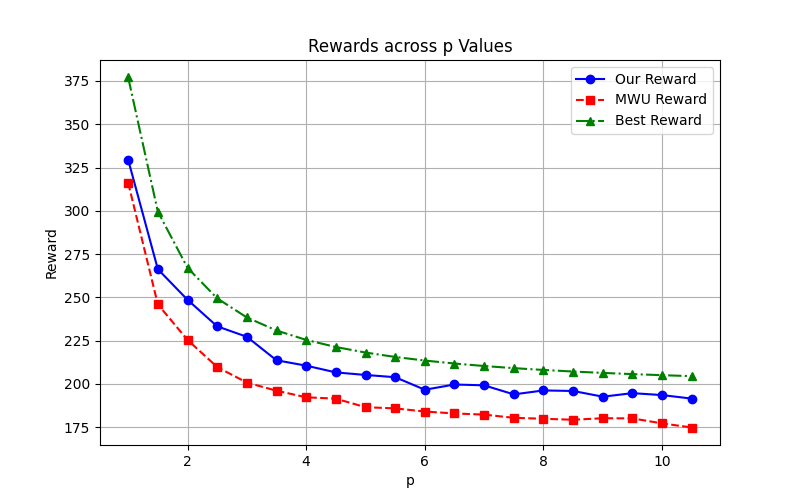
The distributed experts framework arises naturally in large-scale online optimization and hyperparameter tuning across multiple datasets, or in settings where each server holds a private subset of data. Each expert may correspond to a model trained on the aggregated data across servers, with the total loss computed as a sum of per-server losses. The authors validate this on the HPO-B benchmark -- a dataset assembled from the OpenML repository consisting of 176 search spaces evaluated sparsely on 196 datasets with a total of 6.4 million hyperparameter evaluations. In this framing, each ML model is an expert, each dataset is a server, and each search step is one round.
The protocol is best suited for settings where:
- Expert losses are genuinely distributed across servers (federated HPO, distributed model selection, multi-environment RL)
- You want to tune the regret-communication tradeoff explicitly via the parameter R
- The loss aggregation is an ℓp norm for any p ≥ 1, including max-loss (p → ∞) scenarios
There are real limitations to keep in mind. The protocol assumes losses are bounded (ℓi(j,t) ≤ 1 in the general theorem), and the polylogarithmic factors -- while theoretically mild -- can add up in practice. The paper also notes that the geometric mean estimator could potentially be replaced by other variance-reduction techniques, and exploring those alternatives is left as future work. Extensions to submodular or structured loss functions are also open.
Code and reproducibility
The authors provide a complete Python implementation of all algorithms and experimental setups. To support transparency and facilitate reproducibility, a complete implementation of all algorithms, experimental setups, and data pre-processing routines is available at github.com/samsonzhou/distributed-experts. The experiments were run on standard hardware (i7-3770, 16GB RAM), so replication is accessible without specialized infrastructure.
The deeper contribution here is methodological: embedding ℓp norms into a max-finding problem via exponential random variables, then taming the resulting variance with a geometric mean estimator, is a technique that the authors believe has independent value beyond this specific problem. It bridges tools from streaming algorithms and norm estimation into the online learning literature -- a cross-pollination that could unlock similar improvements in other distributed sequential decision-making settings.