
CMU's SocialStoryFrames Reads Reddit Stories the Way Humans Do
Carnegie Mellon researchers built a 10-dimension taxonomy plus two open-weight models that map how readers interpret stories across Reddit communities.
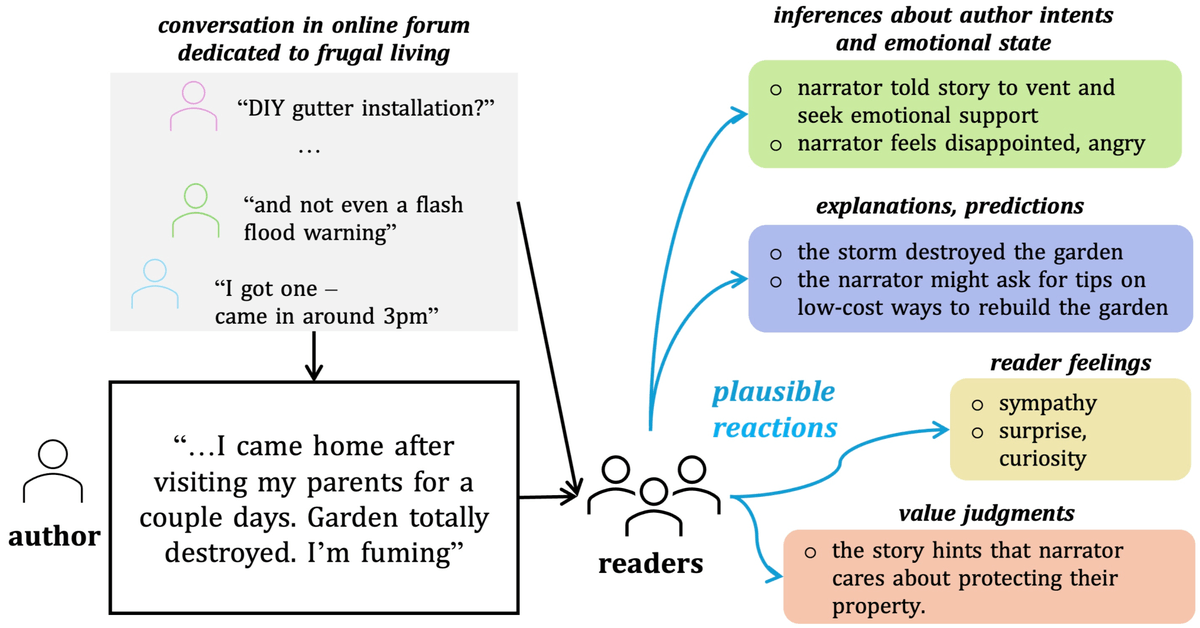
Takeaways
- SocialStoryFrames introduces a 10-dimension taxonomy for reader response to social media stories, grounded in narrative theory and pragmatics.
- Two open-weight Llama-3.1-8B models distilled from GPT-4o and GPT-4.1 handle inference generation and classification.
- SSF-Corpus contains 6,140 stories from 100 subreddits with community and conversation context summaries.
- Human validation with 382 participants found over 94% of generated inferences plausible; classifier matches GPT-4.1 on most dimensions.
- New ssf-sim metric beats semantic similarity 74% to 52% at matching human judgments of narrative similarity.
- Models and data available on Hugging Face; English-only, may underperform in polarized or niche communities.
When someone posts a story on Reddit about coming home to a destroyed garden, readers do a lot of interpretive work in a fraction of a second. They infer emotions, guess motives, form judgments about the characters, and predict what the poster will ask next. That layer of reader response has been mostly invisible to computational analysis, which either studies one community in rich detail or slaps coarse labels across millions of posts. A team from Carnegie Mellon, Copenhagen, McGill, Michigan-Flint, Connecticut, and Oakland is trying to close that gap with SocialStoryFrames, a formalism plus two open-weight models for reasoning about narrative intent and reception at scale.
Depth or breadth, pick one
Computational work on storytelling has been stuck in a trade-off. Studies of individual communities offer rich insights, for example how branching narratives reflect negotiations of power in birth stories, but these methods are difficult to generalize. Large-scale analyses tend to collapse storytelling into blunt signals like frequency counts or structural prototypes, losing the interpretive nuance that makes storytelling socially interesting in the first place.
Prior commonsense reasoning work has a related blind spot. Knowledge bases like ATOMIC and COMET encode inferences about isolated events, but stories on social media are never isolated. They arrive embedded in a subreddit with its own norms, in a comment thread with prior context, and readers use all of that when interpreting what they read.
Ten dimensions of reader response
The core artifact is SSF-Taxonomy, a 10-dimension scheme grounded in narrative theory, pragmatics, and psychology. It splits reader response into author-oriented inferences, causal and predictive reasoning, affective responses, and value judgments. The dimensions are: