
CMU's RobotArena Infinity Turns Real Videos Into Robot Benchmarks at Scale
CMU researchers built an automated pipeline that turns real robot videos into simulated arenas, then ranks vision-language-action policies with 8,749 human preferences.
 Pro
Takeaways
- CMU's RobotArena Infinity auto-generates simulated benchmarks from single-view real robot videos.
- Pipeline stitches Gemini, Hunyuan-3D, MoGE, LaMa, and differentiable rendering into a twin builder.
- Six VLAs ranked over 8,749 Mechanical Turk pairwise preference comparisons across 100+ environments.
- $\pi_0$ and X-VLA topped BridgeSim; automated VLM rankings matched human rankings exactly.
- Perturbations on background, color, and object pose expose that current VLAs overfit training layouts.
- Code and environments open at github.com/offjangir/RobotArena; project site at robotarenainf.github.io.
Evaluating robot policies has always been robotics' dirty secret. While computer vision and NLP have ImageNet and MMLU to keep everyone honest, roboticists still ship physical robots between labs, hand-align T-shirt configurations 20 times per rollout, and hope the lighting doesn't shift. A team from Carnegie Mellon wants to fix that with RobotArena Infinity, a benchmark that automatically converts real robot videos into simulated worlds, then crowdsources thousands of human preference judgments to rank vision-language-action (VLA) models.
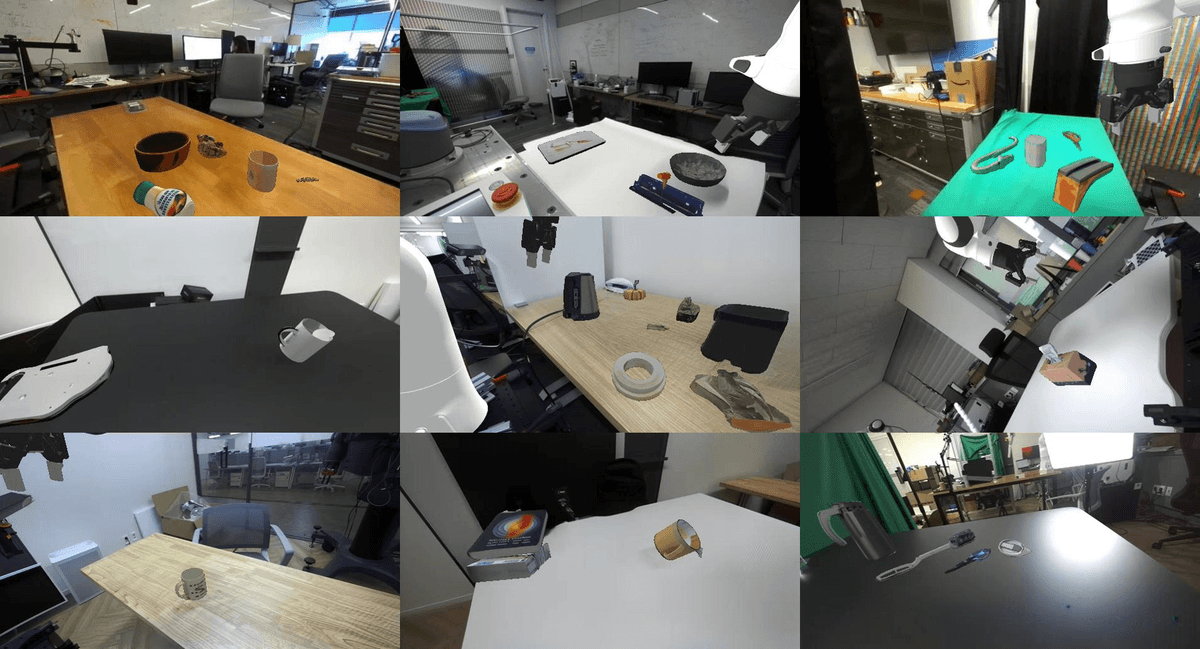
The paper frames this as the LMArena moment for robotics. Instead of shipping hardware around, you drop a policy into a simulator seeded from a real demonstration, run it against a rival, and let crowdworkers pick the winner. The initial benchmark aggregates more than 8500 preference pairs across one hundred nominal environments and hundreds of perturbations, comparing six VLAs from independent labs worldwide, which the authors describe as the largest robot evaluation effort to date.
Why real-world evaluation is broken
The bottleneck isn't algorithmic, it's logistical. Human operators must supervise trials and manually reset scenes, which restricts the scale and frequency of evaluations, and comparisons across labs get muddied by differences in cameras, workspace, and lighting. Centralized competitions like the Amazon Picking Challenge produce clean numbers but happen once a year at most. Existing simulation benchmarks such as LIBERO, RLBench, or CALVIN sidestep the reset problem but reward policies trained inside the same simulator, which favors specialists over the generalist VLAs the field actually cares about.
SIMPLER, the closest prior attempt, hand-built four Bridge-dataset replicas. RobotArena Infinity automates that process end-to-end from a single RGB frame plus joint-angle logs.

Turning one video into a physics-ready twin
The Real2Sim pipeline is a stack of off-the-shelf foundation models glued together with differentiable rendering. From a single demonstration video, it recovers the camera's 6-DoF pose relative to the robot body frame, 3D mesh reconstructions of task-relevant objects, their orientations, sizes, and material properties, a clean background image, and proportional-derivative control gains. The modular design matters because each block can be swapped for a stronger model as the field advances.
The steps roughly break down as:
- Camera calibration by differentiable rendering. A joint-angle-conditioned 3D Gaussian model of the robot is rendered from candidate camera poses, and the camera's 3D translation and orientation are optimized to minimize a composite alignment loss with three terms: an RGB loss, a flow loss enforcing consistency between rendered motion fields and optical flow from the video, and a feature loss aligning DINOv2 embeddings.
- Object segmentation and 3D reconstruction. Gemini segments the robot and interacted objects, InvSR super-resolves the crops, and Hunyuan-3D lifts each crop into a textured mesh.
- Pose estimation via correspondence. Multiple synthetic views of the generated mesh are rendered, MINIMA matches 2D keypoints against the real crop, and the winning view's correspondences are lifted to 3D using MoGE monocular depth calibrated to the robot arm's known geometry. SVD then recovers the rigid transform.
- Background inpainting. LaMa erases the robot and objects from the first frame to produce a clean backdrop.
- System identification. Simulated annealing tunes PD controller gains so simulated end-effector trajectories match the recorded ones.
Two ways to score a rollout
Once policies run inside the twin, RobotArena Infinity scores them two ways. The automated track prompts Gemini 2.5 Pro with video frames plus privileged simulation state (object poses, contacts, robot state) and asks for a per-frame progress score from 0 to 100. To obtain a trajectory-level progress estimate, we compute the mean VLM score over the final 30% of frames in the trajectory, which the authors found aligns well with human annotations.
The human track uses double-blind pairwise comparisons on Mechanical Turk. Workers watch two policies attempt the same task, pick a winner (or tie), and write a free-form justification. That written rationale isn't just for interpretability, the team found that requiring written justification led to more accurate human annotations. Global rankings come from a Bradley-Terry model with a sandwich variance estimator for confidence intervals.
What the leaderboard says
Six policies were tested: Octo, RoboVLM, SpatialVLA, CogAct, X-VLA, and an open-source reimplementation of $\pi_0$. In the BridgeSim environments derived from BridgeV2, $\pi_0$ and X-VLA came out on top. Crucially, the human and VLM rankings match exactly, indicating perfect agreement between automated and human evaluation, which is the strongest signal that the automated pipeline can substitute for crowdworkers at scale.

The more interesting findings are about generalization failures:
- Cross-dataset transfer is weak. Policies collapse when tested in environments seeded from datasets they weren't trained on, evidence that current VLAs are specialists dressed up as generalists.
- The Spatial Paradox. $\pi_0$ and X-VLA outperform SpatialVLA despite lacking explicit 3D inductive biases. The authors suggest the cross-view consistency learned from raw multi-view data may provide a more robust spatial prior for manipulation than the current explicit 3D inductive biases used in SpatialVLA.
- Backbone strength buys robustness. Models with stronger VLM backbones held up better under color perturbations, suggesting they lean on structural cues over surface appearance.
- Everyone overfits to layout. Every policy degraded when backgrounds were swapped or objects reshuffled.
There's also a pointed critique of the previous benchmark of record: all VLAs achieve substantially higher scores on SIMPLER than on BridgeSim. This discrepancy suggests that evaluation on SIMPLER may overestimate policy performance due to the very limited number of test environments and the biased selection of scenarios.
Caveats worth knowing
The framework has real limits. The policies evaluated do not yet incorporate wrist-camera inputs, which restricts the fidelity of certain manipulations, and contact-rich tasks like plug insertion remain hard for any physics engine to reproduce faithfully. The whole pipeline also inherits the failure modes of its component models. If Hunyuan-3D botches a mesh or MoGE misestimates depth on a novel object, the twin drifts from reality. And one qualitative failure mode is worth flagging: in RH20TSim, Octo scored high not because it succeeded but because its policy of slowly lowering the arm happened to intersect the target object, a shortcut the VLM scorer rewarded.
Getting your hands on it
Both the benchmark environments and the evaluation code are being released. The source repository and project website host the artifacts, and the team says the platform will be centrally maintained so new policies can be dropped in for evaluation over time. If you train a VLA, this is now the most rigorous open way to see how it holds up outside your own lab's cameras.