
CMU's RARRL Teaches Robots When to Think, Cutting AI Costs by 60%
A reinforcement learning orchestrator teaches embodied robots when to invoke LLM reasoning and when to skip it, cutting inference time by over 60%.
 Pro
Takeaways
- RARRL learns an RL policy that decides when embodied agents should invoke LLM reasoning versus act directly.
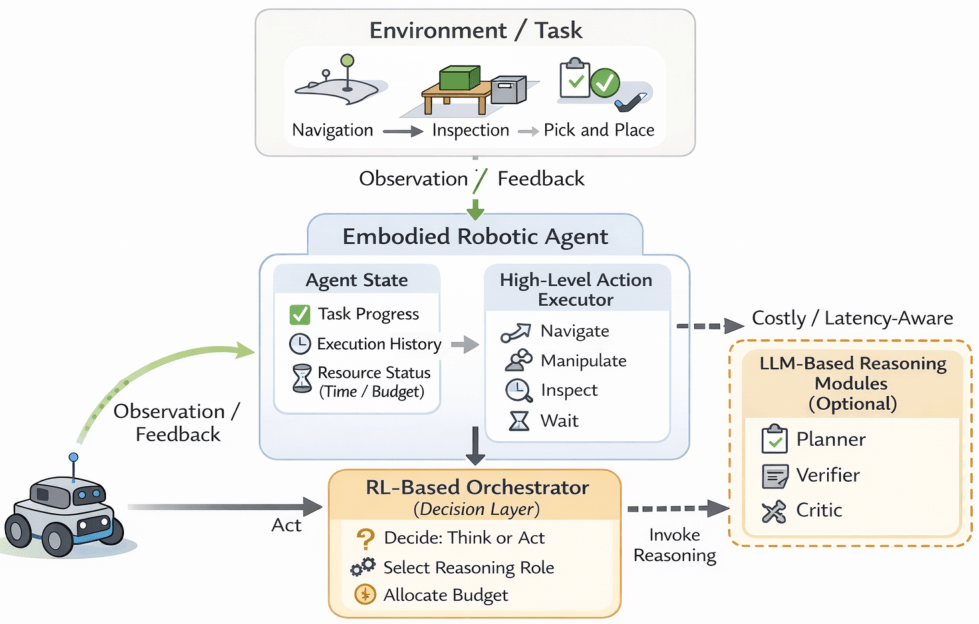
- Framework uses PPO to jointly choose ACT/THINK, reasoning role (planner or verifier), and compute budget level.
- On ALFRED with GPT-4o-mini, cuts LLM inference time over 60% while keeping task success within 1-2% of full reasoning.
- Beats constrained-PPO and heuristic baselines on both success rate and token consumption with statistical significance.
- Under abrupt budget cuts, adapts reasoning frequency and preserves 74.9% success versus 61.8% for heuristics.
- See the full paper on arXiv for MDP formulation, ablations, and calibration details.
Every time a robot pauses to consult a large language model, the clock keeps ticking. That pause might save the mission by producing a smarter plan, or it might waste seconds the robot cannot afford. A new paper from researchers at Carnegie Mellon, Northeastern, Harvard, MIT and collaborators tackles this dilemma with RARRL (Resource-Aware Reasoning via Reinforcement Learning), a framework that learns when a robot should think and when it should just act.
The reasoning tax nobody wants to pay
LLM-driven robots have become the default recipe for turning natural language instructions into executable behavior. Wiring LLM-based reasoning into embodied systems introduces a critical challenge: high-level reasoning is computationally expensive and often incurs substantial latency, making it impractical to invoke indiscriminately during task execution.
The tradeoff is uncomfortable in both directions. Leaning too heavily on LLM calls delays actions and disrupts interaction with the environment, while too little reasoning leads to incorrect decisions, unsafe behaviors, or outright task failure. Most existing systems paper over this with hand-tuned heuristics or fixed schedules such as calling the LLM every k steps, which cannot adapt to task difficulty or remaining compute budget.
Orchestration as a learnable policy
RARRL treats the reasoning-versus-acting decision itself as a reinforcement learning problem. Instead of learning motor control, it learns a high-level orchestrator that sits above the executor. At each step, the orchestration policy selects between two modes: ACT, which directly executes a low-level action, and THINK, which invokes an LLM-based reasoning module such as a planner or verifier. Reasoning is modeled as a costly decision and is only invoked when it is expected to improve downstream execution under limited budgets.