
CMU's PRoID Teaches Robot Swarms to Decide When Exploring Beats Reporting
A new relay criterion lets exploration robots decide adaptively when to return to base, using learned map prediction to weigh future information against risk.
 Pro
Takeaways
- PRoID introduces an adaptive relay criterion for multi-robot exploration, comparing current vs. predicted rates of information delivery to base.
- Uses learned map prediction plus raycasting along planned paths to estimate future sensor coverage before committing to explore further.
- PRoID-Safe variant weights the criterion by Weibull survival probability, biasing toward earlier relay as failure risk grows.
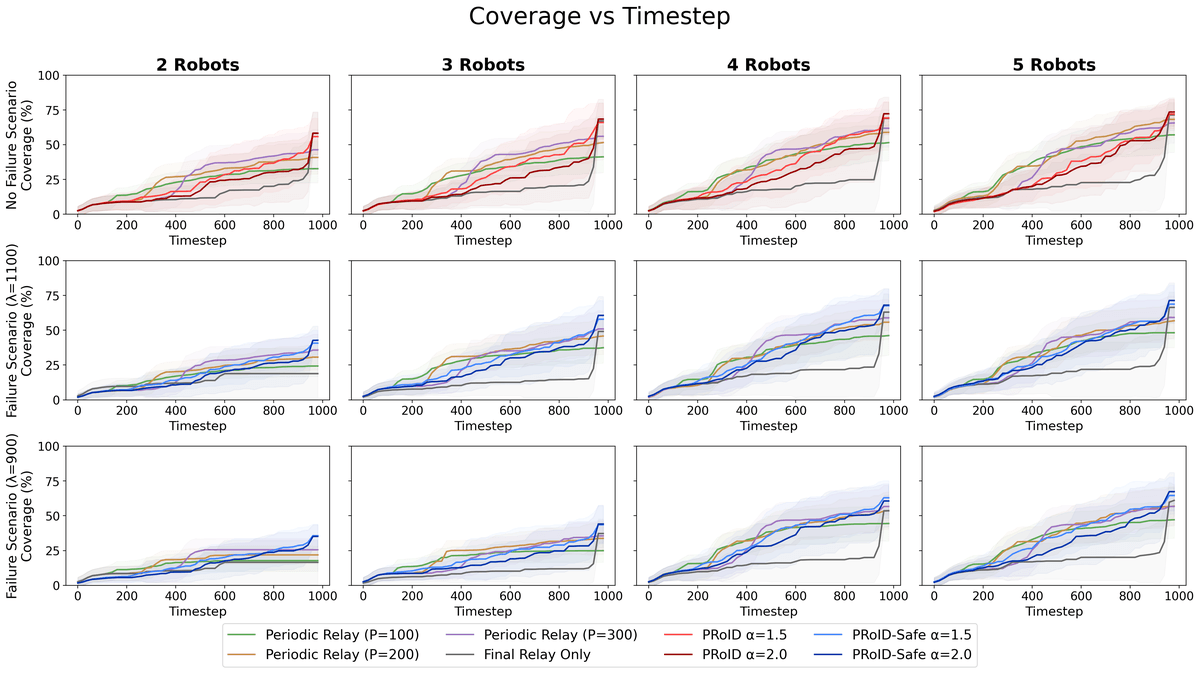
- Beats periodic relay baselines by 7.8 to 12.4 percentage points in coverage across team sizes of 2 to 5 robots.
- Under robot failure, PRoID-Safe delivers up to 24 percentage points more coverage than Final-Relay-Only strategies.
- Evaluated on KTH indoor floor plan dataset; simulation-only, no public code release yet.
When you send a fleet of robots into an unknown building to map it out, coverage is only half the job. Whatever they learn only matters if it reaches the operators at the base station before the mission clock runs out, or before a robot dies mid-corridor. That constraint reshapes the whole problem, and a team from Carnegie Mellon, UNIST, Colorado School of Mines, UTS, and BYU has proposed a new adaptive way to solve it.
Their paper introduces PRoID (Predicted Rate of Information Delivery), a criterion that decides, in real time, whether each robot should keep exploring or head home to relay what it has found. The key insight: framing the relay decision as a comparison of information delivery rates, weighing whether returning to base now or exploring further first yields more information delivered per unit time.
Why fixed schedules break
Most existing multi-robot exploration systems make one of two bad bets. Frequent relaying delivers data reliably but sacrifices coverage; exploring until the deadline maximizes coverage but risks catastrophic data loss if the robot fails before returning. The middle-ground approaches used in practice are still rigid. Periodic-return strategies send robots home every fixed number of timesteps, final-relay strategies push everything to the last moment, and queue-based methods trigger a return when a fixed information threshold is crossed.
None of these respond to what's actually happening in the mission. Fixed thresholds ignore how relay overhead scales with environment size, and no baseline uses a principled online criterion that folds in predicted future gains and team coordination state. The problem gets richer with multiple robots, because one can offload its relay duty to a teammate that's already heading back, and continue exploring instead.