
CMU's GlintMarkers Turn XR Eyeball Cameras Into Object-Tracking Sensors
Carnegie Mellon researchers turn the eye's cornea into a passive world-facing camera, using tiny retroreflective tags to identify objects and estimate their 3D pose from glint patterns alone.
 Pro
Takeaways
- Carnegie Mellon's GlintMarkers turns an eye-tracking camera into a world-facing sensor via corneal reflections.
- Passive retroreflective tags concentrate near-infrared light into bright glints readable inside low-resolution eye images.
- A custom Perspective-n-Point framework recovers 3-DoF orientation, distance, and object ID from the glint constellation.
- Achieves 95-99% object ID accuracy against a 32-entry library and 0.144 m distance MAE at 2-4 m.
- Roll error stays near 5 degrees; pitch is the weakest axis due to corneal convex-mirror distortion.
- Enables gaze-driven object control, proximity assistance, and state inference without any outward-facing camera.
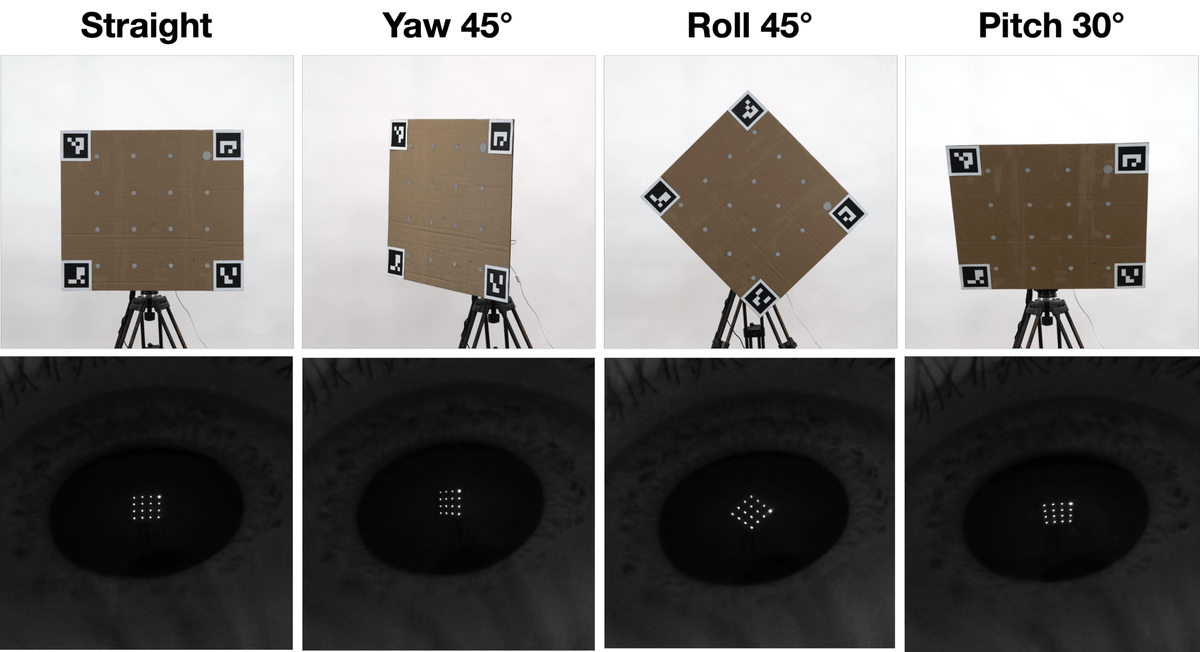
Every set of XR glasses coming to market ships with a camera pointed at your eye. That camera exists to track your gaze, but a team from Carnegie Mellon has shown it can do something stranger: see the world. GlintMarkers uses the cornea as a convex mirror and reads reflections of tiny retroreflective tags to identify objects, estimate their orientation, and measure how far away they are, all without an outward-facing camera.
The corneal reflection encodes enough spatial information to reason about the physical scene, while the same images also reveal where the user is looking. One sensor delivers both attention and geometry.

Why the cornea is a terrible camera
Reading the world off an eyeball is hard for reasons that stack up quickly. Corneal reflections are low-contrast and bounce back less than 1% of incident light, the convex geometry introduces distortions, and iris texture contaminates the scene. All of that varies between users because of physiological differences. Add the meager pixel budget of an inward-facing eye tracker, and standard fiducial systems like ArUco or AprilTag are essentially blind. Place a 20x20 cm ArUco marker next to a GlintMarker and observe both from 4 m: the ArUco is nearly invisible in the eye-facing camera. Eye-facing sensors typically operate in near-infrared, whereas standard ArUco markers are designed for visible-light imaging.
Retroreflectors doing the heavy lifting
The team's trick skips printed patterns and uses retroreflective patches, the same material found on road signs. Retroreflective surfaces concentrate reflected optical energy back toward the source instead of scattering it, producing bright point returns that show up as sharp glints in the corneal reflection. Pair that with a near-infrared LED on the frame and you get punchy, high-contrast dots even in dim rooms.