
CMU's DQ-RISE Teaches Robots to Open Jars With 85.83% Success
A new visuomotor policy quantizes hand states into compact codes so arm precision does not get drowned out by high-dimensional finger control.
 Pro
Takeaways
- DQ-RISE quantizes hand states via residual VQ-VAE so arm control is not dominated by high-DoF finger predictions.
- A continuous relaxation reindexes codes to enable joint diffusion of arm actions and quantized hand states.
- Reaches 85.83% average success across six real-world tasks, beating RISE and separate-diffusion baselines.
- Tested on Flexiv Rizon 4 arm plus ROHand with VR joystick and GForce glove teleoperation.
- Tasks include pull tissue, open jar, collect toy, pour rice, open oven, toast bread.
- Code released at github.com/rise-policy/DQ-RISE, accepted at ICRA 2026.
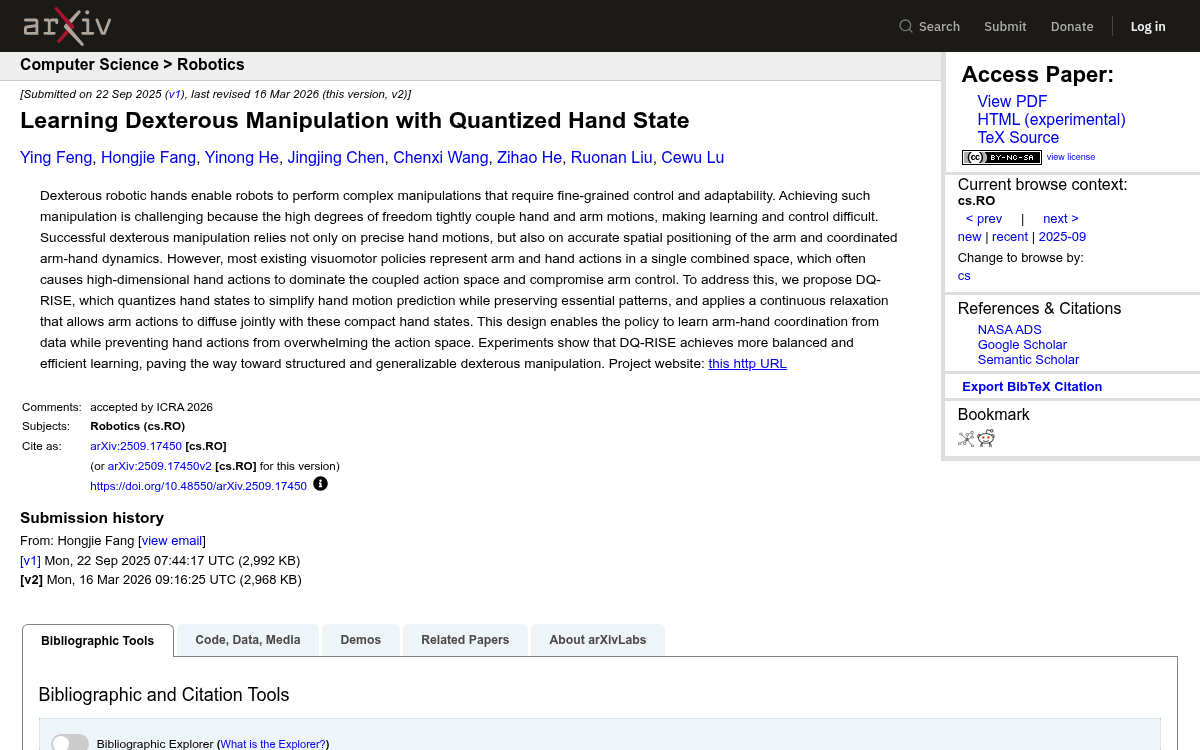
Teaching a robot to open a jar or pour rice is harder than it looks. The arm has to reach the right spot in 3D space, the fingers have to close in a specific grasp, and both must happen in lockstep. When researchers train a single neural policy to predict all of these joints together, the fingers, with their many degrees of freedom, tend to hijack the learning signal and the arm ends up in the wrong place. A new paper from Shanghai Jiao Tong University, Noematrix, and CMU tackles this with DQ-RISE, a policy that treats hand and arm actions differently while still learning them jointly.
The core idea is to quantize the hand's state into a small discrete vocabulary of grasp patterns, then diffuse arm trajectories together with those compact codes. The paper reports an average success rate of 85.83%, outperforming baselines like vanilla RISE (direct concatenation of arm-hand actions) and RISE-S (separate arm and hand diffusions) across six real-world manipulation tasks.

Why combining arm and hand actions backfires
Dexterous hands like the ROHand used in this work have many independently actuated fingers. The high degrees of freedom tightly couple hand and arm motions, making learning and control difficult. Successful manipulation relies on precise finger motions, accurate spatial positioning of the arm, and coordinated dynamics between the two.
Most existing visuomotor policies represent arm and hand actions in a single combined space, which lets the high-dimensional hand actions dominate the coupled action space and compromise arm control. Splitting the prediction into two independent heads sounds like the obvious fix, but naively separating them breaks coordination. The grasp needs to time itself to when the arm actually arrives at the object.
Quantize the state, not the action chunk
The key design choice is subtle but important. Rather than quantizing sequences of hand actions like some prior work, DQ-RISE quantizes single-step hand states. Arms primarily handle spatial localization, while hands execute fine-grained interaction patterns. Quantizing hand action chunks would lead to rapid codebook expansion and create a mismatch in action generation (discrete classification for hand chunks versus continuous diffusion for arm chunks), disrupting coordination.
Concretely, the pipeline works like this:
- DQ-RISE builds on the RISE policy and quantizes hand state into compact patterns via a two-layer residual VQ-VAE that assigns each observed grasp posture to an entry in a learned codebook.
- A continuous relaxation step re-indexes the codebook so neighboring codes correspond to similar hand poses. Reindexing during continuous relaxation makes code transitions smooth and interpretable across hand states, supporting joint diffusion of arm and quantized hand actions.
- A diffusion head then denoises arm trajectories and the (now continuous-friendly) hand code together, so coordination is learned from data rather than hand-engineered.

The teleoperation rig and tasks
Demonstrations come from a hybrid VR-glove setup that decouples the two control streams for the human operator. A Meta Quest 3 VR joystick controls the robotic arm (Flexiv Rizon 4), while an OyMotion GForce glove captures human hand posture and maps it to the ROHand via joint correspondence.
The six evaluation tasks were chosen to stress different aspects of dexterity: pulling tissue, opening jars, collecting toys, pouring rice, opening an oven, and toasting bread. They span pick-and-place, articulated objects, significant rotations, and long-horizon sequences.
What the baselines reveal
The comparison is designed to isolate why quantized state helps. Three alternatives were tested against DQ-RISE:
- RISE: the base policy, which predicts concatenated arm-hand action chunks in one head.
- RISE-S: two separate diffusion heads, one for arm and one for hand.
- DQ-RISE-C: diffuses the arm first, then classifies quantized hand actions from the predicted arm feature.
All three trail the full DQ-RISE, which confirms that both the quantization and the joint diffusion matter. Separating the heads loses timing, and classifying hand codes conditionally on arm predictions loses the smooth interplay that diffusion provides.
Getting your hands on it
The code has been released on GitHub as rise-policy/DQ-RISE and the paper is accepted at ICRA 2026. The codebase is built on RISE, with the diffusion module adapted from Diffusion Policy. The repo ships training and evaluation scripts, several --ensemble_mode options for temporal action aggregation (following ACT and HATO conventions), and calibration guides for hooking it up to a real robot.
DQ-RISE works as a drop-in replacement for the action head of any diffusion-based imitation policy that has to control a multi-finger hand plus an arm. If you already have a working diffusion policy for a parallel gripper and are moving to a dexterous hand, this is a much cleaner starting point than concatenating everything and hoping the network sorts it out. The limits are also clear: it is trained on human demonstrations, it uses point-cloud perception inherited from RISE, and the evaluation runs on a single-arm platform with a five-finger hand rather than a bimanual, tactile-rich setup, so generalization to those richer configurations remains open work.