
CMU's DemoDiffusion Teaches Robots New Skills From One Human Video
DemoDiffusion lets a robot learn any new manipulation task from a single human video demo, with no retraining required — hitting 83.8% success vs. 13.8% for the base model.
 Pro
Takeaways
- What happened: CMU researchers released DemoDiffusion, a method letting robots imitate any manipulation task from a single human video demo with no retraining.
- Key result: 83.8% average success across 8 real-world tasks vs. 13.8% for the base Pi-0 policy and 52.5% for kinematic retargeting alone.
- How it works: Converts hand pose from video into a robot trajectory, adds noise, then denoises with a frozen pre-trained diffusion policy (Pi-0) conditioned on live camera observations.
- Zero training required: Pi-0's weights are never updated; the method works entirely at inference time using a single human demonstration per task.
- Succeeds where base model fails: On 4 tasks where Pi-0 scores 0%, DemoDiffusion achieves 60–100% success by blending human intent with closed-loop policy correction.
- Code available: Implementation released at github.com/demodiffusion/demodiffusion; accepted at ICRA 2026.
Teaching a robot a new skill today is expensive. You either fine-tune a large policy on task-specific robot demonstrations , which requires a teleoperation rig and an expert operator , or you run online reinforcement learning, which can take hours of physical interaction and resets. A new paper from Carnegie Mellon University proposes a third path: just show the robot what to do yourself, once, on video.
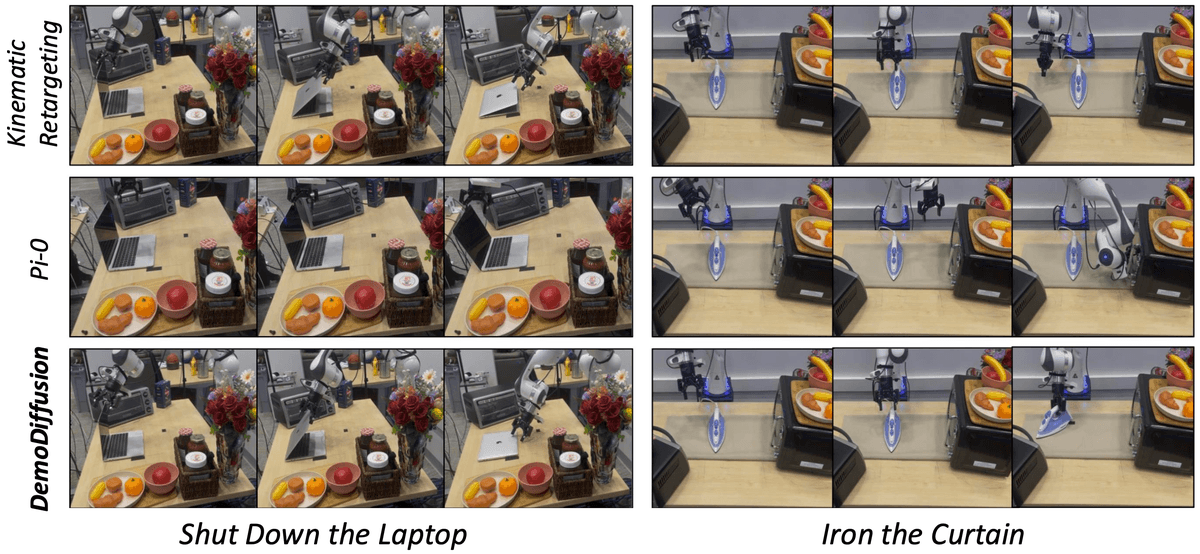
DemoDiffusion, accepted at ICRA 2026, enables a robot arm to imitate a single human hand demonstration with no task-specific training, no paired human-robot data, and no RL. It achieves an 83.8% average success rate across 8 diverse real-world manipulation tasks , compared to 13.8% for the underlying generalist policy running alone and 52.5% for naive kinematic retargeting.
The gap that needed closing
Generalist robot policies like Pi-0 are trained on massive teleoperation datasets and can handle a wide variety of tasks specified by language. But they still struggle badly when deployed zero-shot on novel tasks or unfamiliar environments. The standard fix , collect more robot demos and fine-tune , is a non-starter for most end users who don't own a teleoperation rig.
The obvious alternative is kinematic retargeting: extract the human's hand pose from a video frame-by-frame, map it to the robot's end-effector, and replay it open-loop. This works surprisingly often, but it has two fatal flaws:
- Embodiment mismatch , a human hand and a two-finger gripper move very differently, so the mapped trajectory is often geometrically wrong.
- Open-loop brittleness , without real-time feedback, small errors in object placement or hand tracking compound into task failure.
DemoDiffusion fixes both problems by treating the retargeted trajectory not as a final plan, but as a noisy draft to be corrected by a pre-trained diffusion policy.
The core idea: SDEdit for robot actions
The method borrows a trick from image editing. SDEdit (2022) showed that you can edit an image by adding a moderate amount of noise to it and then running a diffusion model's denoising process , the model preserves the high-level structure of the original image while fixing low-level inconsistencies. DemoDiffusion applies exactly this logic to robot action trajectories.

Here is the full pipeline, step by step:
- Record a human demo. A person performs the task in front of the robot's cameras. The setup uses 4 calibrated RealSense cameras for triangulation.
- Extract 3D hand poses. An off-the-shelf monocular hand reconstruction model (HaMeR) processes each video frame to get per-timestep 3D hand keypoints , wrist position, fingertips, etc.
- Kinematic retargeting. A simple geometric mapping converts the human wrist pose into a robot end-effector pose at each timestep. Gripper open/close is inferred from the spread between the thumb and other fingertips. This gives a full open-loop trajectory.
- Add noise at an intermediate diffusion step. Instead of starting the diffusion denoising from pure Gaussian noise (which would ignore the human demo entirely), the retargeted trajectory is corrupted with noise up to a partial diffusion step
s*. This is the key equation:ã_t^(s*) = sqrt(α_s*) * â_t + sqrt(1 - α_s*) * ε, whereâ_tis the retargeted action andεis Gaussian noise. - Denoise with the pre-trained policy. The diffusion policy (Pi-0 in real-world experiments) runs its reverse denoising process from step
s*down to 0, conditioned on live camera observations. This produces a refined, closed-loop action sequence that follows the human's intent while staying within the distribution of actions the policy knows how to execute.
The single hyperparameter s*/S controls the tradeoff: at 0 you get pure kinematic retargeting; at 1 you get the base policy ignoring the demo entirely. The authors found s*/S = 0.2 works best when the base policy has zero success on a task, and s*/S = 0.4 works better when the base policy already has some competence.
What the numbers look like
Real-world experiments used a Franka Panda arm with a two-finger Robotiq gripper, and Pi-0 (trained on the DROID dataset) as the pre-trained policy. Each task was evaluated over 10 trials with randomized object placement and added visual distractors. DemoDiffusion was never fine-tuned , Pi-0's weights are frozen throughout.

| Task | Pi-0 alone | Kinematic retargeting | DemoDiffusion |
|---|---|---|---|
| Shut down laptop | 20% | 10% | 60% |
| Close microwave | 10% | 80% | 90% |
| Drag basket | 10% | 80% | 80% |
| Wipe table | 50% | 0% | 100% |
| Iron curtain | 20% | 70% | 90% |
| Pick up bear | 0% | 40% | 60% |
| Pick & place bowl | 0% | 70% | 100% |
| Pick & place banana | 0% | 70% | 90% |
| Average | 13.8% | 52.5% | 83.8% |
On four tasks where Pi-0 scores 0%, DemoDiffusion still achieves 60–100%. The wipe-table task is a particularly striking case: kinematic retargeting scores 0% because the open-loop motion consistently misses the tissue, while DemoDiffusion hits 100% by using the policy's closed-loop feedback to correct contact.
How robust is it?
The team ran two robustness ablations. First, they injected 5cm of random noise into the tracked hand keypoints , simulating imperfect hand estimation , and performance dropped only modestly (e.g., 90% to 70% on pick-and-place banana). Second, they swapped in a different retargeting strategy (thumb-to-index distance only, instead of all fingers), and DemoDiffusion still outperformed raw retargeting significantly. This suggests the method is not tightly coupled to any particular retargeting implementation.
The team also tested zero-shot generalization to new objects within the same category , using the same human demo but swapping in a differently shaped bowl or basket. DemoDiffusion adapted its behavior to the new object without any additional input.
Where it falls short
The authors are candid about the limitations:
- No reusable policy. Each run requires the human demo to be present. DemoDiffusion doesn't produce a generalizable task policy you can call later , it's a one-shot execution aid, not a training method.
- Assumes similar strategies. If the human and robot need to approach the task differently due to physical constraints, the human demo can mislead rather than help.
- Temporal alignment. The method assumes the human and robot move at roughly the same speed. There's no mechanism for temporal warping if the human demo is much faster or slower than the robot's natural pace.
- Hand tracking quality matters. Errors in 3D pose estimation degrade the retargeted trajectory, and while the method is somewhat robust to this, large errors will still hurt.
The real unlock
The deeper contribution here is a new deployment paradigm for generalist robot policies. Rather than asking "how do we make Pi-0 generalize better?" the paper asks "how do we steer a frozen generalist policy toward a specific task at runtime?" The answer , treat the human demo as a noisy prior and use the diffusion denoising process to project it onto the manifold of plausible robot actions , is elegant and requires zero additional training.
Code is available on GitHub, and the paper includes full implementation details for both the real-world Franka setup and the simulated dexterous grasping experiments with a 16-DOF Allegro hand.