
CMU's AssistMimic Teaches Humanoid Robots to Physically Support Humans at 94.7% Success
A CMU and Keio team teaches two simulated humanoids to lift each other up through joint reinforcement learning, unlocking physics-grounded caregiving behaviors.
 Pro
Takeaways
- AssistMimic frames humanoid caregiving as multi-agent RL, training supporter and recipient policies jointly in simulation.
- Achieves 83% success on Inter-X and 73% on HHI-Assist, the first physics-based controller to track these interactions.
- Three key tricks: PHC weight initialization, dynamic reference retargeting, and contact-promoting rewards replacing strict tracking.
- Recipient's PD gains and torque limits are reduced to force the supporter policy to learn real load-bearing behavior.
- Distilling specialists into a generalist via DAgger pushes Inter-X success to 94.7% across 30 diverse help-up clips.
- Code is released at github.com/YutoShibata07/AssistMimic; sim-to-real transfer and dexterous grasping remain open.
Getting a humanoid robot to walk, run, or wave has become almost routine thanks to motion tracking controllers trained on human motion capture data. But ask that same robot to help a person sit up in bed, and everything breaks. A new paper from Carnegie Mellon and Keio University, AssistMimic, argues that the reason is structural: existing systems treat interaction as a solo performance, when what caregiving actually demands is two bodies negotiating force in real time.
Why solo motion tracking falls apart on contact
Modern physics-based character controllers, from PHC to MaskedMimic, are trained to reproduce reference motions inside a simulator. Existing tracking-based controllers primarily focus on single-person motion sequences, while interactive behaviors involving close contact and force exchange, which are central to assistive and caregiving scenarios, remain a major open challenge. The dominant workaround has been kinematic replay: pre-record what the recipient should do, then train the assistant to react against a puppet.
That trick collapses under real contact. Applying the kinematic replay used in Human-X to this scenario causes the recipient to stand up independently along a pre-defined trajectory, regardless of the presence of support. Consequently, the assistant's actions do not meaningfully affect the partner's state, preventing the emergence of functional support behaviors. Worse, the kinematically fixed poses also cause severe interpenetration, which induces large restorative forces in the physics engine and eventually pushes the characters apart.

Two policies, one physics engine
AssistMimic reframes the problem as multi-agent reinforcement learning. Unlike prior approaches that rely on kinematic replay, AssistMimic jointly trains policies for both partners within a MARL formulation. This joint optimization removes the need to freeze one agent's motion, allowing the assistant and recipient to co-adapt during training and enabling rich bidirectional coordination, particularly when the recipient becomes physically unstable.
To simulate a person who genuinely needs help, the team cripples the recipient's actuators. To model physical impairment, the recipient's dynamics are parameterized by reduced Proportional-Derivative controller gains and maximum joint torques. The recipient literally cannot stand up on its own, which forces the supporter policy to discover actual load-bearing behavior rather than shadowing a healthy walker.
Training two agents from scratch in this setup is a nightmare of sparse rewards and unstable exploration. AssistMimic tackles it with three tricks:
- Motion prior initialization. Both policies inherit weights from a pre-trained single-person tracker (PHC), with the new partner-observation inputs padded with zeros so the initial behavior is preserved. This bootstraps basic locomotion skills.
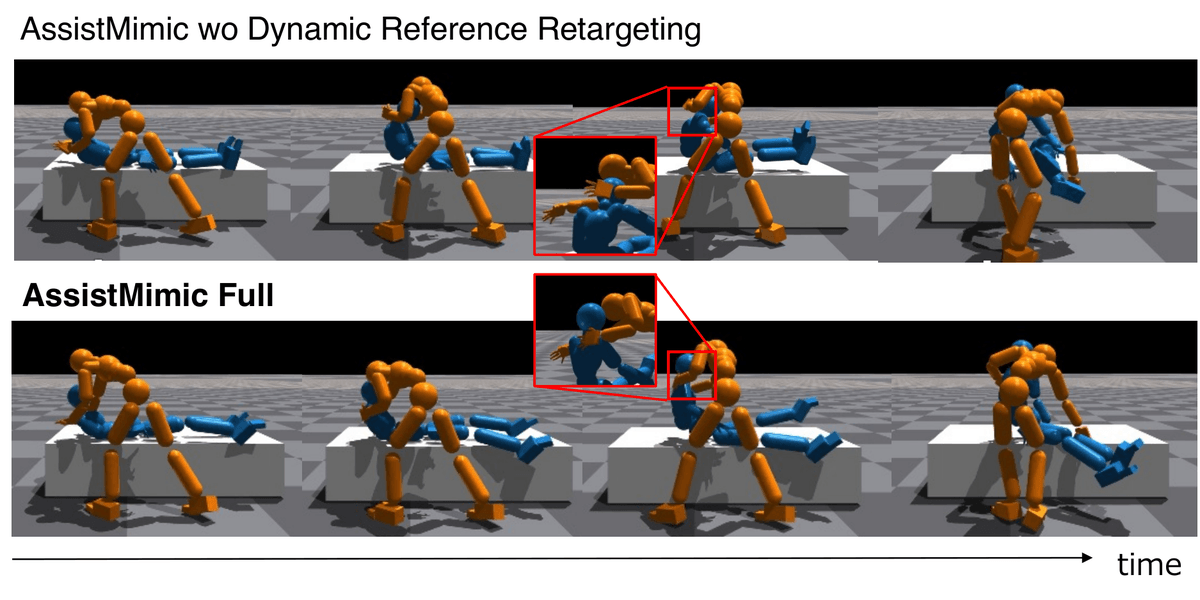
- Dynamic reference retargeting. When the two agents get close, the supporter's hand targets are recomputed relative to where the recipient's body actually is, not where the motion capture said it would be.
- Contact-promoting rewards. Once the supporter's hands are near the recipient, the strict pose-tracking penalty is suppressed and replaced with a reward for making firm, force-carrying contact.

The numbers behind the claim
The team evaluates on two benchmarks: Inter-X, the largest two-person interaction dataset, from which they extracted 30 paired Help-up motions, and HHI-Assist, which captures caregiving motions on a bed or chair, including supporting the recipient's shoulder while lifting them from the bed, or stabilizing the knees and rotating the body to a seated posture.
Success is defined as both bodies staying within 0.5 m of their reference trajectories throughout the episode. Across these benchmarks, AssistMimic achieves task success rates of 83% on Inter-X and 73% on HHI-Assist. The ablations tell the more interesting story:
- Removing weight initialization drops Inter-X success rate to 0%. The policy either fails to converge or hacks the reward with unnatural motions.
- Removing the contact-promoting reward keeps in-distribution performance high, but robustness to a heavier recipient collapses. On HHI-Assist with a 1.5x mass recipient, success drops from 67.8% to 56.4%, and under halved hip torque it drops from 73.2% to 27.7%.
- Removing dynamic retargeting hurts caregiving specifically. On HHI-Assist, robustness to heavier recipients falls from 67.8% to 49.1%.
Distilling the specialist policies into a single generalist via DAgger lifts Inter-X success rate to 94.7%, suggesting the approach scales beyond narrow motion clusters. The controllers also handled trajectories synthesized by a text-conditioned motion diffusion model, cleaning up foot-sliding and penetration artifacts in the generated kinematics.
Where it still struggles
The failure modes are honest and interesting. Motions that require precise grasping and lifting of the recipient's arms fail because grasping a human arm requires fine, coordinated finger control that is difficult to learn from noisy demonstrations, and are further exacerbated by the recipient's weight. Everything here is also simulation only. The authors note that transferring the learned behaviors from simulation to real humanoid systems remains an important challenge.
What is actually new
Prior human-human interaction work like Human-X and PhysReaction produced impressive high-fives and open-loop reactions, but neither closes the loop on force exchange. The real contribution here is showing that if you commit to full multi-agent training, and give both agents a shared locomotion prior plus rewards that acknowledge contact is the point, joint humanoid caregiving becomes tractable. The code is available on GitHub, alongside the paper and project page with videos.
For anyone building simulators for embodied agents or physics-based avatars, the takeaway is concrete: sequential or frozen-partner training leaves large amounts of coordination behavior on the table, and a partner-aware state plus contact-shaped rewards is enough to recover it, without needing hand-designed grasping primitives or object models.