
CMU's 3D-LFM Lifts Any Object Into 3D With One Universal Model
A single transformer model reconstructs 3D structure from 2D keypoints across 30+ object categories, handling any landmark ordering without category-specific training.
 Pro
Takeaways
- CMU and Adelaide release 3D-LFM, a single transformer that lifts 2D landmarks to 3D across 30+ categories.
- Uses transformer permutation equivariance so keypoints can arrive in any order or count.
- Combines Fourier-based Token Positional Encoding, Procrustean alignment, and hybrid local-global attention.
- State-of-the-art on Human3.6M, Animal3D, and facial benchmarks; 3.27% MPJPE gain on rare hippo class.
- Generalizes to unseen categories like fish and works on OpenAI SORA video clips.
- Inference demo available on GitHub; full training code coming later.
Turning a 2D image into a 3D structure has always come with a catch: every object category needed its own model, its own labeled keypoints, and its own carefully aligned training data. A team from Carnegie Mellon and the University of Adelaide is trying to break that pattern with 3D-LFM, a single transformer that lifts 2D landmarks into 3D shapes across humans, animals, faces, vehicles, and dozens of other categories, and it does so without requiring any correspondence between the points.
The paper, 3D-LFM: Lifting Foundation Model by Mosam Dabhi, László A. Jeni, and Simon Lucey, was accepted at CVPR 2024. The 3D-LFM scales to multiple categories (30+ in the authors' experiments), managing diverse landmark configurations through proposed architectural changes.

The correspondence tax nobody wanted to pay
2D-to-3D lifting is one of the oldest problems in computer vision. Given a set of 2D keypoints (say, joints on a body or corners of a car), recover the 3D structure and camera pose behind them. Traditional methods have been confined to specific rigid objects, such as those in Perspective-n-Point (PnP) problems, but deep learning has expanded this capability to reconstruct a wider range of object classes (e.g. C3DPO and PAUL) with resilience to noise, occlusions, and perspective distortions.
The problem is that these neural methods carry a hidden requirement: they have been limited by the fundamental need to establish correspondences across the 3D training data, significantly limiting their utility to applications where one has an abundance of "in-correspondence" 3D data. In plain terms, if you train on human bodies where point 7 is always the left elbow, you cannot suddenly feed in a horse skeleton where point 7 means something else, or a hand with a different number of joints. Every new object type meant a new dataset, a new model, and a new head trained from scratch.
Letting the transformer figure out the order
3D-LFM's core trick is to lean into a property transformers already have: permutation equivariance. Self-attention treats a set of tokens as a set, not a sequence, so the order you feed points in does not matter. The approach harnesses the inherent permutation equivariance of transformers to manage varying number of points per 3D data instance, withstands occlusions, and generalizes to unseen categories.
That means you can throw in a fish with 15 keypoints, a human with 17, or a chair with 8, in any joint ordering, and the model still lifts them into a coherent 3D shape. No camera information is required, allowing 3D-LFM to work out of the box on many categories, provided 2D landmarks are available (in any order or joint connectivity).
Inside the pipeline
The architecture is deliberately simple, which is part of the point. The process begins with the input 2D keypoints undergoing Token Positional Encoding (TPE) before being processed by a series of graph-based transformer layers. The resulting features are then decoded through an MLP into a canonical 3D shape. This shape is aligned to the ground truth in the reference frame using a Procrustean method, with the Mean Squared Error (MSE) loss computed to guide the learning.
Three ideas do the heavy lifting:
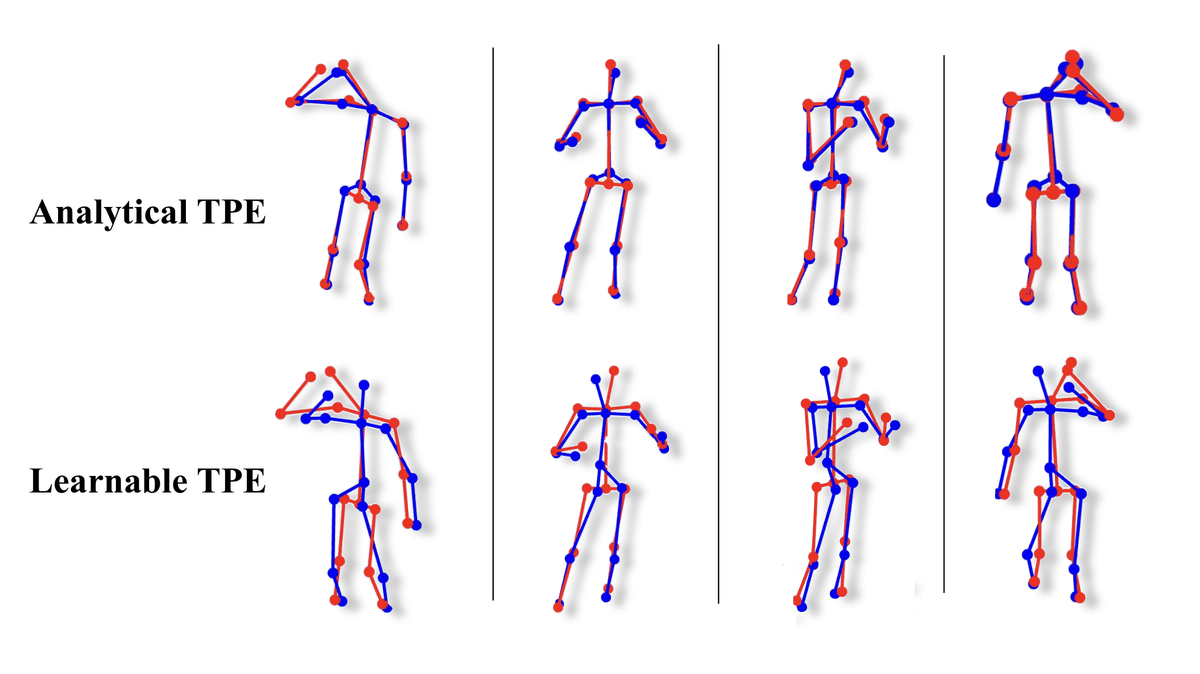
- Token Positional Encoding (TPE): This novel approach replaces fixed or learned positional encodings with Fourier-based TPE, enhancing the model's scalability and its capacity to handle imbalanced datasets. Because each point's identity is encoded by a continuous Fourier feature rather than a slot index, the model can accept variable-length inputs and share knowledge across categories.
- Procrustean transformer: Procrustes alignment is a classical technique that finds the optimal rotation, scale, and translation to line up two point sets. The model integrates Procrustean methods such as Orthographic-N-Point (OnP) to efficiently focus on deformable aspects within a canonical frame, reducing computational complexity. The network only has to learn shape, not viewpoint.
- Hybrid local-global attention: Combining graph-based local attention with global self-attention in transformers allows the model to capture both local and global context. Local attention respects the graph of skeletal connections, while global attention lets distant landmarks talk to each other.
What the numbers say
The team ran detailed experiments on the Human3.6M benchmark and a blend of other datasets including Animal3D and facial datasets to ablate the role of Procrustean transformation, hybrid attention mechanisms, and tokenized positional encoding (TPE). The headline result is that a single unified model matches or beats category-specific baselines. Experimental results demonstrate a significant MPJPE reduction and robust generalization to unseen object categories, outperforming state-of-the-art methods.
The imbalance handling is particularly interesting for anyone who has ever tried to train on a long-tailed dataset. When tested on the underrepresented hippo category from the Animal3D dataset, the TPE-based model showed a 3.27% improvement in MPJPE over the baseline MLP with a 128-dimensional model. Rare categories, in other words, benefit from being trained alongside common ones rather than starving on their own small datasets.

Out-of-distribution: the fish test
The most striking demo is a fish. The model was never trained on fish, has never seen that skeletal layout, and yet still lifts video landmarks into a plausible 3D pose. Fish is completely OOD. The 3D-LFM is capable in recognizing and reconstructing objects in configurations and with a number of landmarks never encountered during its training phase. The authors also show 3D pose estimation on various deformable categories from the internet, including OpenAI's SORA videos.
Where it fits, and where it does not
3D-LFM is not a monocular 3D image reconstructor in the NeRF or Gaussian-splatting sense. It operates on 2D keypoints, so you still need an upstream detector (something like a pose estimator or a landmark predictor) to produce those points. Given that separation, it slots naturally into pipelines for:
- Motion capture across species, where a single model can serve humans, dogs, horses, and more.
- AR/VR rigging of unusual objects where per-category training data is scarce.
- Sports and biomechanics analysis on animals or non-standard equipment.
- Preprocessing for generative video and 3D content pipelines that need pose signals.
Its limitations follow from the same design. The model reconstructs sparse landmarks, not dense meshes or textures, so it will not replace multi-view reconstruction when you need surface geometry. It also inherits the errors of whatever 2D detector feeds it, and while it generalizes to new categories, the paper does not claim it beats specialized models on every metric for every well-studied category.
Getting your hands on it
Code is available on the official GitHub repo, though with a caveat. The repository currently supports demo visualization of the model's performance. The comprehensive codebase, which includes actual training and evaluation functionalities, is planned for release as soon as the licensing information becomes available. Inference and OOD demos are usable now; full training scripts are the next drop.
The broader significance is less about a single benchmark number and more about a shift in how the community treats structured geometric problems. Foundation models arrived in language and images by discarding hand-crafted category structure. 3D-LFM makes a similar bet for 2D-to-3D lifting: stop building one model per object, encode the point identities continuously, let attention learn the correspondences, and align to a canonical frame at the end. If it holds up as the training corpus grows, category-specific lifting networks may start to look as dated as per-language NLP models did after BERT.