
CMU Researcher Reanimates Logic Theorist, AI's First Working Program in 70 Years
A researcher rebuilt the 1956 Logic Theorist by writing an IPL-V interpreter in Common Lisp, then debugged it with help from Gemini and Claude.
 Pro
Takeaways
- Jeff Shrager reanimated the 1956 Logic Theorist, likely the first successful execution of the original code in over 50 years.
- He built a new IPL-V interpreter in Common Lisp emulating the abstract machine rather than JOHNNIAC hardware.
- The code was transcribed from Stefferud's 1963 RAND report; over 99% is the original untouched IPL-V.
- It proves 16 of 23 attempted Principia Mathematica theorems, consistent with the historical system's behavior.
- Gemini and Claude helped debug non-fatal misbehaviors by cross-checking against 1962 punched cards from the Computer History Museum.
- The interpreter and code are open source; GPS and EPAM are next targets.
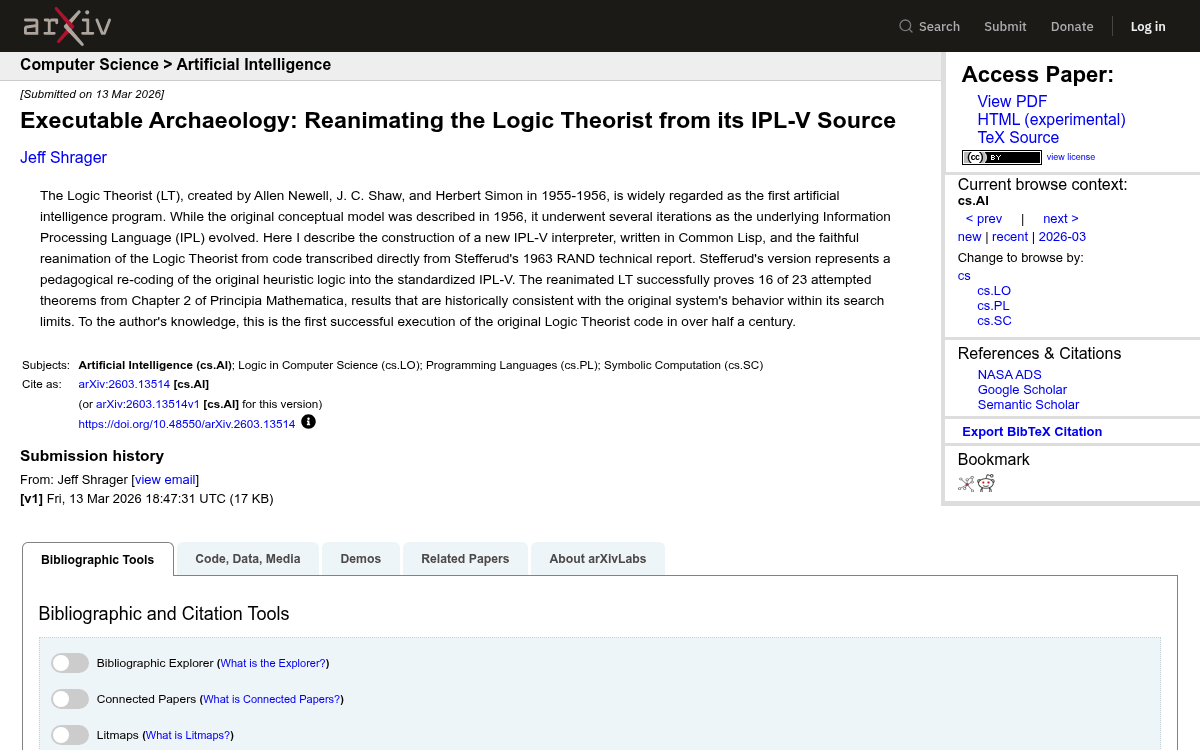
The first working artificial intelligence program is running again. Jeff Shrager, who studied under Allen Newell and Herbert Simon at Carnegie Mellon, has reanimated the Logic Theorist, the 1956 program that Newell, J.C. Shaw, and Simon famously brought to the Dartmouth workshop, the meeting where John McCarthy coined the term artificial intelligence. To the author's knowledge, this is the first successful execution of the original code in more than half a century.
The reconstruction is not a rewrite in Python or a modern reimplementation of the algorithm. It is the actual 1963 source listing, transcribed line for line, running inside a newly built interpreter for a dead programming language.
Why a 70-year-old program is hard to run
The Logic Theorist was written in the Information Processing Language, or IPL, a language Newell, Shaw, and Simon invented specifically to manipulate symbols. IPL introduced list manipulation, dynamic memory allocation, symbols as first-class objects, recursion, and higher-order functions, and it was an explicit direct ancestor of Lisp. But while Lisp thrived, IPL went extinct in the mid-1960s. No maintained implementation exists in any modern environment.
That leaves a strange gap in the historical record. Early AI systems were not just theoretical proposals, they were functioning programs whose real behavior can only be studied by running them. Shrager calls this approach executable archaeology, and it follows his earlier project restoring Weizenbaum's original ELIZA on an emulated IBM 7094.
Building an interpreter for an abstract machine
Rather than emulate the vintage JOHNNIAC hardware the Logic Theorist originally ran on, Shrager targeted the IPL-V abstract machine itself. IPL-V runs on an abstract machine organized around cells, where every cell is potentially a stack of symbols that can be pushed and popped, and everything, including data, routines, and the program itself, is a list of cells.
Key elements of the interpreter, iplv.lisp:
- Control cells H0 through H5, where H0 is the parameter and result cell, H1 serves as both program counter and call stack, H2 is the free list for dynamic memory allocation, and H3 is the cycle counter.
- Ten working cells W0 through W9 for scratch storage.
- The J-functions, IPL-V's roughly 150 built-in operations whose names all start with J.
- A re-entrant evaluator that fetches and executes the list named in H1.
The Logic Theorist source itself came from Stefferud's 1963 RAND memorandum RM-3731, a pedagogical re-coding of the original heuristic logic into standardized IPL-V. More than 99% of the code in the reconstruction is untouched from that report. Transcription was done into a Google spreadsheet and later cross-checked using gridlock, a tool for extracting tabular code from PDFs.
The results, and how they match history
The reanimated system was pointed at 23 theorems from Chapter 2 of Whitehead and Russell's Principia Mathematica, with an effort limit of 20,000 IPL machine cycles per attempt. It proved 16 and failed on 7, a spread consistent with the original system's known behavior within its search limits. A complete run takes approximately 574,000 IPL machine cycles, creates over 576,000 symbols, and finishes in a few seconds on a typical modern laptop, whereas on the JOHNNIAC at RAND in the mid 1950s this likely would have required hours.
The program uses five proof methods, including substitution, detachment (modus ponens), forward and backward chaining, and sublevel replacement. Interestingly, as LT proves a given theorem, that theorem is treated as an axiom and can be used to support subsequent proofs, so LT can be said, in a sense, to learn.
Where LLMs actually helped, and where they nearly hurt
The most novel part of the paper is the debugging story. Shrager built the interpreter and worked through the crash-level bugs alone over many months. Once the program stopped crashing but started misbehaving in subtle ways, that phase stalled. He then brought in Google's Gemini and Anthropic's Claude, but IPL-V is a language with essentially no training corpus. There is no Stack Overflow, no GitHub corpus, no community of practitioners for the LLMs to have learned from.
The LLMs had to infer IPL-V semantics from Shrager's own interpreter, which itself still contained bugs. Any wrong inference risked being propagated back as bad suggestions. Two guardrails made the collaboration work:
- Treat the transcribed Logic Theorist code as correct, and focus all debugging on the interpreter and J-functions.
- Verify inferred semantics against original artifacts whenever possible.
That second rule cracked the hardest bug. After hours of trace analysis, Claude localized a defect in J74, the list-copying function, but the manual's prose seemed to support the buggy implementation. The team then pulled in Simon's J's, an original 1962 IPL-V punched-card deck preserved by the Computer History Museum. Claude read the 1962 card source, compared it to the Lisp implementation, spotted the discrepancy, and a one-line patch made LT run correctly end to end.
What is now runnable
The interpreter is not tied to the Logic Theorist. It implements the general IPL-V abstract machine, which opens the door to other historically significant systems. Shrager is targeting two next:
- General Problem Solver (GPS), Newell, Shaw, and Simon's follow-up architecture.
- EPAM, Feigenbaum's Elementary Perceiver and Memorizer, whose source is preserved in the Feigenbaum archives at Stanford.
Everything is open source: the interpreter, the transcribed LT code, the complete outputs, and partial LLM interaction histories are available in the IPL-V repository on GitHub. For anyone interested in the origins of symbolic AI, cognitive architectures like Soar and ACT, or the practical mechanics of getting an LLM to help you reverse-engineer a dead language, it is now possible to actually poke at the artifact rather than just read about it.