
CMU and Stanford's UMI-on-Air Teaches Drones to Install Lightbulbs
A new diffusion policy technique lets low-level controllers push back on high-level plans, unlocking aerial manipulation from handheld human demos.
 Pro
Takeaways
- UMI-on-Air deploys handheld-gripper demonstrations onto aerial manipulators without any drone teleoperation data
- Embodiment-Aware Diffusion Policy adds controller gradient feedback into diffusion sampling like classifier guidance
- Real hexrotor drone hits 5/5 on peg-in-hole vs 3/5 baseline, and 3/3 on lightbulb installation
- Method is plug-and-play: no retraining needed when swapping robots or controllers
- Simulation shows 20%+ recovery on constrained embodiments under disturbances
- Code, checkpoints, and hardware guide open-sourced at github.com/LeCAR-Lab/UMI-on-Air
Training a drone to install a lightbulb sounds like a punchline, but a joint team from Carnegie Mellon and Stanford has actually done it, using only human demonstrations recorded with a handheld gripper. The catch: getting those demonstrations to translate into stable flight took a new trick that turns diffusion policies into a two-way conversation between the model and the robot's controller.
The system, called UMI-on-Air, targets a problem that has been quietly limiting the field of general-purpose manipulation policies. Data collected once with a cheap handheld tool should, in theory, work on any robot that speaks the same end-effector language. In practice, it works great on tabletop arms and falls apart on anything with real dynamics, like a hexrotor drone trying to hover an inch from a peg board.
Why handheld demos break when they leave the tabletop
The Universal Manipulation Interface (UMI) is a handheld gripper with a wrist camera that lets humans record manipulation demonstrations in the wild, without any robot hardware in the loop. By decoupling demonstrations from specific robots, UMI enables training of embodiment-agnostic manipulation policies. That approach has powered a wave of visuomotor policy work because you can scale data collection just by walking around with a gripper.
The problem is that a policy trained on human hand motion assumes the executor can actually follow whatever trajectory it dreams up. Fixed-base arms with precise controllers are highly UMI-able, able to execute UMI policies as if they were the handheld gripper. Aerial manipulators are the opposite end of the spectrum. They deal with aerodynamic disturbances, underactuated dynamics, and payload limits that a human wrist simply does not have. Feed a drone a human-style trajectory and you get out-of-distribution behaviors, missed grasps, or crashes.
The authors call this quality "UMI-ability" and use it as a measurable notion of how well an embodiment can track policies trained from handheld data. A UR10e arm sits near the top. A hexrotor drone with an arm hanging off it sits near the bottom.
Making the controller talk back
Standard deployments push policy outputs straight to the low-level controller as commands. UMI-on-Air introduces Embodiment-Aware Diffusion Policy (EADP), which flips that into a dialogue. At each denoising step, the embodiment's controller evaluates the noisy end-effector trajectory with a tracking cost, measuring its feasibility under current constraints. By backpropagating this cost to the noisy action trajectory, the policy is guided toward action trajectories that are more feasible.

The mechanism will look familiar to anyone who has worked with classifier guidance in image diffusion. Instead of steering samples toward a class label, EADP steers them toward trajectories the specific robot can dynamically execute. At each DDIM step, the algorithm:
- Takes the current noisy action trajectory sample
- Runs it through the embodiment's controller (either simple inverse kinematics with velocity limits, or a full model predictive controller)
- Computes a tracking cost that penalizes trajectories the controller cannot follow well
- Takes the gradient of that cost with respect to the trajectory
- Nudges the sample against the gradient before running the next denoising step
The guidance strength is scheduled by the diffusion noise level, so it stays weak during noisy early steps and ramps up as the trajectory sharpens. A key point is that the diffusion policy training remains independent of the embodiments used for deployment, but embodiment-specific controllers can inject real-time constraints and feasibility gradients. No retraining. Swap the controller, swap the robot.
What the numbers say
The team built a MuJoCo benchmark with four tasks (open-and-retrieve, peg-in-hole, rotate-valve, pick-and-place) and three embodiments: an oracle flying gripper, a UR10e arm, and a hexrotor UAM with and without simulated disturbances. The oracle gives an upper bound with no embodiment gap.

The visualization above is where the method's behavior becomes concrete. Visualizing 32 action samples across different embodiments for the same observation, UR10e's trajectories are guided upwards to be more kinematically feasible, avoiding kinematic singularities. In contrast, the UAM's trajectories are guided downwards to be more dynamically feasible due to perturbations along the -Z direction. Same policy, same observation, different adapted trajectories.
Success rates tell the same story. For UR10e, improvements are modest but noticeable on difficult tasks. For the UAM, EADP substantially boosts performance, recovering over 9% on average without disturbances and over 20% with disturbances. The gains scale with how constrained the embodiment is, which is exactly what you would hope from an embodiment-aware method.
Actually flying it
The hardware experiments used a fully-actuated hexrotor with a 4-DoF manipulator. Policy inference runs on an NVIDIA RTX 4070Ti at approximately 1.5 Hz; the MPC executes on CPU at 50 Hz, interpolating between asynchronously published reference waypoints. The MPC is solved with ACADOS.
Three real-world tasks, all with baseline diffusion policy comparisons:
- Peg-in-hole (4 cm hole, 2 cm peg, randomized starts): baseline 3/5, EADP 5/5
- Lemon harvesting (find ripe yellow lemon, place in basket): EADP 4/5, with the single failure being a green lemon at the frame edge
- Lightbulb installation (thread bulb, flip switch, over 3 minutes wall clock): EADP 3/3
The cross-environment test is the most interesting one for anyone thinking about scaling. The authors collected UMI demonstrations in various in-the-wild settings, then evaluated peg-in-hole in a completely different environment with distractors. EADP got 4/5, with the only miss being a collision with the enclosure. This is the payoff of UMI's design finally reaching an embodiment that could not benefit from it before.

Where it fits and where it does not
EADP is useful anywhere you have a UMI-style policy and a controller with a differentiable cost. The IK-with-velocity-limits variant works for standard arms and mobile bases. The MPC variant handles drones, and the framework should generalize to legged systems the same way.
The main constraint is that guidance currently needs analytical gradients from model-based controllers, so it maps cleanly onto systems with known dynamics but not onto pure black-box RL controllers yet. There is also a temporal mismatch: policy inference runs at roughly 1 to 2 Hz while the controller runs at 50 Hz. The authors point toward streaming diffusion methods as a way to close that gap.
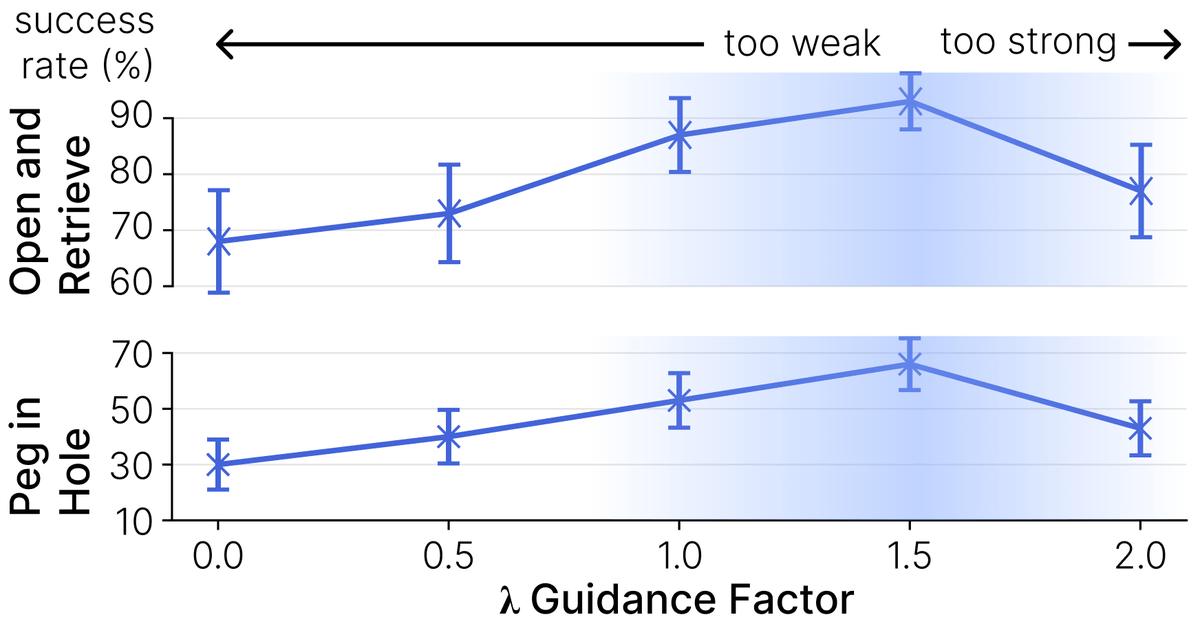
Two other limitations worth flagging. Setting the guidance scale is a real knob. Turn it too high and the denoising process gets over-constrained, producing conservative out-of-distribution motions. The method also inherits the failure modes of the underlying UMI policy, so if the base diffusion model has never seen a green lemon it will still grab a green lemon.
The full stack, including code, data, checkpoints, and hardware details, is available on the project GitHub. For anyone already running diffusion policies with an MPC underneath, adding EADP is essentially adding one gradient step per denoising iteration, which is a low-friction way to test whether embodiment guidance helps your setup.