
CMU and MIT Prove Action Masking Hides a Fatal Flaw in Robot Training
A new paper proves that unmasked RL training exponentially kills valid actions before agents ever see them, and proposes a fix that works without runtime oracles
 Pro
Takeaways
- New theorem proves that unmasked RL training causes exponential decay of valid action probabilities at unvisited states, through shared network parameters.
- Rarely-valid actions like "descend staircase" or "open door" are most affected, collapsing from 1/43 to below 10^-4 within 50M training frames.
- Oracle masking fixes suppression but causes total deployment failure (-0.9 return) when validity oracles are unavailable at test time.
- Feasibility classification adds per-action binary heads to the shared encoder, enabling deployment without oracles at only 2% performance cost (43.2 vs 43.9).
- KL-balanced loss weights classification errors by policy sensitivity, outperforming focal loss 2x and achieving 99% validity prediction accuracy.
- Code and validity functions for Craftax and MiniHack are included in the paper's supplementary materials in JAX.
Action masking is one of those techniques that every RL practitioner uses but few have deeply questioned. You have a game or a robot with rules, some actions are illegal at certain states, so you zero them out before sampling. It works. But why does skipping masking fail so badly, and what exactly is being destroyed? A new paper from Carnegie Mellon University and MIT finally answers that question with a formal proof, and the answer is more alarming than most practitioners assumed.
The hidden cost of skipping the mask
In many real-world RL settings, the set of legal actions changes depending on where the agent is. A robot can only open a door when it is adjacent to one. A game character can only descend a staircase when standing on one. The standard fix is action masking: before computing action probabilities with a softmax, you zero out the logits of illegal actions so they can never be sampled. The alternative, penalizing the agent with negative reward for picking illegal actions, is known to be much worse, with prior work showing masking outperforms penalty-based approaches by margins exceeding 50%.
What was missing was a mechanistic explanation. Prior theory only proved that masking preserves the correctness of the policy gradient update. It said nothing about what goes wrong when you skip masking. The new paper, "Overcoming Valid Action Suppression in Unmasked Policy Gradient Algorithms", fills that gap with a theorem and a practical remedy.
Parameter sharing is the culprit
The core insight is about how neural networks share parameters across states. In a standard policy network, the final action logits are computed as z_a(s) = phi(s)^T * w_a, where phi(s) is the shared encoder output (prefinal layer activations) and w_a are per-action weight vectors. When the gradient pushes down the logit of an invalid action at a visited state, it updates w_a. But because the same w_a is used everywhere, this update also pushes down the logit of that action at every other state, including states the agent has never visited.

The paper calls this valid action suppression. The mechanism is particularly brutal for actions that are rarely valid, like descending a staircase or opening a door. These actions are invalid at almost every state the agent visits early in training, so they accumulate gradient pressure pushing them toward zero. By the time the agent finally reaches a state where the action is needed, its probability has already collapsed.
The exponential decay theorem
The authors prove this formally as Theorem 1. Under two conditions, the probability of a valid action at an unvisited state decays exponentially with training steps:
- Invalid-action dominance gap: At every visited state, the invalid action has strictly lower Q-value than the best valid action. This is almost always true by definition, since invalid actions are no-ops or worse.
- Feature alignment: The encoder representation of the unvisited state is not orthogonal to the advantage-weighted mean of visited state representations. In plain terms: the network's internal features for the unvisited state are correlated with features from visited states.
When both hold, the bound is stark:
pi_T(a | s*) <= exp(-K_T) / n
where K_T is the cumulative suppression rate over T training steps and n is the total number of actions. The probability starts at 1/n at initialization and decays exponentially from there. The paper also analyzes entropy regularization (the common trick of adding an entropy bonus to keep the policy from collapsing): it creates a floor on suppression but cannot eliminate it, revealing a fundamental tradeoff between protecting valid actions and sample efficiency that masking simply sidesteps.
Critically, the authors validate that deep networks actually satisfy the feature alignment condition. They measure Pearson correlation between encoder activations at valid versus invalid states and find correlations of 0.4 to 0.8 throughout training, confirming the theorem applies in practice.
Masking solves one problem but creates another
Oracle masking (using a ground-truth validity function at every step) prevents suppression entirely. But it introduces a deployment problem that practitioners rarely discuss: the encoder never learns to distinguish valid from invalid states, because invalid actions are excluded before they can influence the representation. The policy works only because an external oracle intervenes at every timestep. Remove that oracle at deployment and the policy collapses.
The paper demonstrates this failure empirically. Agents trained with oracle masking drop to a return of -0.9 (near-random) when deployed without masks, even in environments where they previously achieved near-optimal performance. This is not a small degradation. It is total failure.

Feasibility classification: the practical fix
The proposed solution is feasibility classification: add lightweight binary classification heads on top of the shared encoder, one per action, that predict whether each action is valid in the current state. The classification loss is added to the standard PPO objective and backpropagates through the shared encoder, forcing it to develop features that distinguish valid from invalid states.
The training strategy is then:
- Train with oracle masking for stable policy learning (no suppression).
- Simultaneously train the classification heads to predict validity from observations.
- At deployment, substitute the learned predictor for the oracle mask.
The key innovation in the loss function is a KL-balanced classification loss that weights each action's classification error by how much a misprediction would actually change the policy. Misclassifying a high-probability action (one the policy would actually choose) is penalized heavily. Misclassifying an action the policy would ignore anyway contributes almost nothing. This is more effective than standard focal loss, which treats all actions equally, and outperforms it by roughly 2x in deployment performance.
What the numbers show
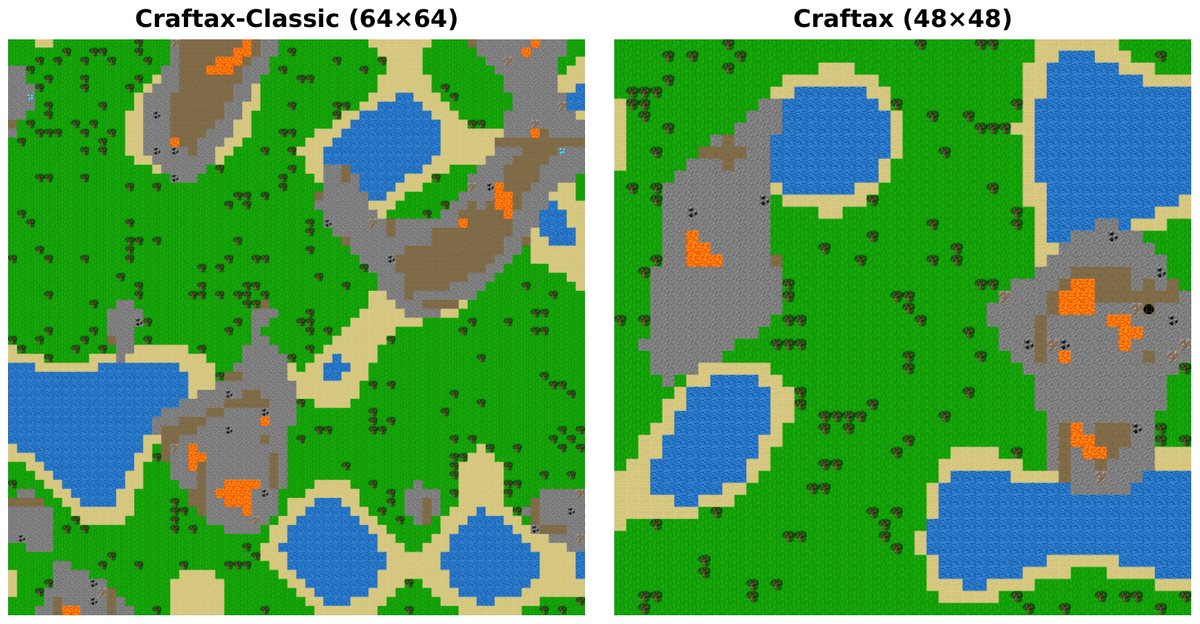
Experiments run on Craftax (a JAX-based survival benchmark with 43 actions across 9 dungeon floors) and MiniHack Corridor-5 (a navigation task with 11 actions) confirm the theory. Key results:
- In Craftax, the probability of the
descendaction at valid staircase states drops from1/43 ≈ 0.023to below10^-4within 50M frames under unmasked training, nearly two orders of magnitude. - Unmasked agents select valid actions at fewer than 15% of timesteps during early training.
- Oracle masking reduces the frames needed to reach a return of 1.0 from 84% of the training budget to 63%, a 21 percentage point improvement in sample efficiency.
- Masked + KL-balanced classification achieves 48.8 return on Craftax-Hybrid versus 45.6 for masking alone, a 7% gain even when oracle masks are available at test time.
- Under predicted masks (no oracle), Masked + KL achieves 43.2 versus -0.9 for masking alone, matching unmasked training performance while providing an explicit validity model.
- The classification heads achieve 99% validity prediction accuracy, and feature correlation drops from ~0.8 (oracle masking alone) to ~0.4 (with classification).
Where this matters most
The practical impact is largest in sim-to-real transfer. Validity oracles are easy to implement in simulation (you have access to the game state), but often impossible or expensive to compute on physical hardware. A robot trained in simulation with oracle masks will fail on deployment if it has no learned model of which actions are feasible. Feasibility classification directly addresses this gap by building that model into the encoder during training.
The approach is also useful for interpretability. The learned validity predictor is an explicit, inspectable model that practitioners can audit. Where it disagrees with ground truth, those disagreements identify potential failure modes before deployment, something oracle masking offers no mechanism for.
The paper does not release a standalone library, but the validity functions for Craftax and MiniHack are implemented in JAX and included in the supplementary materials, making them directly reusable. The architecture change is minimal: add one linear classification head per action on top of the existing encoder, add the KL-balanced loss term, and the rest of the PPO training loop is unchanged.
One limitation worth noting: the theoretical analysis assumes fixed encoder features, while in practice the encoder is jointly optimized with the policy. The authors validate empirically that the predicted behavior holds, but the theory does not yet cover the full dynamics of joint optimization. Deployment with predicted masks also matches but does not exceed unmasked performance, since the policy is trained under oracle conditions and faces a mild distribution shift at test time.