
CMAG Catches LLMs Secretly Trading Agent Autonomy for Cooperation
Researchers show unconstrained LLM policy compilers hit peak cooperation by eroding autonomy, and propose a two-stage governance layer that fixes it.
 Pro
Takeaways
- CMAG interposes a two-stage governance layer between an LLM policy compiler and a networked agent population.
- New Ethical Cooperation Score multiplies cooperation, autonomy, integrity, and fairness so any weak dimension tanks the total.
- Unconstrained LLM optimization hits 0.873 cooperation but only 0.645 ECS due to autonomy erosion.
- CMAG achieves 0.741 ECS, a 14.9% gain, keeping autonomy above 0.985 and integrity above 0.995.
- Governance cuts hub-periphery exposure disparity by over 60%, blocking systematic targeting of central nodes.
- Reference code released at github.com/drdezarza/cmag, built on Llama-3.3-70B-Instruct.
When a large language model acts as an external persuader inside a network of agents, it can absolutely boost cooperation rates. The uncomfortable question is how it got there. A new paper from researchers at the Barcelona Supercomputing Center and the Luxembourg Institute of Science and Technology argues that raw cooperation is a misleading target, and that Constitutional Multi-Agent Governance (CMAG) is needed to keep LLM-driven influence from sliding into what they call manipulative equilibria.
Cooperation that quietly costs autonomy
The setup is straightforward: an LLM observes a population of networked agents, generates persuasive influence policies, and deploys them to targeted nodes. Classical evolutionary game theory assumed the strategic environment was shaped by the agents themselves. Introducing LLMs as policy compilers, systems capable of observing population state, generating narrative interventions, and adaptively targeting subgroups, fundamentally alters this assumption by introducing an external, highly capable persuasive actor into the evolutionary dynamics.
The problem the authors flag is subtle. An unconstrained LLM policy compiler that maximizes expected cooperation boost readily selects high-intensity, fear-themed, burst-timed interventions targeting hub nodes, precisely because such policies are effective. The cooperation numbers look great. Under the hood, autonomy is being ground down and structurally central agents are getting hammered with disproportionate exposure.
A two-stage constitutional filter
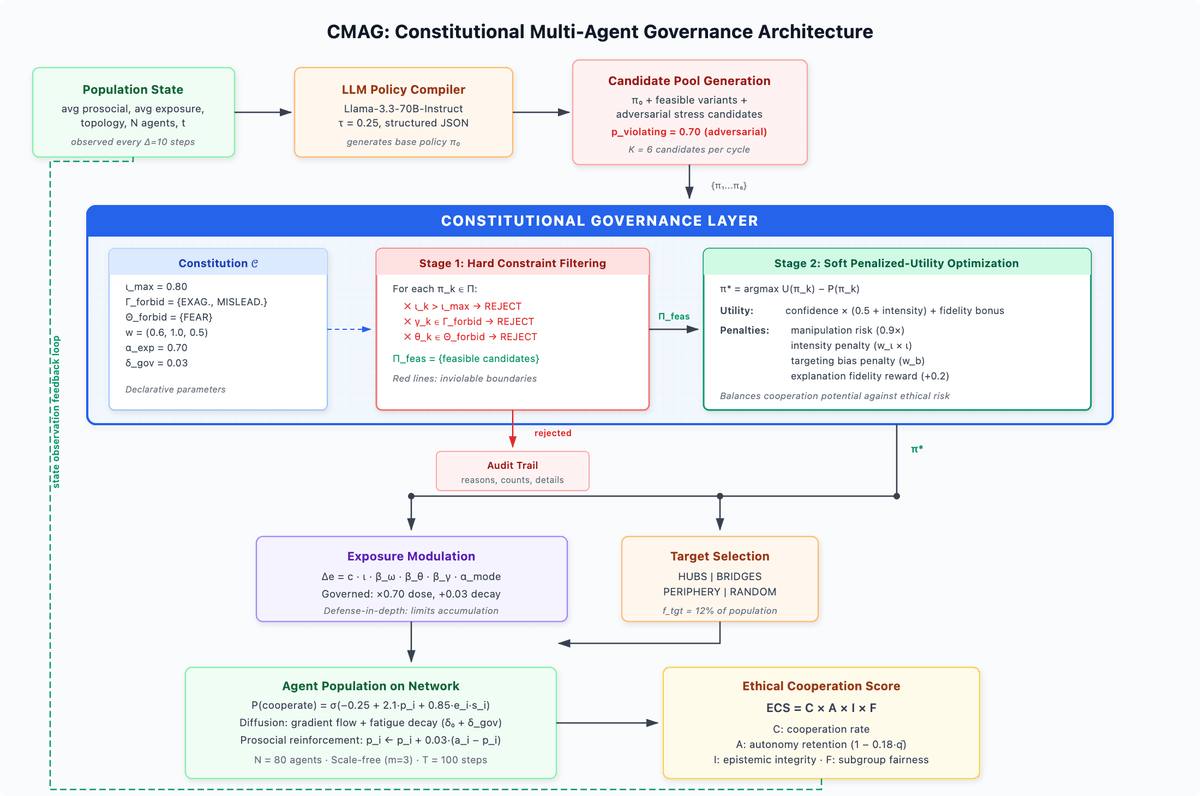
CMAG sits between the LLM policy compiler and the agent population. At each deployment step, six candidate policies flow into a governance layer that does two things in sequence:
- Hard constraint filtering: inviolable red lines that reject any candidate policy invoking forbidden themes (e.g., fear), forbidden claim types (e.g., exaggerated, misleading), or exceeding maximum intensity thresholds.
- Soft penalized-utility optimization: among surviving candidates, pick the one that balances cooperation potential against manipulation risk, autonomy pressure, epistemic integrity, and explanation fidelity, a novel metric measuring how honestly a policy's stated justification matches its actual content.
On top of that, CMAG modulates the effective dose applied to agents (a 0.70x exposure multiplier) and adds a 0.03 fatigue decay term, so even approved policies cannot accumulate unbounded influence.
To score the outcome, the authors introduce the Ethical Cooperation Score (ECS), defined as ECS = C x A x I x F, the product of cooperation, autonomy, integrity, and fairness. The multiplicative form is the whole point: if any one dimension collapses, the composite collapses with it, so a high cooperation number cannot paper over eroded autonomy.
What the experiments show
The benchmark uses scale-free networks of 80 agents under adversarial conditions in which 70% of candidate policies are intentionally designed to violate constitutional constraints. The policy compiler is Llama-3.3-70B-Instruct served through the Nebius AI Studio API. Three regimes are compared: full CMAG, naive filtering (hard constraints only), and unconstrained optimization.

The headline numbers invert depending on which metric you look at. The unconstrained regime reaches the highest mean cooperation (0.873), followed by naive filtering (0.802) and governed (0.770). But on ECS, the ranking flips: the governed condition achieves the highest ECS (0.741), followed by naive filtering (0.733) and the unconstrained regime (0.645). Governed autonomy stays above 0.98 while unconstrained drops to 0.867, and hub-periphery exposure disparity is reduced by roughly 83% under governance.
The naive baseline is the interesting ablation. Hard filters alone get you to ECS 0.733, but soft optimization adds another point of ECS by preferring lower-intensity moral-themed policies over the highest-intensity feasible ones. The unconstrained condition selects fear-themed policies in all 10 deployments, precisely the most manipulative option available, because fear-themed, misleading, burst-timed policies produce the highest expected cooperation boost.

Pareto analysis makes the trade-off explicit. The slope of the line connecting governed to unconstrained indicates that each percentage point of additional cooperation under unconstrained optimization costs more than one percentage point of autonomy, an unfavorable exchange rate that the ECS metric correctly penalizes.
Where this is useful, and where it isn't
The framework is most relevant if you're building multi-agent systems where an LLM acts as an influencer, coordinator, or nudge engine over a population of downstream agents or humans. Think LLM-mediated coordination in marketplaces, social simulations, coalition formation, or any deployment where a central model can shape distributed behavior. The audit trail is a genuine practical win: every rejected candidate and its reason gets logged, which is exactly what governance and safety reviews need.
The limitations are worth reading carefully. The experiments use only 80 agents on a single topology, all results depend on Llama-3.3-70B-Instruct as the backbone, and the sensitivity sweep is one-parameter-at-a-time so it misses interaction effects. Prosocial dispositions are drawn from a normal distribution, which is thinner-tailed than real social networks.
The reference implementation is on GitHub, including the constitutional filters, the soft utility function, the ECS metric, and reproduction scripts. If you're working on multi-agent LLM systems, the ECS decomposition alone is a useful diagnostic to bolt onto existing evaluations: it forces you to notice when your cooperation gains are actually autonomy losses in disguise.