
CM-Bench Ranks 30 AI Matchers on Thermal-to-Satellite Image Localization
A new benchmark stress-tests 30 image matchers on infrared-visible pairs, exposes brittle baselines, and ships a thermal-satellite localization dataset.
 Pro
Takeaways
- CM-Bench evaluates 30 IR-visible matchers across 10 datasets under one unified protocol. Paper
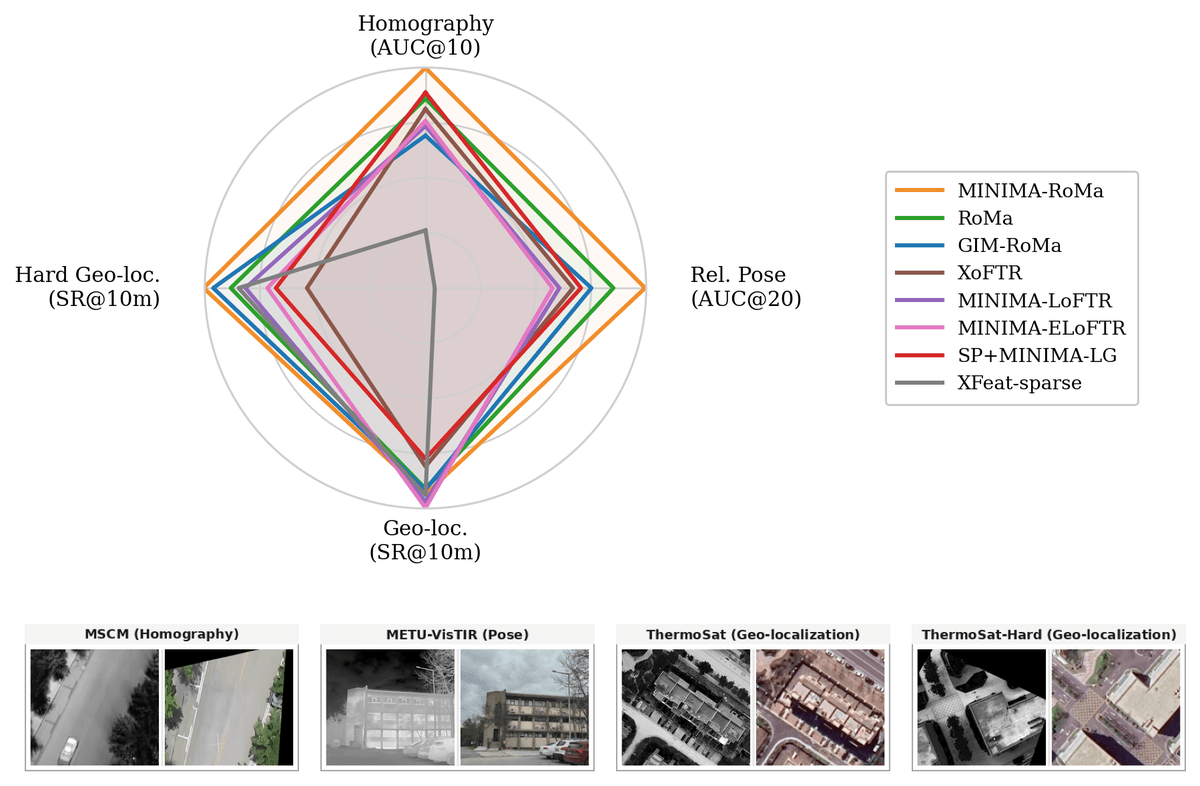
- Dense matchers dominate: MINIMA(RoMa) leads homography, pose, and thermal-satellite geo-localization tasks.
- New ThermoSat dataset ships 832 DJI Matrice 4T thermal-satellite pairs across 41.56 km of trajectories.
- A MobileNetV4 gate picks one of four preprocessing branches per pair, boosting weaker matchers by up to 114%.
- RoMa-based dense methods run 600+ ms per pair, versus under 20 ms for sparse baselines like XFeat.
- Code, dataset, and evaluation harness released on GitHub.
Matching pixels between a thermal infrared camera and a regular RGB or satellite image sounds like a solved problem, but most modern feature matchers were trained on visible-light photos where two views share texture, color, and intensity. When one image is a heat map and the other is a color photograph, those assumptions collapse. A new benchmark called CM-Bench pins down exactly how badly this happens, ranks 30 algorithms under a single protocol, and adds a new drone-thermal-to-satellite dataset that makes the problem concrete for anyone building localization or SLAM systems.
Why cross-modal matching keeps breaking
Infrared and visible modalities exhibit substantial appearance differences, including variations in texture, contrast, edge responses and spectrum, which is why classical detectors that assume consistent intensity patterns tend to fail. The authors also flag a structural problem in the literature: algorithms specifically designed for cross-modal matching are often evaluated on constrained datasets and lack full comparison, so it has been hard to tell whether a new method is genuinely better or just tuned to a favorable split.
What is actually in the benchmark
The team assembles a full taxonomy of matchers and evaluates them on the same footing. CM-Bench compares 30 feature matching algorithms across 10 diverse cross-modal datasets, spanning classic handcrafted features to state-of-the-art deep learning models, and includes a variety of environments, sensor settings, and collection conditions to reflect realistic challenges. Methods are grouped into three families:
- Sparse keypoint detectors and descriptors (SIFT, SuperPoint, ALIKED, XFeat, R2D2, RIFT) usually paired with matchers like LightGlue or SuperGlue.
- Semi-dense transformer matchers that skip keypoints and predict pixel-level correspondences over a grid (LoFTR, Efficient LoFTR, ASpanFormer, XoFTR, TopicFM).
- Dense methods that predict a correspondence for every pixel (DKM, RoMa, RoMa v2, MASt3R, and the MINIMA/GIM fine-tuned variants).
Evaluation is split across four tasks: homography estimation on a 7,083-pair Multi-Source Cross-Modal set (MSCM) built from VisDrone, LLVIP, KAIST, FLIR and others; relative pose estimation on METU-VisTIR; and thermal-to-satellite geo-localization on the authors' own dataset under a standard and a hard protocol.
ThermoSat: drone thermal meets satellite basemaps
The most reusable artifact for practitioners is probably the new dataset. ThermoSat contains 832 manually annotated infrared-satellite image pairs captured by a DJI Matrice 4T platform for practical geo-localization evaluation. The thermal images are acquired at 1280x1024, and the selected sequences provide a cumulative trajectory length of approximately 41.56 km with total local coverage of approximately 35.86 square km across seven surveyed regions. The hard protocol keeps the same underlying localization scenes but adds attitude-angle changes and altitude variations to simulate flight-induced viewpoint perturbations, which is where most matchers fall apart.

A gate network that picks the right preprocessing
Beyond ranking existing matchers, the paper introduces an adaptive preprocessing front-end. The motivation is empirical: no single image enhancement helps every pair. Sharpening a low-contrast thermal image can help, but the same filter applied to an already-matchable pair can destroy useful texture.
The solution is to cast preprocessing selection as a four-way classification problem. Given an IR-VIS pair, both images are resized to 224x224 and fed into a classification network built on a MobileNetV4-Conv-Small backbone. The backbone produces global features for each image, which are then concatenated with their absolute difference and element-wise product so the classifier sees appearance, discrepancy, and shared structure at once. It then chooses one of four branches:
- None - keep the original image intact.
- Unsharp - strengthen local edges and fine detail.
- Scharr gradient with local contrast normalization - emphasize gradient structure while suppressing cross-modal intensity differences.
- Morphological gradient - highlight object boundaries and region contours.
Training labels come without human annotation. For each training pair the candidate branches are exhaustively evaluated, and the branch that produces the largest number of geometric inliers after matching and RANSAC verification is used as the target label. The gate itself is cheap: 7.74M parameters and roughly 21.1 ms per pair on an RTX 4090 at 224x224 input.

Who actually wins
The headline result is that dense matchers, and specifically the RoMa family fine-tuned with MINIMA, dominate across every task. MINIMA(RoMa) achieves the best homography accuracy with AUC@5/10/20 of 0.198/0.509/0.733, followed by RoMa (0.151/0.438/0.672) and XoFTR (0.136/0.414/0.640). On relative pose, MINIMA(RoMa) again leads with AUC@5/10/20 of 0.379/0.612/0.786. On ThermoSat under the harder protocol, MINIMA(RoMa) stays strongest with a median error of 0.333 m and SR@5m of 0.456, followed by GIM(RoMa) at 0.392 m and RoMa at 0.421 m.
The paper attributes RoMa's robustness to its use of DINOv2's semantic-rich features that remain consistent to modality differences, while the MINIMA series enhances performance through generative models that synthesize infrared data for fine-tuning. Handcrafted baselines like SIFT and RIFT trail far behind, and RoMa v2, despite being a newer release, underperforms the original RoMa on ThermoSat.
The catch: dense accuracy is expensive
Efficiency numbers make the tradeoff clear. At 640x512 resolution, sparse methods are the fastest, with SuperPoint+MNN and XFeat(sparse) providing the lowest runtime, while in the semi-dense family MINIMA(ELoFTR) and ELoFTR offer the best efficiency. RoMa-based dense models take 600+ milliseconds per pair, and MASt3R crosses 3.7 seconds. For a real-time drone stack, that gap matters more than a few AUC points.
What the adaptive front-end actually buys you
The learned gate delivers uneven but real gains. On METU-VisTIR, ALIKED+LightGlue jumps 114.6%, SuperPoint+LightGlue improves 60.7%, and DKM improves 51.2% relative to their baselines, while already-strong matchers like MINIMA(RoMa) only nudge up by a fraction of a percent. The pattern is consistent across MSCM and the hard ThermoSat split: preprocessing selection is a cheap way to rescue weaker matchers, but it will not close the gap to a purpose-built dense model.
Getting the code
The dataset, evaluation harness, and adaptive preprocessing pipeline are being released on the CM-Bench GitHub repository. If you are building thermal SLAM, UAV geo-localization against satellite basemaps, or any cross-modal pipeline that has to survive attitude changes, this is the first benchmark where you can compare 30 matchers with a single set of metrics rather than trusting each paper's cherry-picked split.