
Clemson's Neuro-Symbolic Framework Cuts Self-Driving Collision Rates by 31.8%
Researchers pair an LLM-driven logic solver with a differentiable bicycle model to make end-to-end driving planners auditable and physically feasible.
 Pro
Takeaways
- Researchers propose a neuro-symbolic driving planner combining an LLM rule extractor with an ASP logic solver, described in the arXiv paper.
- A differentiable Kinematic Bicycle Model produces a physical baseline trajectory that a neural network refines with bounded residual corrections.
- The Clingo solver enforces a five-tier priority hierarchy where safety axioms strictly override efficiency and legal compliance rules.
- On nuScenes, the method reaches 0.57 m L2 error, 0.075% collision rate, and 0.47 m TPC, beating MomAD.
- Ablations show the ASP layer, not the physics model, drives the 31.8% collision-rate reduction over KBM alone.
- LLM rule extraction runs at roughly 1 s per frame; an asynchronous scheme keeps Clingo arbitration under 5 ms.
End-to-end autonomous driving stacks have been climbing the nuScenes leaderboard for years, but they still share an uncomfortable trait with the rest of deep learning: nobody can fully explain why they steer the way they do. A new arXiv paper from Hongyan Wei and Wael AbdAlmageed at Clemson University proposes a fix that borrows from an older branch of AI. Their framework, described in A Neuro-Symbolic Framework Combining Inductive and Deductive Reasoning for Autonomous Driving Planning, wires a formal logic solver directly into a neural trajectory decoder, and reports state-of-the-art numbers on nuScenes while doing it.
The black-box problem in self-driving
Modern end-to-end planners like UniAD, VAD, SparseDrive, and MomAD map raw camera inputs to trajectories through a single differentiable network. That works well on the fat part of the data distribution, but the authors argue this purely data-driven inductive reasoning paradigm has two structural weaknesses. First, when the car meets a long-tail scenario that was rare or absent in training, the network can produce trajectories that violate common sense or basic physics. Second, when things go wrong, engineers have no logical trail to audit, only weights and activations.
Existing workarounds fall into two camps, and neither actually changes how the trajectory is generated. Collision re-scoring filters unsafe trajectories after the fact. Data augmentation tries to paper over gaps in coverage. The paper's argument is that safety needs to be baked into the decoder itself, not bolted on afterward.
Two brains, one steering wheel
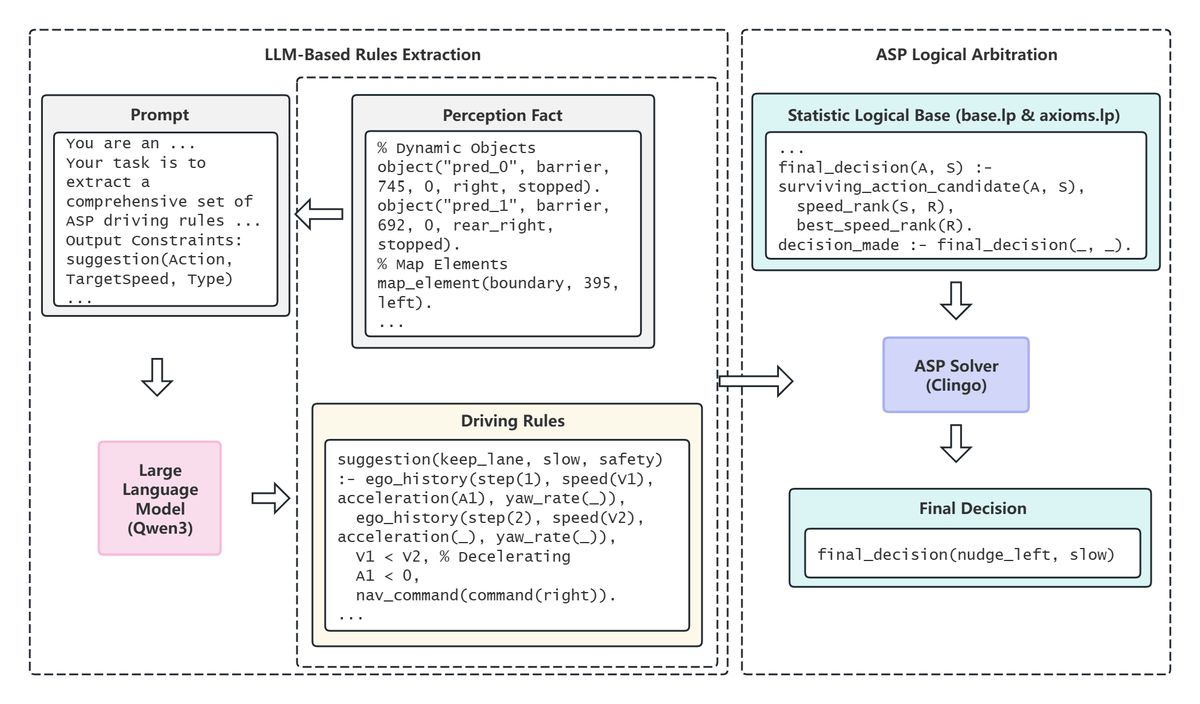
The proposed architecture runs an inductive neural stream and a deductive symbolic stream in parallel, then fuses them inside the trajectory decoder. There are three modules:
- Perception Fact Extraction: A sparse perception backbone (built on SparseDrive with a ResNet-50 encoder) produces 3D objects, map topology, and ego state, then serializes them into ASP predicates like
object(id, category, distance, speed, heading, relative_pos, attribute, ttc). - Dynamic Deductive Reasoning Engine: A large language model reads those facts and writes scene-specific logic rules. A Clingo solver then arbitrates between them.
- Decision-Conditioned Physical Residual Planner: The discrete decision from the solver conditions a differentiable Kinematic Bicycle Model, which produces the actual continuous trajectory.

How the logic layer actually works
The deductive engine is the interesting part. Rather than hand-coding an exhaustive rule base, the authors use an LLM (they employ Qwen in their experiments) as a scene-adaptive rule extractor. Given the ASP facts for the current frame, the model emits 3 to 6 candidate logic suggestions in a fixed predicate format: suggestion(Action, TargetSpeed, Type).
To keep the LLM from drifting into free-form text, its output vocabulary is bounded to a small mutually exclusive space:
- 9 actions: keep_lane, change_lane_left, change_lane_right, turn_left, turn_right, nudge_left, nudge_right, yield, emergency_stop
- 6 target speed levels: current, zero, creep, slow, normal, fast
- 3 navigation modes: left, right, straight
That gives a compact 9 x 6 x 3 discrete decision space. Those candidate rules go into Clingo, an Answer Set Programming solver, along with predefined safety axioms. A five-level priority hierarchy resolves conflicts, with emergency avoidance at the top and efficiency goals at the bottom. The solver outputs one deterministic decision per frame: final_decision(Action, Speed). Crucially, this hierarchy is not a learned hyperparameter; it is a rigid formal encoding of the principle that safety beats efficiency.
Bridging symbols and steering angles
Turning a symbol like (yield, zero) into an actual trajectory is where most neuro-symbolic ideas fall apart. The authors solve this with two mechanisms.
The first is dual-path decision embedding. The discrete action and speed are mapped into a high-dimensional decision vector, which then modulates the planning query (shaping the trajectory geometry) and biases the initial velocity fed into the physics model (shaping the speed profile).
The second is a differentiable Kinematic Bicycle Model integrated with second-order Runge-Kutta. Given predicted acceleration and steering angle, it produces a physically consistent baseline trajectory. A neural residual, bounded by a tanh, is then added on top:
tau_final = tau_physics + lambda * tanh(tau_residual)An anisotropic residual loss penalizes lateral (X-axis) deviations ten times more than longitudinal ones, which suppresses unphysical sideslip in the corrections. Because the KBM is differentiable, gradients flow through the physics into the rest of the network.
The nuScenes numbers
Evaluation follows the standard nuScenes open-loop protocol, comparing against UniAD, VAD, SparseDrive, and the current state-of-the-art baseline MomAD, which recently introduced momentum planning that integrates historical planning guidance to improve trajectory consistency and stability. All camera-only methods use ResNet-50 backbones for fairness.
| Method | L2 Avg (m) | Collision (%) | TPC (m) |
|---|---|---|---|
| SparseDrive | 0.61 | 0.08 | 0.57 |
| MomAD | 0.60 | 0.09 | 0.54 |
| Neuro-Symbolic (this work) | 0.57 | 0.075 | 0.47 |
The gains are largest in the short horizon, where the immediate logical decision matters most: L2 error at 1 second drops 12.9%, versus only 1.1% at 3 seconds. That aligns with the semantic scope of the ASP engine, which infers immediate action intent rather than long-term geometry.
The ablation is telling. Adding the KBM alone actually raises collision rate from 0.09% to 0.11%, even though L2 and TPC improve. The physics module makes trajectories smoother but does not make them safer. Only when the ASP deductive path is added does collision drop to 0.075%, a 31.8% reduction from the KBM-only variant. In other words, the logic engine is doing genuine safety work, not just decorating an already-good planner.
Traceable decisions, real-time caveats
The interpretability payoff shows up in a pedestrian yielding case study. When time-to-collision drops to 890 ms, the ASP engine triggers the safe-following axiom, arbitrates a (yield, zero) decision, embeds a roughly -2 m/s velocity bias, and the KBM integrates it into a deceleration trajectory. Every step is logged and auditable. A conventional planner might also decelerate here, but nothing in its output tells you it did so because of the TTC.
The obvious catch is latency. The LLM rule extraction takes about one second per frame, which is nowhere near real-time. The authors propose an asynchronous dual-rate scheme where the LLM runs at low frequency to extract macroscopic rules while Clingo executes frame-by-frame arbitration in under 5 ms. For the benchmark, they precompute ASP decisions offline and index them by sample token.
Where this sits, and what is missing
The paper is under review and does not currently include a public code release. It is worth reading if you work on planning, safety cases, or any embodied system where a downstream regulator or safety engineer will eventually ask you to explain a decision. The framework is also a reasonable template for other neuro-symbolic tasks that need continuous control from discrete logic.
Two limitations are worth flagging. First, nuScenes uses open-loop log replay, which the authors acknowledge underestimates closed-loop collision risk. Their future work targets 6-second horizons and CARLA-style closed-loop evaluation. Second, the LLM sits outside the training loop, so distilling the symbolic chain into a lightweight network is still open. For teams already invested in end-to-end planners, the interesting question is whether embedding a small ASP solver into a decoder is cheaper than continuing to scale data coverage for long-tail scenarios. This paper offers the first quantitative evidence that it might be.