
Claude Code Beat 11 Peer-Reviewed Algorithms in a Single Workday
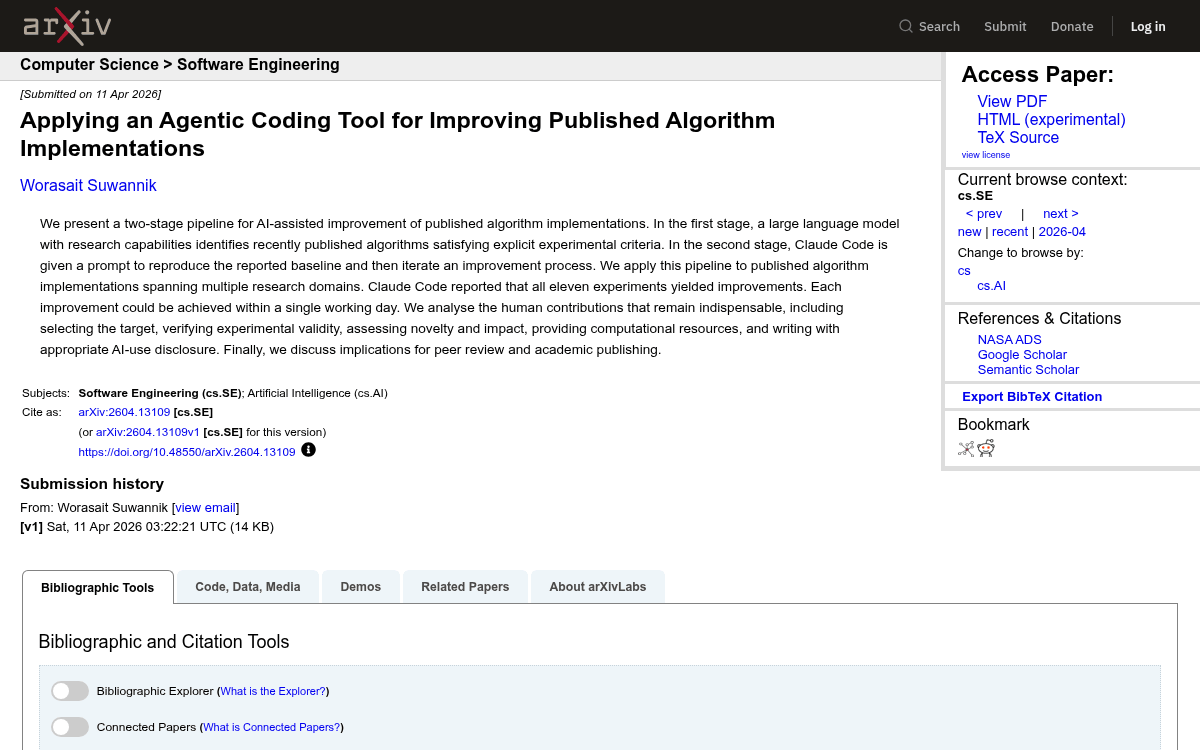
A two-stage pipeline paired Deep Research with Claude Code to beat published baselines across eleven algorithm papers, each within one working day.
 Pro
Takeaways
- A two-stage pipeline using Deep Research plus Claude Code improved 11 of 11 published algorithms.
- Every improvement was achieved within a single working day of researcher time.
- Wins included 193x, 1000x and 34x speedups across optimization, segmentation and bioinformatics.
- A one-paragraph prompt drove up to 20 hypothesis-logged iterations per experiment.
- Results are unaudited; the author calls them preliminary and requiring replication.
- Human role shifts to target selection, novelty checks, and verifying that gains are real.
A single-author study just ran an audacious experiment: point an agentic coding tool at recently published, peer-reviewed algorithms and ask it to beat them. Across eleven papers spanning combinatorial optimization, image segmentation, bioinformatics, molecular simulation and more, Claude Code reported an improvement every single time, and each one landed within a working day of effort.
The paper reads less like a benchmark and more like a field report on what agentic coding can and cannot do when turned loose on real research code. The results are striking, and so is the honest accounting of where humans still had to intervene.
Two moves, one afternoon
The setup is a two-stage pipeline for AI-assisted improvement of published algorithm implementations. The idea trades on a fact that has quietly become true across ML and systems research: papers ship with runnable code and public datasets, which is exactly the substrate an agent needs.
Stage one is discovery. A commercial LLM with deep-search capabilities is prompted to identify recent, well-scoped papers satisfying explicit experimental criteria covering recency, journal tier, code availability, and execution time. The author used ChatGPT Deep Research to hunt for papers with a GitHub repo, downloadable datasets, sub-30-second runtimes on at least two datasets, and publication in a Q1 or Q2 journal after 2021. The recency filter is deliberate: it reduces the chance that improvement recipes for the exact paper are already sitting in the model's training data.
Stage two is improvement. The target PDF is dropped into a Claude Code working folder (Sonnet 4.6, with Opus 4.6 as a fallback when rate limits hit), and the agent gets a one-paragraph prompt telling it to: