
CLARE Beats Space Weather's Best Model by 5x on GPS Accuracy
A team from CU Boulder and JAXA turned a continuous regression problem into a 150-bin classification task, boosting plasmasphere temperature accuracy from 13% to nearly 70%.
 Pro
Takeaways
- CLARE is the first ML model for plasmasphere electron temperature between 1,000 and 8,000 km altitude.
- It hits 69.67% accuracy within 10% tolerance versus 13.49% for the Titheridge-IRI baseline.
- Reframes regression as 150-bin classification, gaining 6.46% accuracy and free uncertainty estimates.
- 84M parameter 6-layer feedforward network trained on AKEBONO satellite data plus NASA OMNI indices.
- Storm-time accuracy drops to 46.17% because storms are only 0.74% of training data.
- Code available at github.com/blakedehaas/clare.
Space weather forecasting has a blind spot roughly 1,000 to 8,000 kilometers above your head. That region, the plasmasphere, is where a lot of satellites live and where electron temperature drives dynamics that ripple down into GPS accuracy and communication reliability. A new paper introduces CLARE, a neural network that predicts plasmaspheric electron temperature with a trick borrowed from reinforcement learning: turn the continuous regression problem into a discrete classification problem.
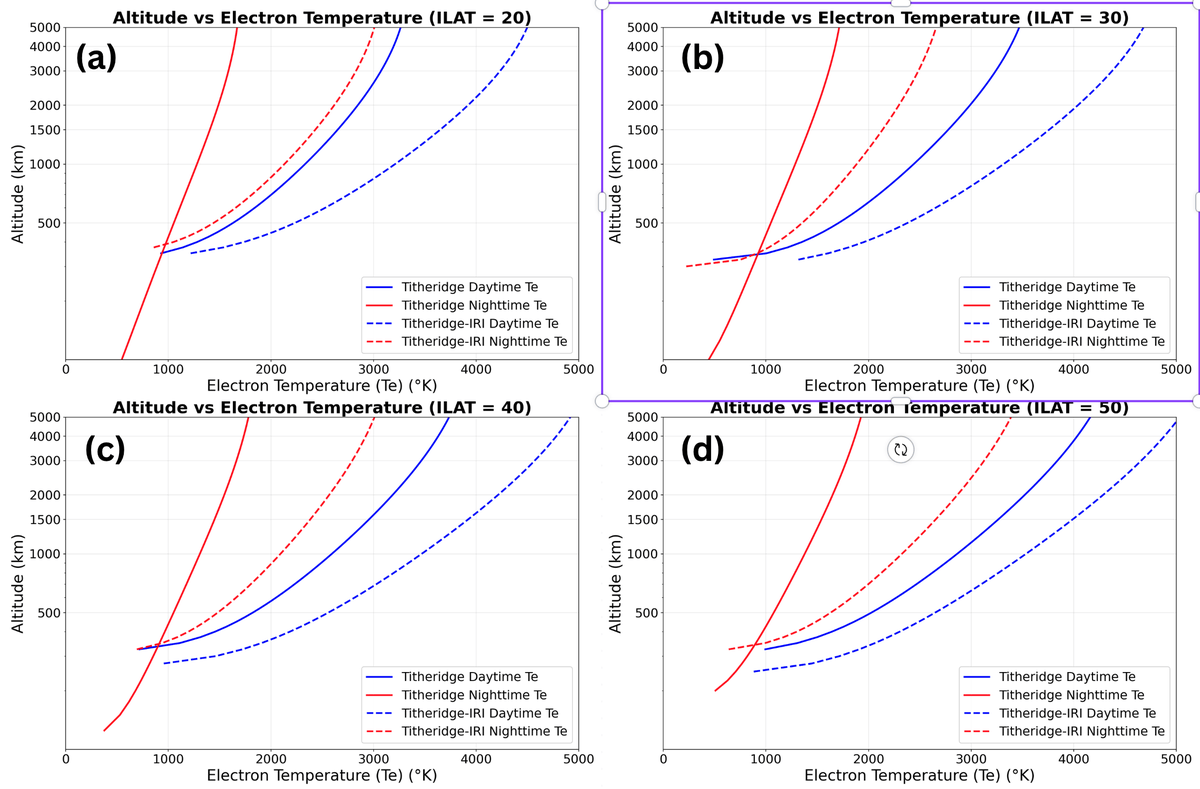
The result is a jump in accuracy that is hard to ignore. CLARE achieves 69.67% accuracy within 10% tolerance on quiet solar activity periods, compared to 13.49% for the best baseline, the Titheridge-IRI empirical model that has been the field's workhorse for years.
Why plasmasphere data is a machine learning desert
Electron temperature is an important parameter governing space weather in the upper atmosphere, but has historically been underexplored in the space weather machine learning literature. The reason is mundane but stubborn: data scarcity. Most ML work in space physics has focused on electron density in the ionosphere below 1,000 km, where low Earth orbit satellites and ground instruments produce plenty of measurements. The plasmasphere above that is thinly sampled, and a dedicated ML model leveraging satellite measurements for predicting electron temperature specifically within the plasmasphere has been missing.
Traditional approaches lean on physics-based empirical models like Titheridge (1998) and the International Reference Ionosphere (IRI-2020). They encode decades of domain knowledge, but they are also computationally heavy and struggle to capture the messy interplay of drivers during geomagnetic storms.
The classification trick
Temperature is a continuous quantity, so the obvious framing is regression with a single scalar output. CLARE does the opposite. It discretizes the continuous Te range into a set of 150 bins, predicting a probability distribution over these bins, then outputs the center value of the most probable bin. Concretely, each of the 150 output neurons predicts the probability that the true temperature falls in a 100 K interval between 0 and 15,000 K, trained with cross-entropy loss.

Under the hood, CLARE is an 84 million parameter 6-layer feedforward network with an initial hidden size of 2048, expanding to 8192 before projecting down to 150 neurons. Each block is a linear layer followed by LayerNorm, ReLU, and Dropout. Training took 90 minutes on a single V100.
Two things fall out of this design for free:
- Better accuracy. The binned objective beats an otherwise identical scalar-output model by 6.46% relative on the quiet test set, likely because binning reduces sensitivity to outliers in noisy satellite measurements.
- Built-in uncertainty. The softmax over bins gives you a probability distribution. Sharp peaks mean high confidence; flat, multi-peaked distributions mean the model is guessing. No separate Bayesian machinery required.
Data and training setup
The training data pulls from the Japanese AKEBONO satellite's thermal electron distribution instrument, using data between 1000 km and 8000 km in altitude during a 10-year period from January 1st 1990 to January 1st 2001. Inputs combine spatial features (L-shell, magnetic latitude, magnetic local time) with solar and geomagnetic indices from NASA OMNI: SYM-H, AL, F10.7, and Kp.
Evaluation splits into two held-out sets: a random 50,000-sample quiet period, and a full geomagnetic storm from January 30 to February 7, 1991, kept completely out of training.
Results and where it breaks

On the storm data, CLARE lands at 46.17% accuracy despite storm conditions comprising only 0.74% of the training data. That is a real limitation worth flagging. The model tends to predict smooth distributions biased towards the mean without fully capturing the complexity of short-term variations during storms, because it has seen so few of them.
A feature ablation exposes an interesting wrinkle. Training only on solar features degrades quiet-period accuracy by about 4%, while training only on spatial features degrades it by 16%. But on the storm set, CLARE-spatial (trained only on spatial features) has the best overall accuracy on the chaotic storm test set which suggests that the solar storm prediction task is highly correlated with the state of the spacecraft as opposed to the solar environment in general. That is a counterintuitive finding worth follow-up work.
What is actually new here
Two things. First, this is the first neural network specifically targeted at electron temperature in the plasmasphere, filling a real gap between ionospheric ML models and the higher-altitude region where physics-based models dominate. Second, the classification-based regression pattern is a clean, general-purpose recipe that gives you uncertainty quantification without bolting on Bayesian layers or ensembles. If you have a continuous target, a noisy training set, and you care about calibrated confidence, discretizing into bins is a surprisingly effective move.
The code is available on GitHub, AKEBONO data lives at JAXA DARTS, and the solar indices come from NASA OMNI. Everything used to reproduce the paper is public, which is the other quiet contribution: showing that high-accuracy plasmasphere models are achievable without proprietary data.