
CityU's DROCO Makes Robot Policies 14% Stronger Against Real-World Wear
DROCO introduces a novel Bellman operator that makes offline RL policies robust to both training-time domain gaps and real-world deployment perturbations simultaneously
 Pro
Takeaways
- Dual robustness gap: Prior cross-domain offline RL methods only handled training-time domain gaps; DROCO is the first to also handle test-time deployment perturbations.
- Fragility exposed: Existing methods like IGDF degrade 72.4% under hard kinematic perturbations; with only 10% target data, the collapse is even worse.
- Core innovation: The Robust Cross-Domain Bellman (RCB) operator applies worst-case state perturbations to source domain data while using standard updates on target data, achieving both robustness goals simultaneously.
- Strong results: DROCO scores 1105.2 total normalized score across 16 D4RL tasks, outperforming the next-best baseline (OTDF at 969.8) by 14%, while also showing far less degradation under adversarial attacks.
- Practical algorithm: DROCO adds an ensemble dynamics model, a dynamic value penalty coefficient, and Huber loss for Bellman updates on top of IQL -- all tunable with clear heuristics.
- Open source: Code is available on GitHub; accepted at ICLR 2026.
Training a robot policy offline is already hard. Training it on data from a slightly different robot, then deploying it on hardware that has worn down since the data was collected? That is a compounding robustness problem that most offline RL research has quietly ignored. A new paper from researchers at CityU Hong Kong, UIUC, Tsinghua, and Yale tackles exactly this gap with DROCO (Dual-Robust Cross-Domain Offline RL), a framework that simultaneously handles both the training-time mismatch between data sources and the test-time perturbations that happen in the real world.
The two-sided robustness problem nobody was solving
Offline RL trains policies from fixed datasets, with no further environment interaction. When your real-world data is scarce, cross-domain offline RL is a natural fix: borrow data from a related but slightly different domain (say, a simulator or a robot with different joint limits) and use both datasets together. The catch is a dynamics shift -- the borrowed source domain data was generated under different physics than your target environment.
Prior work like IGDF and OTDF focused on train-time robustness: filtering or reweighting source data so the policy does not overfit to the wrong dynamics. But they assumed the target environment at deployment time would behave exactly like the target domain dataset. In practice, that assumption breaks constantly:
- Robot joints degrade and stiffen over time
- Payload changes shift the effective mass distribution
- Sim-to-real gaps compound with hardware wear
- Adversarial or environmental perturbations alter transition dynamics
Existing studies primarily focus on train-time robustness, neglecting the test-time robustness against dynamics perturbations when deployed in practical scenarios. DROCO is the first framework to address both simultaneously in the cross-domain offline setting.
How fragile is the status quo?
The authors ran a revealing diagnostic before proposing any solution. They trained a strong cross-domain baseline (IGDF) on MuJoCo's hopper task, then evaluated it under progressively harder kinematic perturbations at deployment time.
The policy demonstrates vulnerability to intense dynamics shifts, with performance degradation of 40.9% at medium perturbation level and 72.4% at hard level compared to the clean environment. When the target domain dataset was reduced to just 10% of its original size (a realistic scenario when real-robot data is expensive), the fragility got significantly worse across all perturbation levels.
The authors attribute this phenomenon to the discrepancy between the true dynamics and the observed dynamics in the target domain dataset, whose magnitude inversely correlates with the dataset size. In other words, the less real-world data you have, the more the policy overfits to the dataset's specific physics, and the more brittle it becomes at deployment.
The Robust Cross-Domain Bellman Operator
The core innovation is the Robust Cross-Domain Bellman (RCB) operator, a modified version of the standard Bellman backup used in Q-learning. The standard Bellman operator computes expected future value by rolling forward through the transition dynamics. The RCB operator applies a different rule depending on which dataset a transition came from:
- Target domain data: use the standard in-sample Bellman update to maximize performance on the known target environment
- Source domain data: apply a worst-case (infimum) Bellman update over a neighborhood of perturbed next states, forcing the Q-function to be conservative about source-domain transitions
The key theoretical result is that this asymmetric treatment achieves both robustness goals at once. The conservatism on source data prevents Q-value overestimation from out-of-distribution dynamics (train-time robustness), while the worst-case evaluation over perturbed states means the learned policy is guaranteed to perform at least as well under bounded deployment perturbations as the worst-case scenario it was trained against (test-time robustness).
A critical practical challenge: the worst-case update requires knowing the dynamics uncertainty set -- all possible next states within some distance of the source domain's next state. This set is not directly observable. The authors solve this with a dual reformulation that converts the intractable dynamics perturbation into a tractable state perturbation: instead of perturbing the transition kernel, you perturb the next state within a ball of radius epsilon. Since next states are observed in the dataset, this is computable.
From theory to DROCO
The practical algorithm, DROCO, implements the RCB operator with two additional stabilization techniques that address value estimation errors introduced by the worst-case operator:
- Ensemble dynamics model: Rather than fixing a hard epsilon radius for the state uncertainty set, DROCO trains an ensemble of N neural network dynamics models on the target domain data. The ensemble's spread of predictions naturally defines the uncertainty set -- each member predicts a plausible next state, and the infimum is taken over these N predictions. This avoids unnecessary conservatism when source and target domains are far apart.
- Dynamic value penalty: A tunable coefficient beta controls how aggressively the worst-case backup penalizes source domain Q-values. Setting beta above 1.0 suppresses overestimation; below 1.0 alleviates underestimation from the infimum operator. The paper finds that beta less than or equal to 1.0 works for most tasks, suggesting underestimation is the more common failure mode.
- Huber loss for Bellman updates: The standard squared-error (L2) loss for Q-function training is replaced with Huber loss on source domain data. When the Q-error exceeds a threshold delta, the loss transitions from L2 to L1, making the update robust to the outlier Bellman targets that the worst-case operator can produce.
The full training loop looks like this in pseudocode:
# DROCO core loop (simplified)
# 1. Pre-train ensemble dynamics on target data
for i in range(N_ensemble):
    model[i].train(D_target)  # MLE on target transitions
# 2. For each gradient step:
for step in range(1_000_000):
    # Compute value penalty for source transitions
    V_src = V(s_next_src)
    V_worst = min(V(model[i].predict(s, a)) for i in range(N))
    u = V_src - V_worst  # penalty term
    # Bellman target: standard for target data, penalized for source
    target_tar = r + gamma * V(s_next_tar)
    target_src = r + gamma * (V(s_next_src) - beta * u)
    # Q loss: L2 for target, Huber for source
    loss = L2(Q(s,a) - target_tar, D_target)
           + Huber(Q(s,a) - target_src, D_source, delta=delta)
    # Policy extraction via advantage-weighted regression (IQL)
    A = Q(s, a) - V(s)
    policy_loss = -E[exp(A) * log_pi(a|s)]
Benchmarks and results
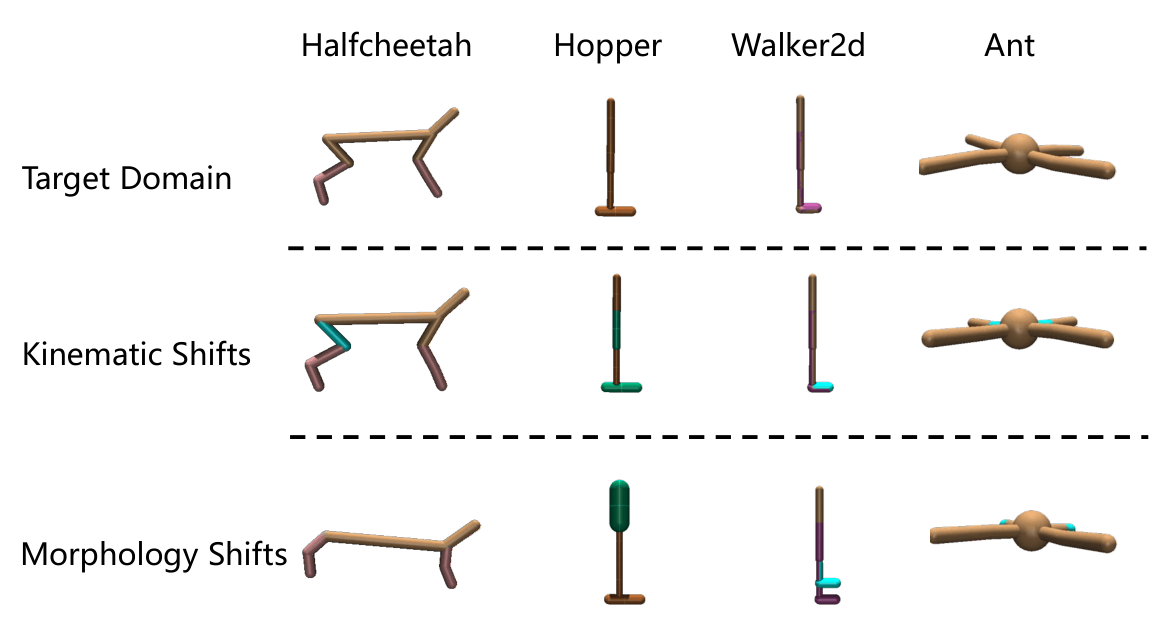
Experiments use the standard D4RL benchmark with MuJoCo locomotion tasks (HalfCheetah, Hopper, Walker2d, Ant). The setup introduces two types of source domain dynamics shifts:
- Kinematic shifts: joint rotation ranges are physically constrained (e.g., a hopper with a broken foot joint)
- Morphology shifts: robot body proportions are modified (e.g., shorter legs, different torso size)
Each task uses four dataset quality levels (medium, medium-replay, medium-expert, expert), with only 10% of the D4RL data used as the target domain dataset to simulate the scarce real-data regime. Baselines include IQL*, CQL*, BOSA, DARA, IGDF, and OTDF.
Train-time robustness (clean evaluation): DROCO achieves superior performance in 9 out of 16 tasks, outperforming all 6 baselines. In terms of the total normalized score, DROCO achieves a remarkable 1105.2, significantly surpassing the second-best method OTDF (969.8) by 14.0%. Under morphology shifts, the gap widens further: DROCO scores 1166.4 versus OTDF's 1025.1.
Test-time robustness (perturbed evaluation): This is where DROCO's unique contribution shows most clearly. Three perturbation types were tested: kinematic, morphology, and adversarial min-Q attacks (which find the worst-case next state for the Q-function). Under easy-level kinematic shifts, DROCO shows only a 19.3% performance degradation, whereas both IGDF and OTDF suffer over 50% performance deterioration. Under the hardest adversarial attack at scale 0.2, DROCO degrades by 37.9% versus 73.6% for OTDF and 84.0% for IGDF.
Limitations worth knowing
DROCO is not a universal solution. A few practical constraints:
- Morphology perturbations hurt more than kinematic ones. DROCO displays greater sensitivity to morphological perturbations than to kinematic perturbations, with a 42.1% performance decrease under easy-level morphological variations. The authors attribute this to the absence of morphology shifts in the source domain data, rendering the policy less adaptable to this unseen perturbation type.
- Hyperparameter sensitivity. The penalty coefficient beta and Huber threshold delta need per-task tuning. The paper provides heuristics (beta at or below 1.0, delta around 30-50), but optimal values vary.
- Antmaze and Adroit remain unsolved. Cross-domain RL on navigation tasks with structural barriers or dexterous manipulation remains an open problem that DROCO does not address.
- Assumes shared state-action spaces. Source and target domains must have the same observation and action dimensions, though the authors note extensions via domain mapping are possible.
What this unlocks
The practical value of DROCO is clearest in sim-to-real transfer pipelines. An RL policy for robotics manipulation is trained on data collected from a real robot (target domain data) and an imperfect simulator (source domain data). When the policy is deployed on the real robot, the robot's physical components may degrade over time, causing the transition dynamics to deviate from that observed in the target domain dataset. DROCO is specifically designed for this failure mode.
More broadly, any setting where you have abundant data from a related but imperfect source (a different hardware generation, a physics simulator, a different lab's dataset) and limited data from your actual deployment target is a candidate for this approach. The dual robustness guarantee means you get both better use of the source data and a policy that degrades more gracefully when the real world surprises you. Code is available at https://github.com/zg2r/DROCO.git.