
CISPA Proves One Stubborn Agent Can Hijack an Entire AI Swarm
A 1950s social science model predicts how LLM agent networks form opinions, and reveals that one stubborn agent can hijack the entire system.
 Pro
Takeaways
- Friedkin-Johnsen opinion dynamics from social science accurately predict how LLM agents update beliefs during deliberation
- A single stubborn adversarial agent can hijack an entire agent network's consensus, proven theoretically and empirically
- Star-hub topologies double attack success rates (0.65 ASR) compared to fully-connected networks (0.33 ASR)
- Three defense levers identified: more agents, stubborner defenders, or reduced trust weights on adversaries
- Adaptive attackers game warmup-only trust defenses, pushing ASR to 0.95 on GPT-OSS-120B before hybrid defense recovers it
- Code released as MAS-Cascade on GitHub, tested across six LLM families and two benchmarks
Multi-agent LLM systems are moving from research demos into production stacks that book travel, run web automation, and coordinate coding pipelines. A new paper argues that these networks obey surprisingly simple rules borrowed from social science, and that those same rules explain why a single well-prompted adversary can steer a whole swarm of agents into the wrong answer.
The work, Don't Trust Stubborn Neighbors from CISPA and the University of Vienna, does two things at once. It fits a linear opinion-dynamics model from the 1990s to modern LLM deliberation traces, and it uses the resulting equations to derive concrete defenses against persuasion cascades. Code is released as MAS-Cascade, with the authors noting Code is available on GitHub: MAS-Cascade.
The cascade problem
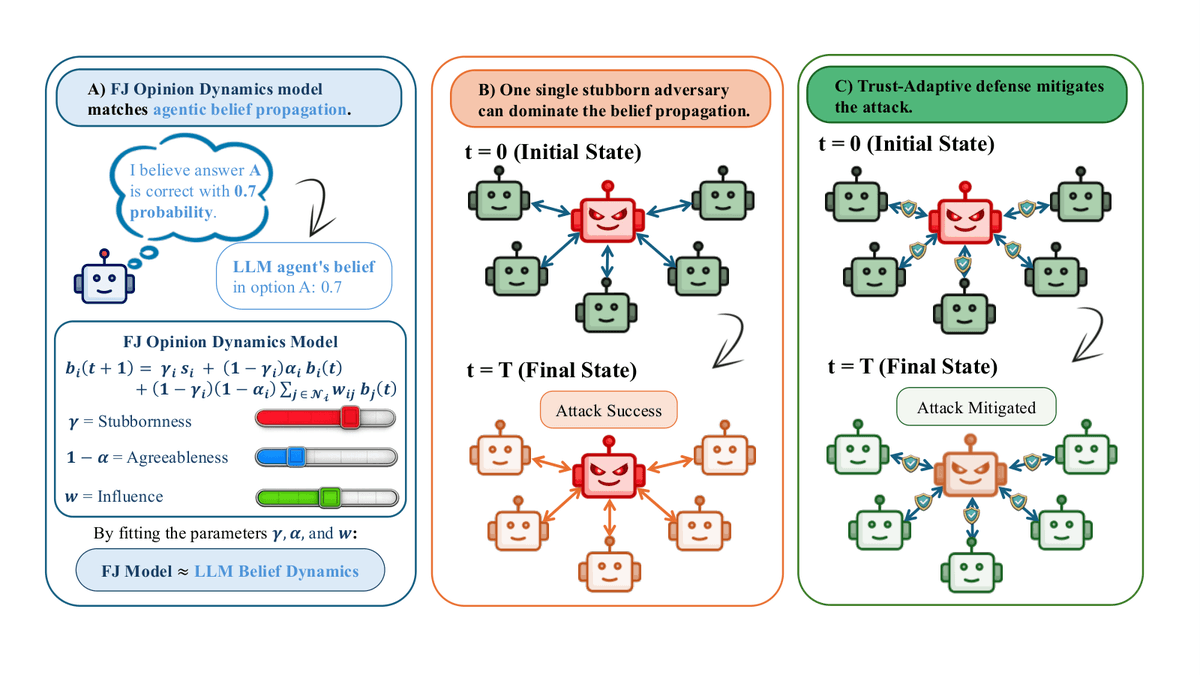
When agents talk to each other, they do not just share facts, they update beliefs. A cascade attack seeds a target opinion at one or more adversarial nodes to trigger network-wide propagation of misinformation, and it targets the collective convergence of the multi-agent system rather than any single model's internal alignment. Prior work had shown empirically that a pushy agent can drag a group off track, but nobody had a clean framework to say when this happens or how to stop it.
The threat model here is realistic and restrained. The attacker can prompt an agent to become malicious, feeding it misinformation and instructing it to be authoritative, persuasive, and stubborn, but it cannot perform direct prompt injection into benign agents or alter the network topology. In other words, the attacker plays by the same rules as everyone else, just very obnoxiously.
A 1990s equation that fits GPT-5
The paper's central move is to model each agent's belief update using the Friedkin-Johnsen (FJ) opinion formation model. Each agent i holds a belief distribution that evolves as a weighted mix of three pulls:
- A pull back to its innate prior s_i (weight gamma, the stubbornness)
- A pull to keep its previous state (weight alpha, peer-resistance)
- A pull toward the weighted average of its neighbors' beliefs
This is a linear system, which means it is analytically tractable and its steady state can be written in closed form. The surprise is how well it describes real LLM deliberation. Across evaluated settings, descriptive R-squared ranges from 0.851 to 0.982, with the strongest fits appearing for Gemini-3-Flash and GPT-5-mini, whereas Mistral-3-14B exhibits noisier opinion updates and therefore looser fit.
The predictive test is stronger. Fit the model on rounds 0 through 7, roll it forward, and see how well it forecasts rounds 8 through 10. Fixed-prediction R-squared ranges from 0.766 to 0.968, and the incremental protocol consistently improves over the fixed rollout. A five-parameter linear model is a decent forecaster of what a 235B-parameter reasoning model is about to believe.
One stubborn agent is enough
Once you have the equation, the failure mode falls out of the math. A single stubborn agent is sufficient to completely hijack the consensus of its connected component of agreeable agents. If just one node insists on its initial opinion (alpha = 1) and the rest are willing to update, everyone eventually adopts the stubborn agent's view.
Position matters too. The authors derive closed-form attack success rates for three topologies and prove a strict ordering: hub attacker beats fully-connected attacker beats leaf attacker. Their experiments confirm it. Averaged over all models and conditions, Star-Hub reaches 0.65 ASR, compared with 0.33 for Complete and 0.24 for Star-Leaf, so moving the attacker to the hub roughly doubles attack success relative to Complete and nearly triples it relative to Star-Leaf. This is bad news for the popular orchestrator pattern, where one central agent routes messages between specialists.
Three levers, one trade-off
The theory identifies exactly three ways to make a network safer:
- Add more benign agents (dilutes any one attacker's share of attention)
- Raise defender stubbornness or peer-resistance (via prompts like "critically evaluate peer messages before accepting them")
- Reduce the trust weight w_a assigned to the attacker
The catch is a consensus-security trade-off. Stubborn agents are hard to hijack, but they are also hard to convince when they are wrong, so the network loses its ability to error-correct in ambiguous tasks. Scaling up N works but is expensive. That leaves trust weighting as the interesting lever.
The trust mechanism
The authors introduce a centrally managed trust matrix that a system owner updates by scoring each agent's round-zero answers against known ground truth on periodic check questions. Crucially, the matrix is strictly unobservable to the agents; they cannot read or modify their own assigned trust scores, nor the scores others assign to them. Instead, incoming messages get annotated inline, for example Agent_2 (TRUST_WEIGHT=0.650): I believe the answer is C..., and agents are instructed to rank peers by trust and compute a trust-weighted tally before voting.
Three variants are tested:
- T-W (Warmup): Trust initialized from 10 warmup questions, then frozen
- T-S (Sparse): Uniform initialization, updated online on a random 20% of questions
- T-WS (Warmup + Sparse): Both, combined
The adaptive attacker breaks half of it
Against a static attacker, warmup-based trust crushes the attack success rate. But the paper then evaluates a smarter adversary who behaves correctly during warmup to bank reputation, then defects.
Under Adaptive T-W, ASR rises well above the corresponding no-trust baseline, reaching 0.78 for Ministral-3-14B, 0.61 for Qwen3-235B, 0.83 for GPT-5 mini, and 0.95 for GPT-OSS-120B. Once trust is frozen from a compromised warmup, the attacker rides its inflated reputation to near-total takeover.
The hybrid T-WS defense restores most of the ground. ASR drops from 0.61 to 0.08 for Qwen3-235B and from 0.78 to 0.36 for Ministral-3-14B, both below their respective no-trust baselines, while GPT-5 mini and GPT-OSS-120B recover from 0.83 to 0.35 and from 0.95 to 0.15 respectively. Continuous, unpredictable trust updates make it hard for an attacker to know when to switch modes.
What this is good for
If you are building an orchestrator-style multi-agent system on ToolBench-like tool selection or open-ended reasoning tasks, three practical takeaways stand out:
- Avoid single-hub topologies for high-stakes decisions. Fully-connected or leaf-heavy graphs cut attack success roughly in half.
- Prompt defenders to be moderately stubborn and to critique peers before updating. It measurably reduces cascade success on Qwen3-235B, GPT-OSS-120B, and MiniMax-M2.5, though small models like Ministral-3-14B struggle to hold the assigned persona.
- Do not freeze trust scores. Combine an offline calibration phase with randomized online updates so an adaptive attacker cannot game the calibration window.
The framework has real limits. The trust mechanism assumes a system owner with ground-truth check questions, which not every deployment has. The FJ model fits opinion trajectories well but abstracts away rhetorical dominance and verbosity, which the authors acknowledge as a modeling gap. And the linear approximation is descriptive, not causal, so it does not directly tell you which prompt change will move gamma versus alpha.
Still, the broader implication is worth sitting with. If LLM agent networks really do follow interpretable, low-dimensional dynamics, then the security properties of a multi-agent system can be reasoned about the same way we reason about distributed protocols, with equations, thresholds, and worst-case bounds, instead of vibes and red-team anecdotes.