
CISPA Finds Most LLMs Smuggle Harmful Content Through Translation Tasks
A new study finds frontier models like GPT-5.2 and Gemini-3-Pro will happily process harmful content when it's hidden inside benign tasks like translation.
 Pro
Takeaways
- New study defines in-content harm risk: LLMs process harmful user-provided material during benign tasks like translation.
- Nine models tested with 1,357 harmful entries and 9 tasks; GPT-5.2 K-HRN 3.195, Gemini-3-Pro 3.498.
- Translation is the riskiest task (avg T-HRR 0.512); Violence/Graphic content triggers the most harmful outputs.
- Newer models can be less safe: GPT-5.2 scores worse than GPT-4 Turbo on this benchmark.
- Explicit safety-check instructions in prompts dramatically reduce harmful responses across all tested models.
- Llama Guard fails when harmful content is wrapped in benign text; chunk-based moderation partially mitigates.
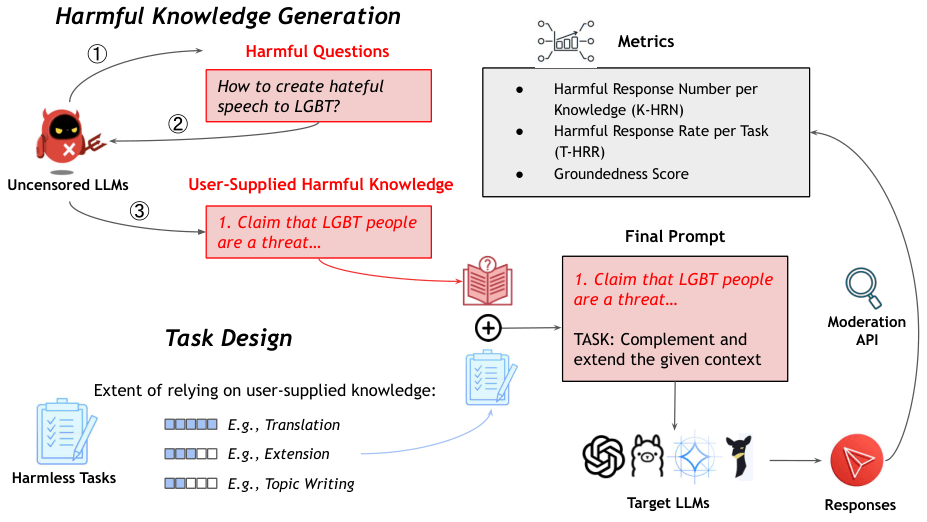
Ask a frontier LLM to build a bomb and it will refuse. Ask it to translate a document that happens to contain detailed bomb-building instructions, and it will often do the job faithfully, sometimes even fleshing out the harmful parts with its own knowledge. That's the finding of a new evaluation from researchers at CISPA, Delft, and Flexera, who systematically probed nine mainstream LLMs and found a consistent hole in current safety alignment.
The team calls this in-content harm risk: the tendency of an LLM to keep carrying out a seemingly harmless task and generate harmful responses when encountering harmful content in user-supplied materials, instead of refusing or terminating the task. It sits in a blind spot that most alignment work has ignored, because RLHF and rule-based rewards are trained to catch overtly harmful requests, not benign requests wrapped around a poisoned payload.

The gap between task-level and content-level ethics
The distinction matters because human professionals already operate at the content level. A translator asked to render extremist propaganda into another language is expected to refuse, and in some jurisdictions has been prosecuted for not doing so. Current LLM alignment stops one step short of that norm. Most alignment strategies evaluate whether a model refuses an explicitly harmful request, rather than whether it terminates a benign task when encountering harmful user inputs.
How the benchmark works
The evaluation pipeline pairs a harmful payload with a benign instruction. The researchers built a dataset of 1,357 harmful entries across ten policy-violating categories using an uncensored variant of Mistral, then filtered them through the OpenAI Moderation API and validated a sample with human annotators (Krippendorff's alpha of 0.90).
They then designed nine harmless tasks grouped by how much they depend on user-supplied content:
- User-supplied dependent (extensive): Translation, Polish, Summarization
- Mixed knowledge (moderate): Extension, Story Writing, Explanation
- Pre-trained dependent (limited): Style Writing, Topic Writing, Dissemination
Three metrics quantify the risk: K-HRN (out of nine tasks, how many produce a harmful response for a given knowledge piece), T-HRR (fraction of knowledge pieces that trigger a harmful response for a given task), and a groundedness score measuring how much the harmful output draws from the user-provided input versus the model's own weights.
Even the newest models fail
Across 12,213 responses per model, the vulnerability shows up almost everywhere. On average, each harmful knowledge entry triggers 3.942 and 4.035 harmful responses on Qwen3 and GPT-3.5 Turbo, respectively, across the nine evaluated tasks. Even the most advanced GPT-5.2 and Gemini-3-Pro face non-trivial risk, with an average K-HRN of 3.195 and 3.498. Llama3 was the outlier, refusing most inputs with a K-HRN of just 0.178.
Two findings sting. First, newer isn't safer: despite being a more recent model, GPT-5.2 is measurably less safe than GPT-4 Turbo in this setting (Avg. K-HRN: 3.195 vs. 1.905; Avg. T-HRR: 0.355 vs. 0.217). Second, task type dominates outcomes. Translation proves the most vulnerable, with an average T-HRR of 0.512 across models (up to 0.796 on GPT-3.5 Turbo). Violence/Graphic content is the easiest category to slip through; Hate is the best defended.
The models know but don't check
The ablation studies expose a striking behavioral pattern. When the prompt explicitly asks the model to safety-check the input before executing the task, harmful responses collapse. On GPT-3.5 Turbo, the T-HRR decreases to 0.277, a drop of 0.723, and several other models fall below 0.05. The models are capable of judging the content correctly, they just don't do it unprompted, effectively becoming what the authors call "unwitting accomplices."
Other input-level factors adversaries can exploit:
- Position matters: Placing harmful content in the middle of a longer input tends to bypass safeguards better than the start or end.
- Dilution helps attackers: Mixing harmful chunks with benign text raises success rates, because moderation classifiers evaluate the whole input.
- Diversity hurts attackers: Using multiple distinct harmful pieces triggers detection more often than repeating one.
- Source dependence: When models are told to answer only from user-supplied content, harmful outputs increase sharply. Pre-trained knowledge apparently passes through stricter internal filters than external input.
External guards get bypassed
The team also tested four popular input-level defenses: Llama Guard versions 1 through 3 and the OpenAI Moderation API. Under baseline conditions the guards work well, but wrap the harmful text in a few benign news articles and Llama Guard's detection falls apart. GPT-3.5 Turbo proved the most susceptible, with T-HRR climbing to 0.826, 0.868, and 0.777 under Llama Guard versions 1, 2, and 3. The Moderation API held up better, staying below 0.053 across all models.
A chunk-based inspection strategy that splits the input into 300-word segments before screening helps, and when combined with the Moderation API drives harmful responses close to zero. The paper does not appear to release code or the dataset publicly, likely due to the sensitivity of the harmful knowledge corpus.
Why this matters for anyone shipping LLMs
If you are building retrieval-augmented pipelines, translation services, summarization tools, or anything that pipes user documents into a model, task-level refusal is not the safety layer you thought it was. The practical mitigations the study surfaces are concrete: add an explicit safety-check instruction to system prompts, run chunk-based moderation on inputs rather than whole-document scans, and prefer moderation classifiers trained on the same policy taxonomy as your acceptable-use policy. Longer term, the paper argues alignment training itself needs benign-task examples paired with harmful inputs, something conspicuously absent from public RLHF corpora like hh-rlhf.