
CineAgents Turns Full Movies Into Coherent Recaps Without Hallucinating Missing Scenes
A new benchmark and multi-agent system tackle the hard problem of turning full-length films into instruction-driven short-form edits with coherent narrative flow.
 Pro
Takeaways
- CineBench is the first benchmark for instruction-driven cinematic video compilation with 500+ expert-edited pairs.
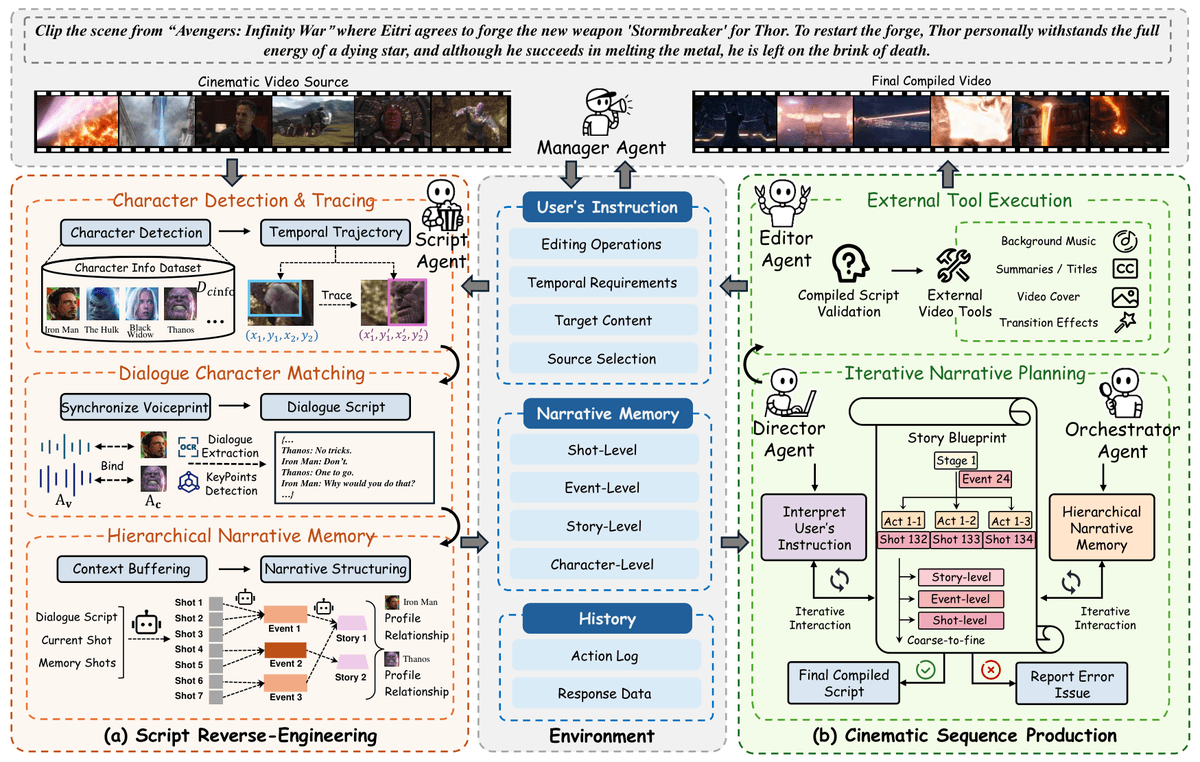
- CineAgents replaces retrieve-and-rank with a design-and-compose multi-agent pipeline built on Gemini-2.5-pro.
- Script reverse-engineering builds a four-level memory: shot, event, story, character profiles.
- Director and orchestrator agents iteratively refine a story blueprint grounded in that narrative memory.
- Adversarial rejection jumps from 52% to 87% versus MetaGPT, F1 rises from 55.7 to 62.4.
- Costs about $14 to index a film and $0.62 per subsequent edit, roughly six minutes each.
Turning a two-hour film into a two-minute recap that actually makes sense is deceptively hard. Existing automatic compilation tools handle vlogs and casual footage well enough, but they fall apart on cinematic content where plots interweave, characters recur, and shots only make sense in the context of what came before. A new paper introduces both a benchmark, CineBench, and a multi-agent system, CineAgents, that reframes the problem from "pick the best clips" to "design a narrative, then compose it."
Prior compilation methods focus on casual videos with linear narratives and predefined tasks. They typically rely on a retrieve-and-rank paradigm that suffers from two failure modes on long cinematic content: contextual collapse, where shots are retrieved inaccurately because the model lacks narrative understanding, and temporal fragmentation, where isolated shot selection produces disjointed sequences.

Why retrieve-and-rank breaks on movies
Earlier work in cinematic editing stayed narrow, tackling B-roll insertion, trailer generation, or highlight detection in isolation. The typical pipeline scores each shot against a user query and picks the top-ranked ones. That works when clips are semantically self-contained, but a movie shot rarely is. A flashback frame of a gold watch is only meaningful if the model knows whose watch it is, why it matters, and what scene it belongs to.
Contextual collapse happens when the model retrieves the wrong clip because it treats shots as isolated images. Temporal fragmentation happens when the retrieved clips, even if individually correct, are stitched into an order that no human would call a story.
Inside CineBench: 500 professionally edited pairs
CineBench contains over 500 expert-annotated video pairs covering films and series from 1930 to 2020 across multiple genres, in both English and Chinese. User instructions are broken into four axes: