
ChoreoLLaMA Generates Realistic 3D Dance for Any Music Using 100 Hours of Data
A new framework scales music-to-3D-dance generation with a 100-hour dataset and a LLaMA-based choreography model that generalizes to unseen songs.
 Pro
Takeaways
- InfiniteDance releases a 100.69-hour 3D dance-music dataset built from monocular video, roughly 10x larger than AIST++.
- A Foot Restoration Diffusion Model fixes sliding, jitter, and ground penetration in scraped motions using contact and geometry guidance.
- ChoreoLLaMA adapts LLaMA-3.2-1B as a choreography backbone, predicting VQ-VAE motion tokens autoregressively.
- Retrieval-augmented generation injects similar reference dances as prompts so the model handles unseen or rare music styles.
- A slow/fast Cadence Mixture-of-Experts routes tokens by tempo band, smoothing rhythm transitions across genres.
- Code, weights, and data are public on Hugging Face under a non-commercial research license.
Generating convincing 3D dance from arbitrary music has been a stubborn problem. Models trained on small motion-capture corpora look great on the songs they know, then fall apart the moment you play them something new. A new paper called InfiniteDance, accepted at ECCV 2026, attacks the problem from both ends: it scales up the training data by harvesting motions from monocular video, and it swaps the usual bespoke choreography model for a LLaMA-based architecture with retrieval and a rhythm-aware mixture of experts.
Why in-the-wild dance breaks current models
Existing 3D dance generation methods perform well in controlled scenarios but struggle to generalize in the wild. When conditioned on unseen music, they often produce unstructured or physically implausible dance, largely due to limited music-to-dance data and restricted model capacity. Prior work like Bailando, FineDance, and Lodge established the recipe, but the community has been stuck training on a few hours of studio motion capture, which is expensive to collect and biased toward a narrow set of genres.
The obvious fix is to mine 3D motion from the enormous supply of dance videos on the internet. The catch is that off-the-shelf video-to-motion reconstruction produces motions that look wrong in ways humans instantly notice: sliding feet, ground penetration, and jittery contacts. Recent motion imitation methods built on physical simulators improve physical plausibility but often suffer from foot jittering due to inaccurate estimation of diverse in-the-wild ground friction. That physical noise is what has kept scraped video from being usable as training data.
Fixing feet with a diffusion model
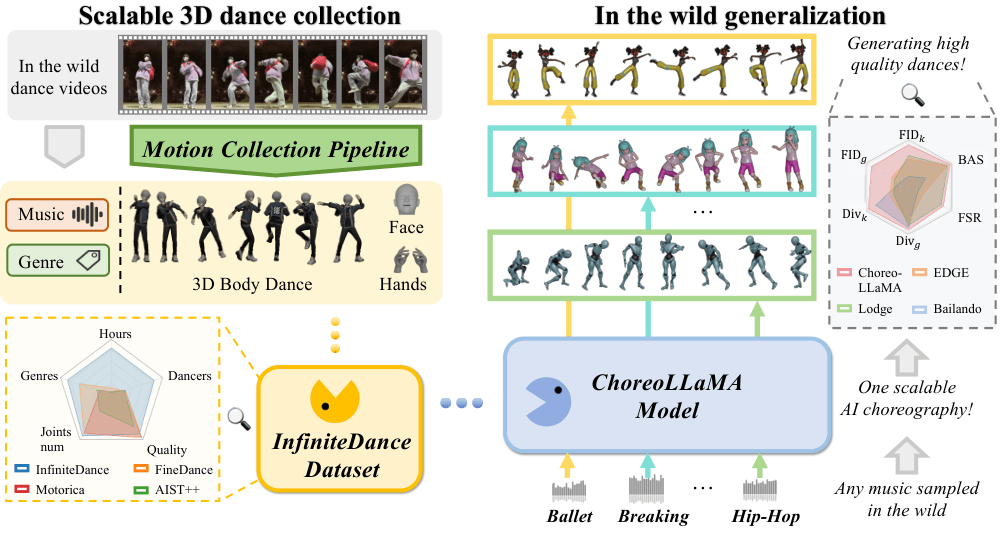
InfiniteDance's first contribution is a data pipeline that ends with a targeted repair step called the Foot Restoration Diffusion Model (FRDM). FRDM repairs foot-related artifacts in a self-supervised manner using velocity, position, and rotation cues, while preserving fidelity to the original motion. With geometric guidance during inference, FRDM significantly improves motion realism and brings reconstruction quality close to professional MoCap.

The pipeline runs four stages in order: raw video motion capture, physical restoration in a simulator, foot restoration with FRDM, and export. What is different from prior physics-based cleanup is that the fix is learned as a diffusion prior over foot trajectories, conditioned on contact and geometry constraints, rather than being hand-tuned per scene. That lets the same model correct thousands of clips from different camera angles and ground conditions without manual per-video tweaking.
The output is a dataset called InfiniteDance. The final multimodal 3D dance dataset totals 100.69 hours, roughly an order of magnitude larger than AIST++, and it spans a wider range of genres, tempos, and body styles because it comes from real-world videos rather than studio recordings.
Choreographic LLaMA
The second contribution is the model. Instead of designing another dance-specific transformer, the authors adapt a small language model. On the modeling side, they propose ChoreoLLaMA, a scalable architecture that maps music and motion conditions into learnable tokens instead of relying on handcrafted priors. The backbone is LLaMA-3.2-1B, and motion is discretized with a three-layer residual VQ-VAE so the language model can predict motion tokens the same way it would predict text.
Two ideas make the LLaMA backbone actually good at choreography:
- Retrieval-augmented choreography. Instead of relying solely on music embeddings, the model retrieves top-k reference dances that share similar musical attributes, providing strong choreographic priors for rare or unseen music. This is the same trick that helps LLMs handle rare facts, applied to rare musical styles.
- Cadence Mixture-of-Experts. The reference motions are decomposed into multiple frequency bands and processed via specialized experts. This design mitigates data imbalance and enables structured motion generation. In practice, slow experts handle sustained poses, fast experts handle rapid steps, and the router picks the right mix based on the tempo of the input song.

How the pieces fit together
End-to-end, generating a dance for a new song looks like this:
- Extract per-frame MuQ audio embeddings from the input track at roughly 30 fps.
- Run the retrieval network to pull the top-k most similar dances from the corpus based on musical style.
- Feed the music tokens plus retrieved reference motion tokens into ChoreoLLaMA, which autoregressively predicts VQ-VAE motion tokens with the Cadence-MoE routing between slow and fast experts.
- Decode the motion tokens back into SMPL joint parameters and render.
Concretely, the released inference script drives it with a handful of knobs familiar to anyone who has sampled from a language model:
python infer_llama_infinitedance.py \
    --music_path .../muq_features/test_infinitedance \
    --checkpoint_path .../best_model_stage2.pt \
    --vqvae_checkpoint_path .../dance_vqvae.pth \
    --style Popular --music_length 320 --dance_length 288 \
    --temperature 0.8 --top_k 15 --top_p 0.95 --seed 42
Training is two stages: first the bridges and adapters are trained with the LLaMA backbone frozen, then the whole stack is fine-tuned end-to-end with weight decay and dropout tuned to keep the LLM from collapsing onto the dance modality.
Results and what it is good for
With FRDM for high-quality motion collection and ChoreoLLaMA plus RAG and Cadence-MoE for rhythm-aware choreography, the system produces more stable, expressive, and generalizable 3D dances across diverse music styles. The paper reports gains on the standard FID-k, FID-m, and Div-k/Div-m metrics used in music-to-dance work, along with the Beat-Align score, and includes a comparison showing InfiniteDance's reconstructed motions approach marker-based motion capture in quality.
The obvious use cases are the ones the graphics and games industry has wanted for years: procedural background dancers, previz for music videos, VTuber and avatar animation driven by live music, and rapid choreography drafts that a human animator can then polish. Because motion is generated as SMPL/SMPL-X parameters, the output drops into standard rigs without extra retargeting.
The limitations are worth naming. The model outputs single-person body motion only, so duets, hand articulation, and facial expression are outside its scope. Foot restoration is a diffusion-based cleanup and can still miss edge cases like extreme contact-heavy styles such as tap or breaking. And the release is explicitly non-commercial: the license restricts code, checkpoints, model weights, annotations, and data resources to non-commercial academic research, education, and evaluation only, so shipping this inside a product will require a separate arrangement.
Getting the code and weights
The repository is live at MotrixLab/InfiniteDance. Everything a researcher needs to reproduce the paper is published: the LLaMA-based checkpoint, the residual VQ-VAE, the retrieval network, the MuQ test features, the balanced training motion features, and the per-clip SMPL-X fits for the 9,748 project-owned dance clips. Weights and data are hosted together on Hugging Face, and the layout mirrors the repo so a single huggingface-cli download drops everything into place.
The broader signal here is that music-to-motion is following the same trajectory as text and image generation: once the data problem is unblocked, a general-purpose transformer with retrieval starts outperforming domain-specific architectures. If that pattern holds, expect the next round of dance, gesture, and full-body motion models to look a lot more like LLMs and a lot less like the hand-crafted pipelines that came before.