
Chongqing University's ISRF Beats Top Recommenders by 24% Using Group Reasoning
A new WWW 2026 framework uses LLM chain-of-thought reasoning plus a two-graph pipeline to bridge individual and group interests in recommenders.
 Pro
Takeaways
- ISRF is a WWW 2026 framework that adds explicit-to-implicit interest reasoning on top of LLM-based recommenders.
- Uses bidirectional chain-of-thought prompts to generate positive and negative semantic descriptions for items and users.
- Builds two LightGCN graphs: user-item interactions for explicit interests, user-user similarity for group implicit interests.
- Iterative contrastive refinement aligns the two representations during training on both direct and sequential tasks.
- Beats ELMRec by 7.5-24.6% on direct recommendation and 3.7-10.4% on sequential across Sports, Beauty, and Toys.
- Code and prompts available at github.com/htired/ISRF, backbone is T5-small with DeepSeek-R1-14B offline.
Most LLM-powered recommender systems today do one thing: they use a large model to encode item and user text into embeddings, then hand those vectors to a downstream model. A new paper from Chongqing University of Technology argues that this is only half of what an LLM should be doing. The other half, reasoning from what a user clicked to what similar users implicitly want, is where the real gains hide.
The team's framework, called ISRF (Iterative Semantic Reasoning Framework), was accepted to The Web Conference 2026 and posts double-digit improvements over the previous state of the art on three Amazon benchmarks. Code is on GitHub.
Why plain semantic embeddings aren't enough
Recommendation systems aim to learn user interests from historical behaviors and deliver relevant items, and recent methods leverage LLMs to construct and integrate semantic representations of users and items. The authors' complaint is that this stops at integration. User behavior theories suggest that truly understanding user interests requires not only semantic integration but also semantic reasoning from explicit individual interests to implicit group interests.
The paper's motivating example makes this concrete: a user clicks basketball shoes with an air-cushioned midsole and non-slip outsole. The explicit interest is high-impact court performance. But look at similar users and many actually prioritize breathability and lightweight design for long training sessions. That implicit, group-level preference is invisible if you only encode the individual's history.
Three modules, one iterative loop
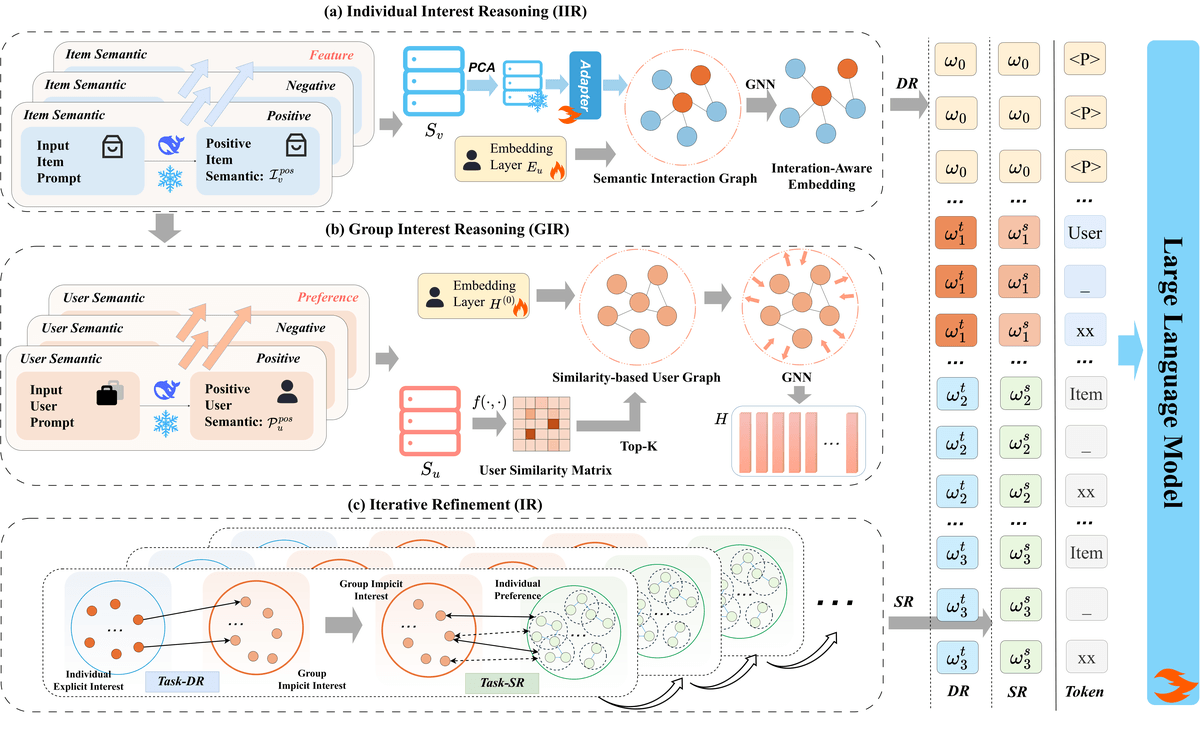
ISRF splits the job across three coordinated components that talk to each other during training:
- Individual Interest Reasoning (IIR): A chain-of-thought pass over each item's structured attributes. The LLM first generates a positive description (what users might like about the item), then a negative one conditioned on the first (what they might dislike), and fuses both into a richer semantic feature. These features feed a LightGCN over the user-item interaction graph to produce explicit interest embeddings.
- Group Interest Reasoning (GIR): The same bidirectional prompting is applied to users, sampling items from their history. The resulting user embeddings are used to build a top-k cosine similarity graph, and a second LightGCN propagates preferences across behaviorally similar users.
- Iterative Refinement (IR): A contrastive distillation loop where the explicit representation supervises the group representation on direct recommendation, and the group representation guides the individual one on sequential recommendation, via mutual-information maximization.
Practically, the LLM heavy lifting is done offline. DeepSeek-R1-14B handles the multi-step reasoning, EasyRec-RoBERTa-large turns the descriptions into embeddings, PCA compresses them, and a small T5 backbone (matching P5, POD, ELMRec) drives the actual recommendation. The pipeline looks like this in shorthand:
item_attrs --LLM CoT--> I_pos --LLM CoT--> I_neg
                             \_________________/
                                     |
                                fuse -> I_se -> PCA -> adapter -> E_v
E_v + user_ids -> LightGCN(interaction graph) -> explicit E~_u
user_history --LLM CoT--> P_se -> similarity top-k -> R
R + H0 -> LightGCN(user graph) -> implicit H_u
contrastive(H_u, E~_u) <-> iterative refinement
The numbers
Experiments run on three Amazon subsets: Sports and Outdoors, Beauty, and Toys and Games, using Hit Rate and NDCG at 5 and 10. Against the previous best baseline ELMRec, ISRF posts gains from 3.71% to 10.37% on sequential recommendation and 7.52% to 24.57% on direct recommendation. The biggest jump is on Sports direct H@10, going from 0.6479 to 0.7697.
Ablations show every piece earns its keep. Dropping the direct-to-sequential distillation loss or the sequential contrastive loss hurts sequential H@10 by around two points. Replacing the LLM-generated item semantics with random embeddings crashes Toys direct H@10 from 0.6733 to 0.5093. The adapter that maps semantic vectors into the recommendation space is also load-bearing.
Compute overhead is modest
Compared to ELMRec, ISRF adds roughly 30 to 50% training time per epoch and marginal extra GPU memory, while inference times are nearly identical. The whole thing runs on a single RTX 4090 with 24 GB of VRAM. The dominant complexity is still O(n squared) from LightGCN, matching the baseline.
What it is good and bad at
ISRF is a strong fit if you already run a T5-style generative recommender on textual side information and want a bolt-on that squeezes more out of the same LLM budget. The bidirectional reasoning and group graph are largely offline preprocessing, so serving costs barely change.
It is less suited to cold-start users with no interactions (the user similarity graph needs signal), streaming settings where the semantic graph would need constant rebuilding, or purely ID-based collaborative filtering pipelines with no textual attributes. The evaluation is also limited to three medium-scale Amazon domains, so behavior on billion-item catalogs remains an open question. A case study on a Sports user is illustrative: ELMRec kept recommending generic accessories, while ISRF picked up on latent cycling and headlight interests by borrowing signal from semantically similar users.
The broader shift is that generative recommendation is following the same trajectory as LLM reasoning research: from single-shot encoding toward multi-step, cross-user inference. ISRF is a compact, reproducible instantiation of that idea.