
Chinese Academy's FG-CLTP Teaches Robots to Feel Exact Forces With 95.9% Accuracy
A new tactile pretraining framework teaches robots to describe touch in exact numbers, cutting contact-state regression error by more than half.
 Pro
Takeaways
- FG-CLTP aligns 3D tactile point clouds with language using discrete numeric tokens for force, depth, and orientation.
- Reduces regression MAE by 52.6% versus prior CLTP and hits 95.9% contact-state classification accuracy.
- New Contact3D dataset offers 100k tactile point cloud-language pairs across 136 objects and four sensors.
- Only 3.5% sim-to-real gap on GelStereo 2.0, with zero-shot transfer to unseen DM-Tac sensors.
- 3D-TLA policy built on π0.5 with flow matching beats ACT and Diffusion Policy on three real tasks.
- No public code release yet for FG-CLTP or Contact3D; predecessor CLTP is available at sites.google.com/view/cltp.
Most tactile representations bolted onto vision-language-action models can tell you a surface is rough or a grip is firm, but they cannot tell you the force is 5 newtons rather than 20, or that a peg is tilted 90 degrees rather than 45. A team from the Institute of Automation at the Chinese Academy of Sciences and the Beijing Academy of Artificial Intelligence is trying to close that gap with FG-CLTP, a contrastive language-tactile pretraining framework that injects explicit numerical tokens into a robot's touch vocabulary and pairs it with a flow-matching policy for contact-rich manipulation.
The headline results are strong: 95.9% classification accuracy and a 52.6% reduction in regression error (MAE) compared to state-of-the-art methods, with a minimal sim-to-real gap of 3.5% when moving from simulation to physical sensors.
The lexical bottleneck in touch
Prior tactile-language models like UniTouch, TVL, AnyTouch, and CLTP successfully anchored tactile signals into a shared embedding space with vision and language. But existing tactile representations predominantly rely on qualitative descriptors (e.g., texture), neglecting quantitative contact states such as force magnitude, contact geometry, and principal axis orientation, which are indispensable for fine-grained manipulation. The authors call this a lexical bottleneck: standard word tokens can flag a hard press, but cannot represent the continuous physical parameters a controller actually needs.
That matters because contact-rich tasks like peg insertion, wiping, or writing require the policy to modulate force and pose at millimeter and newton resolution. Vague adjectives like "firm" or "tilted" simply do not compile down to a 30 Hz control signal.

Teaching the model to speak physics
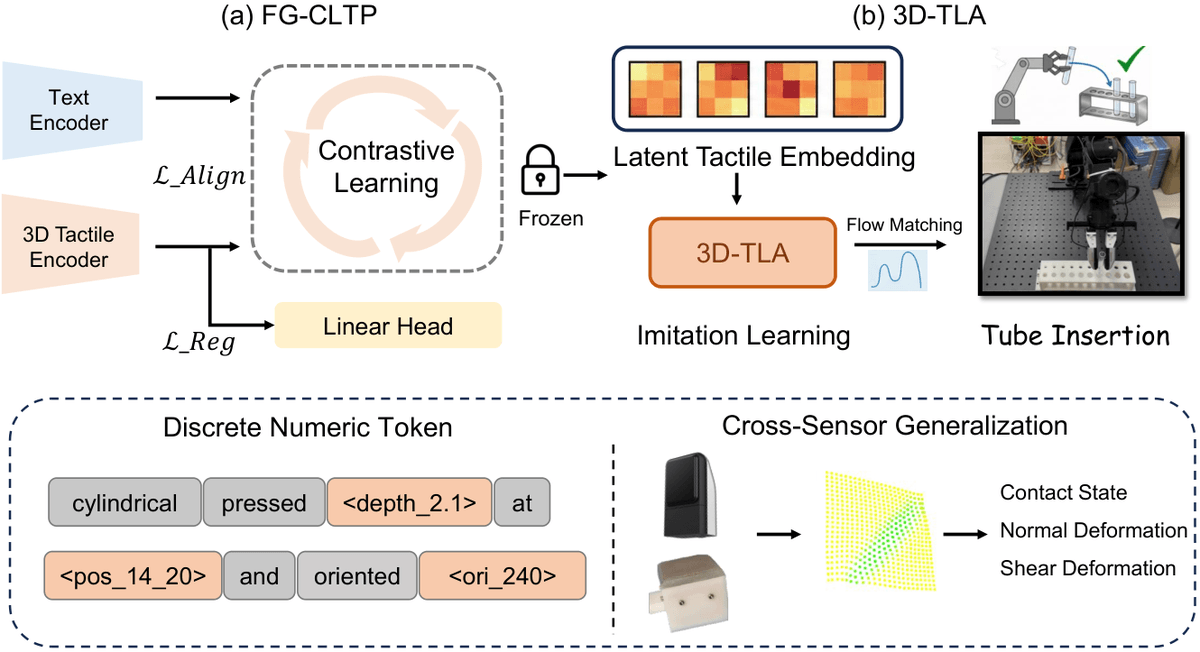
FG-CLTP's central trick is a discretized numerical tokenization mechanism. Instead of describing a press with an adjective, the paper bins continuous physical values into new vocabulary items added to the CLIP text encoder. Depth becomes tokens like <depth_0.0> through <depth_4.0>, contact area maps to <area_0.01> through <area_1.0>, and orientation gets a full 360 bins as <principal_0> through <principal_360>. A sample caption then reads like:
A smooth cylindrical object, pressed <depth_2.1>
at <pos_12_12> with <area_0.21> contact area,
oriented along <axis_90>, not sliding, not twisting.
To avoid corrupting CLIP's pretrained semantics, only the embeddings of the new numerical tokens are trainable; the original vocabulary stays frozen. A standard InfoNCE contrastive loss aligns tactile point clouds, tactile images, and these digit-enhanced captions, and an auxiliary MSE regression head predicts the raw physical values directly, which forces the encoder to keep continuous magnitudes rather than just coarse categories.
Contact3D: a dataset built around numbers
The authors also release Contact3D, which they describe as a novel dataset comprising over 100k tactile 3D point cloud-language pairs that explicitly capture multidimensional contact states from the sensor's perspective. It spans 136 objects (YCB items, McMaster industrial parts, and custom pegs) across four visuotactile sensors including GelSight Mini, DIGIT, GelStereo 2.0, and DM-Tac.
Data was generated with three interaction primitives (pressing, sliding, twisting) using the TacFlex Isaac Gym FEM simulator, capturing tactile images, marker displacement fields, 3D deformation point clouds, and 6-DoF force/torque readings. Shape and texture labels came from Qwen3-VL-8B-Instruct fed rendered depth maps, while quantitative attributes like contact depth, principal axis (via SVD of the deformation field), and shear direction were computed analytically and slotted into templated prompts.

From representation to policy: 3D-TLA
The pretrained tactile encoder plugs into a downstream policy called 3D-TLA, built on top of Physical Intelligence's π0.5 vision-language-action model. The stack looks like this:
- Language instructions go through PaliGemma.
- RGB observations go through SigLIP.
- Tactile 3D point clouds (529 sampled points, sensor-normalized) go through the FG-CLTP encoder.
- All tokens concatenate into a Gemma-2B backbone.
- A flow-matching action head predicts a 10-dimensional control vector (3-DoF translation, 6-DoF rotation, binary gripper).
Flow matching, in this context, learns a time-dependent vector field that continuously transforms Gaussian noise into the expert action distribution, similar in spirit to diffusion policies but typically faster and more stable. Training runs in two stages: freeze the backbone and train alignment MLPs, then LoRA-finetune the whole thing.
What the numbers say
On the offline benchmark, FG-CLTP hits 90.6% shape classification and 97.6% on both depth and position. On continuous regression across depth, position, area, principal axis, and shear, it lands a macro-average R2 of 0.960 versus 0.826 for the closest baseline CLTP and 0.686 for UniTouch. The improvement is largest on deformation-sensitive attributes: shear MAE drops from 0.373 (TVL) and 0.225 (CLTP) down to 0.078, and principal-axis R2 jumps from 0.626 to 0.959.
The sim-to-real story is arguably more interesting for practitioners. Trained purely on Contact3D simulation, the model was evaluated on real GelStereo 2.0 data and an unseen DM-Tac sensor. The 3.5% drop on GelStereo 2.0 beats UniTouch (4.9%) and AnyTouch (5.7%), and zero-shot transfer to DM-Tac still hits 86.5% average accuracy. Aligning everything to a unified 3D point-cloud representation, rather than sensor-specific 2D images, appears to be the key ingredient.

Real-world manipulation
Three real-world tasks on an Imeta Y1 arm with two DM-Tac M fingertip sensors round out the evaluation:
| Task | ACT | Diffusion Policy | 3D-TLA |
|---|---|---|---|
| Insert Tube | 70.0% | 75.0% | 85.0% |
| Wipe the Board | 65.0% | 65.0% | 75.0% |
| Handwriting | 45.0% | 50.0% | 60.0% |
Tube insertion stresses in-hand localization under visual occlusion, wiping tests continuous force modulation, and handwriting stresses fine trajectory control. The gains are consistent but not enormous, which matches the intuition that better tactile features help most where vision fails.
What it is good for, and what to watch
The framework is most useful when your setup involves:
- Visuotactile fingertip sensors that produce a marker field or depth map convertible to a 3D point cloud.
- Tasks where force magnitude, penetration depth, or contact-patch orientation actually matter, such as assembly, delicate grasping, or surface-following.
- A need for cross-sensor generalization without retraining a new encoder from scratch for every hardware swap.
Caveats worth flagging: the numerical vocabulary is only as fine as the chosen bin resolution, so precision has a hard ceiling set at pretraining time. The handwriting task still tops out at 60%, meaning the policy is not yet ready for true dexterous work. And while the predecessor CLTP released code and dataset at sites.google.com/view/cltp, the FG-CLTP paper itself does not yet advertise a public release for Contact3D or the 3D-TLA policy weights. Anyone hoping to plug this into an existing VLA stack will likely need to wait for the authors to open-source the pipeline, or reimplement the tokenization scheme against the CLTP baseline.
The broader significance is conceptual: it treats numerical values as first-class citizens in a multimodal vocabulary rather than something to be summarized away in adjectives. That trick, borrowed from work like TP-BERTa on tabular data and Perception Tokens on depth, may generalize well beyond touch to any modality where a controller needs to reason over exact magnitudes.