
Chinese Academy of Sciences' SkeletonAgent Teaches AI to Separate Similar Human Actions
A new framework wires an LLM directly into a skeleton action recognizer, using two agents to trade real-time confusion data for sharper joint-level cues.
 Pro
Takeaways
- SkeletonAgent adds a feedback loop between a skeleton action classifier and an LLM via two agents.
- A Questioner tracks the confusion matrix and asks the LLM to differentiate the hardest-to-separate classes.
- A Selector parses LLM responses into per-class joint constraints and a discriminative text embedding.
- Hits 94.5% on NTU-60 X-Sub and 53.6% on Kinetics-Skeleton, with +4.3 points on hard classes.
- Robust across GPT-4o, Gemini 2.5, Claude Sonnet 4, Qwen 3, GPT-5, DeepSeek-V3.1 (within 0.6 pts).
- Code, configs and checkpoints available at github.com/firework8/SkeletonAgent.
Skeleton-based action recognition has been quietly borrowing tricks from large language models for a couple of years now. The idea is straightforward: ask an LLM to describe what an action looks like, encode the text with something like CLIP, and align those embeddings with graph convolutional features extracted from human joint trajectories. The catch is that the LLM has no idea whether its descriptions are actually helping the classifier.
A new paper called SkeletonAgent from researchers at the Institute of Automation, Chinese Academy of Sciences, tries to close that loop. Instead of a one-shot prompt, it wraps the LLM and the recognizer in an agent framework that iteratively swaps performance feedback for more targeted textual guidance.
Why static descriptions fall apart on similar actions
The authors identify two failure modes in the standard pipeline. First, homogeneous textual semantics: when you ask an LLM to describe similar actions like writing versus typing on a keyboard, you get nearly identical text that hides the discriminative cues. Second, coarse cross-modal alignment: matching a whole skeleton sequence to a whole paragraph gives the model no fine-grained control over which joints correspond to which words.
The result is that GCN-based recognizers keep tripping on visually similar classes. On the NTU-60 benchmark, prior state of the art still hovers around 63% accuracy on writing and 75% on take-off-a-shoe, even when overall accuracy pushes past 93%.

Two agents, one feedback loop
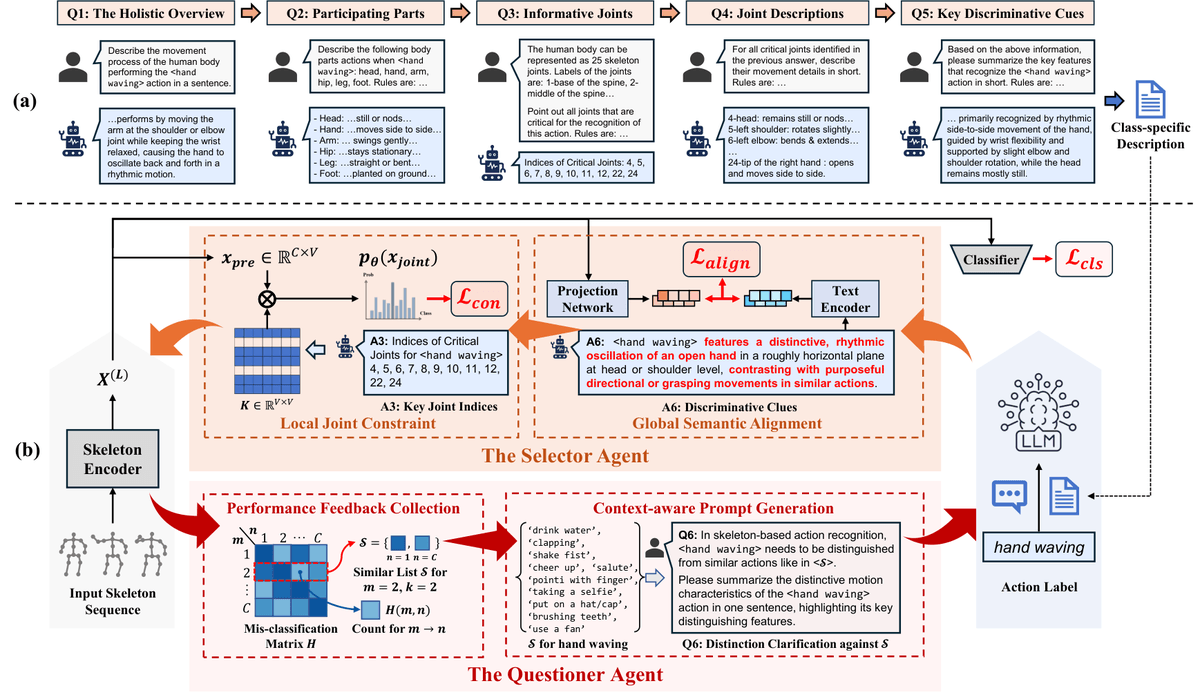
SkeletonAgent introduces a Questioner and a Selector that sit between the recognizer and a general-purpose LLM (GPT-4o in the default configuration).
- Questioner. During training, it maintains an online confusion matrix. Every few epochs (five by default), it looks at the top-k most-confused classes for each action and rewrites the prompt to the LLM: not "describe hand waving" but "describe how hand waving differs from these specific look-alikes."
- Selector. It parses the LLM's replies to pull out the joints and body parts the description actually calls out, then encodes that into a per-class binary topology matrix K that is multiplied against the pooled joint features and supervised with a dedicated cross-entropy loss.
On top of that, the framework does a bidirectional skeleton-to-text alignment using CLIP's ViT-B/32 text encoder, but crucially it aligns skeletons with the discriminative description rather than a generic one. Because a batch can contain multiple samples from the same class, the alignment uses KL divergence over the similarity distribution instead of a hard InfoNCE contrast.
The total loss is just the sum of the classification loss, the joint-constraint loss (weight 0.2), and the alignment loss (weight 0.5).

What the numbers say
Evaluations span five benchmarks: NTU RGB+D, NTU RGB+D 120, Kinetics-Skeleton, FineGYM, and UAV-Human. A few results stand out:
- 94.5% on NTU-60 X-Sub and 98.2% on X-View with the six-stream ensemble, edging past ProtoGCN and Hyper-GCN.
- 53.6% top-1 on Kinetics-Skeleton, a 1.7-point jump over the previous best.
- 52.1% on UAV-Human CSv1, a large gain over prior GCN methods hovering in the high 40s.
- The gains are concentrated exactly where you would want them. On the "Hard" NTU-60 subset (classes previously below 70% accuracy), SkeletonAgent gains +4.3 points, and individual confusable actions like "wear a shoe" jump +7.7 points.
Ablations show the framework is not overly dependent on GPT-4o: Gemini 2.5, Qwen 3, Claude Sonnet 4, GPT-5, and DeepSeek-V3.1 all land within 0.6 points of each other. Swapping the text encoder to BERT or older CLIP variants costs about 0.4 to 0.8 points.
What is actually shipping
The code is on GitHub under an MIT license, with pretrained checkpoints on Hugging Face and Google Drive. The implementation is built on top of PYSKL, so if you have ever trained a CTR-GCN or ST-GCN model, the config format will look familiar. Training uses a single RTX 3090 with SGD, 150 epochs, batch size 64.
One practical note: the training loop calls an LLM API periodically, so you need to plug in a key in skeletonagent/models/heads/agent.py. There is also a "semi-version" config that skips live LLM calls if you would rather use pre-generated descriptions.
Where it fits, and where it does not
The extra machinery, an online confusion matrix, periodic LLM calls, an auxiliary topology matrix, only affects training. At inference time, you are running the same skeleton encoder as any GCN baseline, so latency is unchanged. That makes the approach a reasonable drop-in for anything where fine-grained action discrimination matters: gymnastics scoring, workplace safety monitoring, UAV surveillance, sign language, or medical rehabilitation.
The limitations are the usual ones for LLM-in-the-loop training. You are trusting the LLM's anatomical intuition, which the authors mitigate with verification prompts, and you are paying for API calls during training. And because the confusion-matrix feedback is class-level, this framework helps when your problem is separating similar classes; it will not save you if the underlying skeleton signal is just too noisy, as often happens with occluded joints in aerial footage.