
Chinese Academy of Sciences' SDF-Net Matches Ships Across Radar and Optical Satellites
A new satellite-imagery model matches ships across optical and radar sensors by anchoring on hull geometry instead of texture, hitting 60.9% mAP on HOSS-ReID.
 Pro
Takeaways
- SDF-Net sets new state of the art on optical-SAR ship re-identification at 60.9% mAP.
- Uses gradient energy from intermediate ViT layers as a modality-invariant geometric anchor.
- Adds zero parameters over the TransOSS baseline, only 0.17 extra GFLOPs.
- Improves SAR-to-Optical mAP by 7.9 points, critical for night and cloud-cover retrieval.
- Ablations show disentanglement is harmful without the geometric anchor to stabilize it.
- Code and weights released at github.com/cfrfree/SDF-Net; benchmark at Zenodo.
Matching a ship photographed by an optical satellite to the same ship in a synthetic aperture radar (SAR) scan is one of the nastier problems in remote sensing. The two sensors literally measure different physics: one collects reflected sunlight, the other bounces microwaves off the hull. A team from the Chinese Academy of Sciences just published SDF-Net, a Vision Transformer variant that side-steps the appearance gap by learning to recognize ships from their geometry rather than their pixels, and it beats the previous best method on the only public benchmark for the task while adding zero extra parameters.
Why texture-matching breaks down at sea
The optical imagery in the benchmark was acquired by the Jilin-1 constellation at 0.75 m ground sampling distance as 8-bit RGB, while the SAR imagery came from the TY-MINISAR constellation at 1.0 m as single-channel 32-bit floating-point images. That mismatch is the tame part. SAR is an active sensor: it fires microwaves and measures coherent backscatter, which produces multiplicative speckle noise, sudden bright spikes from metallic superstructures acting as corner reflectors, and geometric distortions like layover and foreshortening. Optical images, meanwhile, get corrupted by clouds, sun glint on water, and shadows.
Prior work on cross-modal re-identification largely came from the visible-infrared person ReID world, where both sensors are still passive electro-optical devices and colors and textures partially transfer. Those assumptions fall apart with SAR. Existing optical-SAR baselines like TransOSS, a ViT that employs contrastive learning to pre-train on large-scale optical-SAR image pairs, still rely on self-attention alone to discover cross-modal correspondence, and get fooled by the exact speckle spikes and wake patterns that are modality-specific.
The trick: gradients from the middle of the network
SDF-Net starts from a physical observation that sounds almost too simple: ships are rigid. Their hull outline and aspect ratio are the same whether you image them with light or radar, even though every pixel value differs. So instead of aligning distributions, the authors force the network to align geometry.

The architecture layers two physics-guided modules on top of a ViT-B/16 backbone that inherits TransOSS's dual-head tokenizer and pretrained weights. The first is Structure-Aware Consistency Learning (SCL). Rather than compute edges on the raw pixels, where speckle would swamp them, SCL taps the intermediate feature map at Transformer block 6 out of 12 and computes horizontal and vertical spatial gradients there. Those gradients get summed into a per-channel energy descriptor, instance-normalized to strip absolute-amplitude differences between SAR backscatter and optical reflectance, then averaged into a per-identity prototype for each modality. The loss simply pulls the optical and SAR prototypes for the same ship together in Euclidean space.
The second module, Disentangled Feature Learning (DFL), splits the final ViT representation into two linear projections: a shared identity vector and a modality-specific vector, held apart by an orthogonality loss on their normalized inner product. At inference the two are combined with plain element-wise addition, so the modality-specific features act as a residual refinement on the geometric anchor. There are no learned fusion weights.
What the numbers say
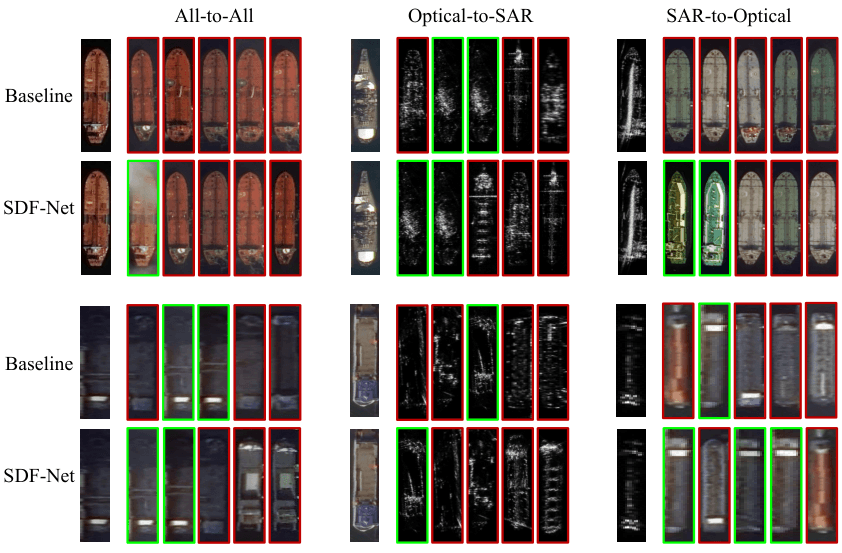
On HOSS-ReID, the only public optical-SAR ship ReID benchmark, the results look like this:
| Method | All-to-All mAP | Rank-1 | SAR-to-Optical mAP | Params |
|---|---|---|---|---|
| TransReID | 48.1% | 60.8% | 20.9% | - |
| DEEN | 43.8% | 58.5% | 27.4% | - |
| TransOSS | 57.4% | 65.9% | 38.7% | 86.24M |
| SDF-Net | 60.9% | 69.9% | 46.6% | 86.24M |
The 7.9-point jump in SAR-to-Optical mAP is the interesting one. That protocol simulates the operationally important case of searching optical archives for a ship first spotted at night or under cloud on radar. And it all comes at a cost of 0.17 additional GFLOPs, since the gradient operator, instance normalization, and additive fusion are all parameter-free.
The ablation tells the real story
Turning SCL on alone raises SAR-to-Optical mAP but drops Rank-1 slightly, which the authors interpret as a robustness-versus-discriminability trade-off: geometric matching finds more correct candidates spread through the ranked list, but occasionally puts a geometrically similar wrong ship at position one. Turning DFL on alone is actively harmful in SAR-to-Optical (mAP falls from 44.5% to 41.4%) because without a geometric anchor the disentangled subspaces drift into incompatible regions. Only together do the two modules cross the state-of-the-art bar. That is a useful design lesson for anyone trying to combine disentanglement with cross-modal alignment.
The layer-choice ablation is equally instructive:
- Block 2 (too shallow): SAR speckle contaminates the gradient statistics.
- Block 6 (sweet spot): spatial topology is preserved, sensor noise is filtered.
- Block 10+ (too deep): global attention has collapsed the spatial grid.
Where it breaks, and where it might go
The authors are unusually candid about failure modes. Performance degrades below roughly 3.0 m ground sampling distance, where the ship spans too few pixels to yield stable gradient statistics. It also degrades at SAR incidence angles below about 15 degrees, where layover and foreshortening warp the hull footprint that SCL depends on. And because SCL anchors on macroscopic geometry, it confuses ships of the same class with similar hulls, which fine-grained texture might have disambiguated.
Practically, the model is aimed at maritime surveillance pipelines that already run a ship detector on full-scene imagery and then need to associate crops across sensors, for search-and-rescue, illegal fishing enforcement, and shipping analytics using low-Earth-orbit constellations for all-weather revisit. Anyone working on similar active-passive sensor pairs, LiDAR to camera, radar to thermal, may want to look at the intermediate-gradient-energy trick as a general recipe. Code and trained checkpoints are available in the official SDF-Net repository.