
Chinese Academy of Sciences' RPDI-EE Stops DeepSeek-R1 Overthinking, Boosting Accuracy by 7.9 Points
A training-free early-exit method spots overthinking loops by tracking spikes in high-entropy transition tokens like Wait and But, gaining 3.9% accuracy on average.
 Pro
Takeaways
- RPDI-EE mitigates overthinking in reasoning LLMs by monitoring entropy spikes from transition tokens like Wait and But.
- The method is training-free, needs no proxy model or answer probing, and adds only O(1) bookkeeping per token.
- Reasoning Path Deviation Index is the ratio of local window entropy to global entropy, with exit triggered at RPDI > 2.0.
- Delivers 3.9% average accuracy gain over vanilla CoT across eight models from 1.5B to 235B parameters.
- Biggest wins on distilled reasoning models (5.1% gain) and hard competition math like AIME and OlympiadBench.
- Trades less token savings for better accuracy compared to aggressive early-exit methods like DEER and Dynasor-CoT.
Reasoning models like DeepSeek-R1 and Qwen3-Thinking have gotten remarkably good at solving hard math and science problems by writing out long chains of thought. But there is a well-known catch: they often keep thinking long after they have already found the answer, second-guessing themselves into wrong conclusions and burning through tokens in the process. A new paper from researchers at the Chinese Academy of Sciences proposes a clean fix that requires zero training and just watches the model's own uncertainty signals to decide when to stop.
The method is called RPDI-EE, short for Reasoning Path Deviation Index Early Exit. Across multiple benchmarks and LRLMs of different types and scales, it delivers the largest performance improvement over vanilla CoT compared to existing early-exit methods. The average accuracy gain is 3.9%, rising to 5.1% on distilled reasoning models that tend to overthink the most.
The overthinking trap
Long chain-of-thought reasoning is a double-edged sword. When a model gets stuck in a verification loop or introduces a small arithmetic mistake mid-way, that error can snowball. The paper illustrates this with a geometry problem where the model initially computes the correct answer, then trips over a tiny calculation error during self-verification, and spirals into a redundant re-derivation loop that ends with the wrong result.

Prior work has tried to cut this off with early-exit strategies, but each approach has trade-offs:
- Fixed token budgets (like s1's NoThinking or ThinkLess): easy to implement but blind to problem difficulty, so they truncate too aggressively on hard problems.
- Proxy-model detectors (SpecExit, FlashThink): require training a separate verifier, adding overhead and coupling the exit signal to a specific base model.
- Answer probing (DEER, Dynasor-CoT): periodically interrupt reasoning to generate a tentative answer and check confidence. This constant context switching kills throughput, and models often exhibit false confidence, exiting before self-correcting.
An inward-looking signal
The team's insight came from a preliminary analysis of 45.9 million tokens generated by the DeepSeek-R1-Distill-Qwen series across seven datasets. Two things jumped out:
- Token entropy follows an extreme long-tail distribution. The first 60% of tokens (sorted by entropy) contribute essentially nothing to the total entropy sum.
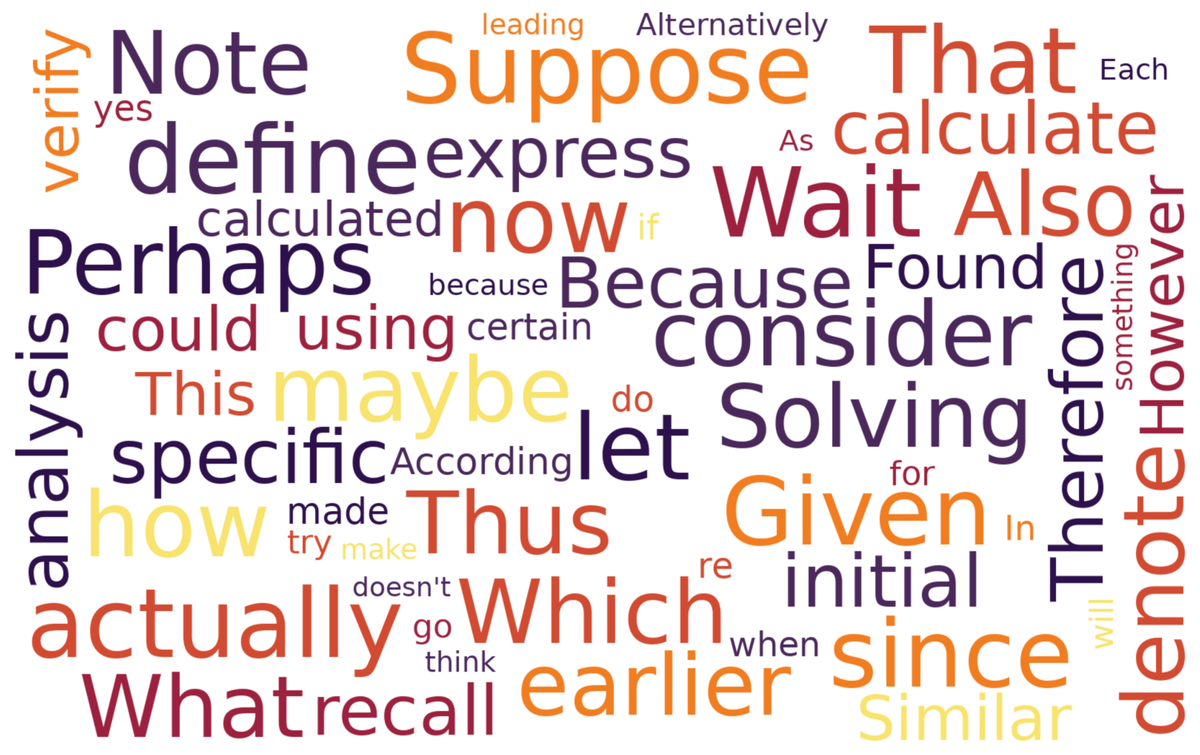
- The high-entropy tokens that dominate the average are almost all transition words:
Wait,But,Alternatively,However,Hmm. These are exactly the tokens a model produces when it is second-guessing itself.
That means average entropy over a window of recent tokens can act as a soft counter for how often the model is switching reasoning paths. If a model is calmly deepening one line of thought, entropy stays low. If it is bouncing between candidate paths, the window fills with transition tokens and the average spikes.
How RPDI works
Rather than count high-entropy tokens against a fixed threshold (which would not generalize across models), RPDI-EE builds a relative metric:
- Local Transition Frequency (LTF): average token entropy inside a sliding window of the last W tokens.
- Global Transition Frequency (GTF): average token entropy across the entire reasoning trace so far, serving as an adaptive baseline for that specific problem and model.
- RPDI = LTF / GTF: when the model advances steadily along the correct path, LTF and GTF are roughly comparable and RPDI fluctuates around 1. When the model falls into overthinking and frequently produces high-entropy content locally, LTF becomes significantly higher than GTF, causing RPDI to increase sharply.
When RPDI crosses a threshold (the paper uses λ = 2.0 with a window of W = 512), the system injects a </think> token, forcing the model to stop reasoning and generate its final answer. Two accumulators keep the running sums, so per-token bookkeeping is O(1). To avoid chopping reasoning mid-thought, RPDI is only evaluated when the current token belongs to a set of boundary symbols (periods, newlines, etc.) that mark the end of a semantic unit.

The numbers
The authors evaluate on eight models spanning 1.5B to 235B parameters, including the DeepSeek-R1-Distill-Qwen family, DeepSeek-R1-Distill-Llama-8B/70B, and Qwen3-30B-A3B-Thinking-2507 and Qwen3-235B-A22B-Thinking-2507. Benchmarks are split into MATH EASY (GSM8K, AMC23, MATH500), MATH HARD (AIME 2024, AIME 2025, OlympiadBench), and SCIENTIFIC (GPQA-Diamond).
On DeepSeek-R1-Distill-Qwen-32B, RPDI-EE lifts average accuracy from 67.6 to 75.5, an 7.9-point gain. On MATH HARD problems specifically, accuracy jumps from 50.4 to 61.0. Compared head-to-head against DEER on the same model, RPDI-EE wins on all three benchmark categories while using slightly more tokens. That token trade-off is intentional, since the method only exits when the model is genuinely stuck rather than eagerly cutting reasoning short.
| Model | Vanilla CoT Avg | DEER Avg | RPDI-EE Avg |
|---|---|---|---|
| DeepSeek-R1-Distill-Qwen-7B | 56.2 | 59.9 | 61.8 |
| DeepSeek-R1-Distill-Qwen-14B | 68.6 | 69.2 | 73.4 |
| DeepSeek-R1-Distill-Qwen-32B | 67.6 | 72.5 | 75.5 |
| Qwen3-30B-A3B-Thinking | 87.3 | 86.8 | 89.1 |
| Qwen3-235B-Thinking | 87.6 | 89.1 | 89.7 |
An interesting finding from the trigger-rate analysis: the harder the problem, the more often RPDI-EE fires, and every time it fires, accuracy on that sample improves. The method essentially never triggers on easy problems where the model is confidently working through steps, and it triggers most on the elite competition math where models are most likely to lose the plot.
What it is good and bad at
The strengths are clear:
- Training-free: no fine-tuning, no proxy verifier, no probing. Drop it in front of any existing reasoning model.
- No context switching: RPDI is computed from the logits the model already produces, so throughput is not affected.
- Adaptive: the GTF baseline auto-calibrates per problem, avoiding brittle thresholds across model sizes.
The main weakness is that RPDI-EE is less aggressive at cutting tokens than methods like Dynasor-CoT or ThinkLess. If your primary goal is raw latency reduction rather than accuracy, and you can tolerate performance loss, aggressive truncation methods win. The ablations also show that removing the boundary-triggered mechanism causes a 2.8% accuracy drop, meaning naive per-token evaluation hurts semantic integrity. And on some models like DeepSeek-R1-Distill-Qwen-7B on GPQA-Diamond, RPDI-EE actually underperforms Dynasor-CoT, suggesting the entropy signal is not always the best exit criterion for scientific reasoning.
Why it matters
The broader takeaway is that the overthinking problem may not need external oracles at all. The model's own next-token distribution already contains a strong deviation signal, buried in the entropy of a small set of transition words. That is a shift from the current trend of bolting verifier models onto reasoning pipelines, and it suggests a promising direction for other inference-time interventions that treat the reasoning trajectory itself as observable state. For anyone running reasoning models in production, the paper is worth reading closely: a few lines of entropy bookkeeping around your generation loop could meaningfully improve both accuracy and average token spend.