
Chinese Academy of Sciences' GR³ Cuts Reasoning Tokens 40% Without Losing Accuracy
A new reinforcement learning trick called GR³ cuts reasoning tokens by 40 percent while matching or beating GRPO on math, code, and chat benchmarks.
 Pro
Takeaways
- GR³ replaces additive length penalties with multiplicative reward rescaling, avoiding the shortcut where models shrink outputs at the cost of accuracy.
- Cuts reasoning tokens by over 40 percent on AIME while improving accuracy versus standard GRPO on 7B models.
- Group-relative normalization adapts the length budget to prompt difficulty using on-policy statistics, not fixed thresholds.
- Works for both RLVR (binary rewards) and RLHF (continuous rewards), unlike prior gating methods.
- On Qwen3-8B RLHF, lifts Arena-Hard-Auto from 77.2 to 92.8 while keeping response length flat.
- Authors state code and model checkpoints will be released.
Reinforcement learning made large language models smarter, but it also made them chattier. Models trained with RL routinely pad their reasoning with filler, second-guess themselves in loops, and burn tokens without improving accuracy. A new paper from researchers at the Chinese Academy of Sciences and Xiaohongshu introduces Group Relative Reward Rescaling (GR³), a length control method that fixes this without the accuracy tax that plagues existing approaches.
The verbosity tax on RL-trained models
The problem, which the authors call length inflation, shows up across major RL paradigms. In RLHF, models exploit reward-model biases toward verbosity, leading to reward hacking. In RLVR (RL with verifiable rewards), length inflation stems from reasoning inefficiency, where models generate unnecessarily long chains of thought to marginally improve the likelihood of a correct solution.
The fixes proposed so far have all hit the same wall. Two dominant strategies exist, and both break in predictable ways:
- Additive length penalties of the form
R' = R - λ·length. This makes extreme brevity an attractive shortcut independent of task success. The model learns to shrink outputs even when that hurts correctness. - Heuristic gating that only applies the penalty when
R=1. These designs are inherently limited to binary feedback and do not extend naturally to continuous-reward settings like RLHF.
Multiply, do not subtract
GR³ reframes length control by regularizing length through multiplicative rescaling, which acts as a generalized gating mechanism and removes the compensatory shortcuts inherent to additive schemes. The rescaled reward is:
R_hat(x, y_i) = R(x, y_i) * 1 / (1 + alpha * (len_i / mean_len))where mean_len is the average response length across the group of sampled rollouts. Because length only scales the existing reward rather than adding a competing objective, a model that produces a short but wrong answer still gets zero. The gradient with respect to the length term is proportional to the task reward itself, so length pressure kicks in only when the model is actually solving the problem.
This turns out to be mathematically elegant. In binary reward settings, the multiplicative form reduces exactly to the heuristic gating approach that prior work uses. In continuous reward settings like RLHF, it acts as a soft gate that scales length pressure by response quality, no threshold hyperparameter required.
Two additional tricks that make it lossless
Two design choices keep the optimization signal intact:
- Group-relative normalization. Instead of comparing against a fixed threshold like a 4K token budget, GR³ normalizes against the mean length within each sampled group of rollouts. Hard prompts naturally produce longer groups, so the length budget adapts to difficulty on the fly.
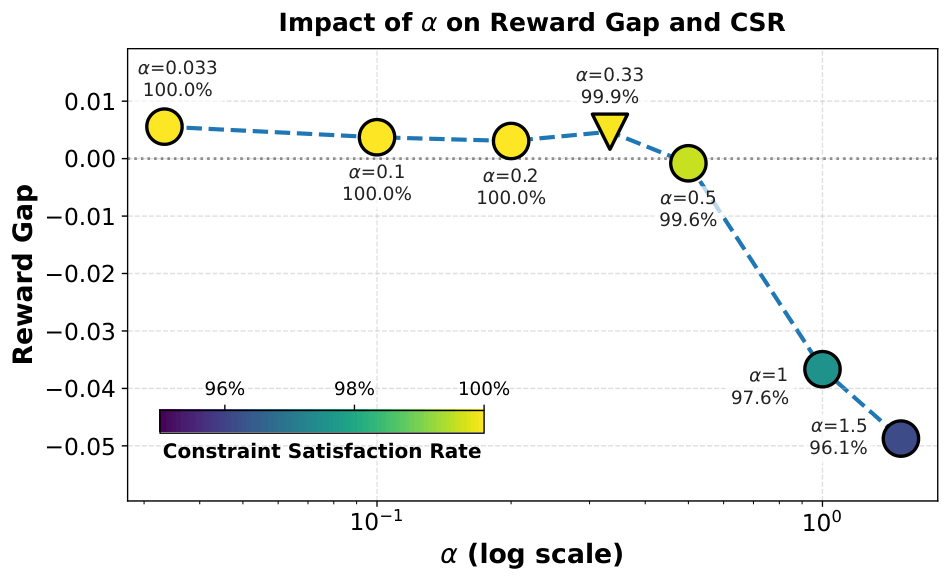
- Advantage-aware calibration. The paper derives a constraint that ensures a hypothetical average-length correct response still receives a non-negative advantage after normalization. This becomes a calibration criterion for picking the penalty coefficient
alpha, run as a short warmup at the beginning of training.
Numbers that actually move
Trained on DeepSeek-R1-Distill-7B for math reasoning, GR³ beats standard GRPO on both accuracy and length. On AIME24, GR³ reduces the average length from 13,213 to 7,923 tokens while improving Avg@32 from 52.4 to 60.1, whereas GRPO only reaches 57.1. On AIME25, none of the competing length-oriented methods (LC-R1, Laser, AdaptThink, DLER) beats the initial checkpoint accuracy of 39.4, while GR³ lifts it to 46.9 with roughly 40 percent fewer tokens.
The RLHF results are arguably more striking. Standard GRPO on Qwen3-8B doubles response length from 1,171 to 2,343 tokens on Arena-Hard-Auto through pure reward hacking. GR³ pushes the score from 77.2 to 92.8 while keeping length essentially flat at 1,178 tokens. Training dynamics show a clean "expand then compress" pattern: the model grows its outputs early to capture alignment gains, then trims them once performance plateaus.
Why it sometimes beats vanilla GRPO on accuracy
The counterintuitive result is that a length-regularized method outperforms unregularized GRPO on the underlying task. The authors attribute this to signal density. Under standard GRPO, policies drift toward long trajectories full of low-contributing tokens, spreading the learning signal thinly. By discouraging verbosity, GR³ concentrates gradient updates on the tokens that actually matter for solving the problem. The qualitative rollouts back this up: GRPO-trained models get stuck in self-doubt loops re-deriving the same intermediate results, while GR³-trained models produce cleaner, more decisive chains of thought.
Practical considerations
The method plugs directly into any GRPO training pipeline. You need to run a brief calibration phase to pick alpha (the paper uses 0.33 for math and code, 0.00133 for chat), and add an online filter that skips groups where every rollout hits the maximum reward, since the multiplicative form degenerates in that all-correct case. The authors present GR³ as a principled framework for lossless efficiency optimization that regularizes length through multiplicative rescaling and state they will release code and model checkpoints.
The caveat is worth naming: aggressive length compression can hurt in safety-critical domains where exhaustive reasoning traces are needed for verification. For general-purpose deployment, though, cutting 40 percent of tokens from reasoning models with no accuracy penalty is a straightforward win on inference cost and latency.