
Chinese Academy of Sciences' GAPL Beats AI Image Detectors Using 10x Less Data
A CVPR 2026 paper shows that scaling AI-image detectors across thousands of generators backfires, and proposes a prototype-based fix that hits 90.4% accuracy.
 Pro
Takeaways
- GAPL identifies a Benefit then Conflict paradox where AI-image detectors degrade as training generator diversity grows.
- Root causes: data heterogeneity from diverse generators plus frozen CLIP encoders that cannot adapt.
- Solution learns 64 forgery prototypes via PCA, then maps images to them through cross-attention.
- Two-stage training with LoRA fine-tuning on 550k images from 4,700 generators, beating baselines using 10x less data.
- Achieves 90.4% mean accuracy across 55 test subsets, a 3.5% jump over prior SOTA.
- Code, weights, and Community Forensics dataset are public: GitHub, HuggingFace.
Training a universal detector for AI-generated images sounds like a scaling problem you solve by adding more data. Grab samples from more generators, feed them to a classifier, watch generalization improve. A new paper from researchers at the Chinese Academy of Sciences shows that intuition is wrong. Beyond a few generators, detector accuracy stalls and then falls off a cliff, even as the training set grows more diverse.
Their fix, Generator-Aware Prototype Learning (GAPL), was accepted to CVPR 2026 and hits 90.4% average accuracy across 55 test subsets spanning six benchmarks, a 3.5% jump over prior state of the art. The code and pretrained weights are already public.
The paradox nobody was measuring
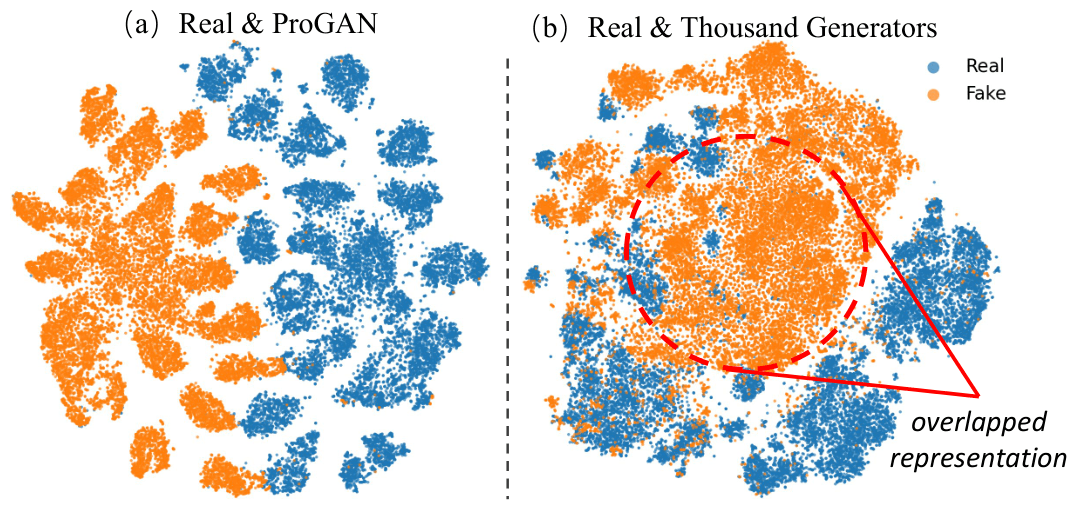
The authors call it the Benefit then Conflict dilemma. Aggregating data from a handful of generators helps, but the detector's efficacy diminishes as the diversity of training sources expands. Add one or two generators, accuracy climbs. Add hundreds or thousands, it collapses.

To figure out what was breaking, they built controlled datasets from GenImage containing a fixed 8,000 real and 8,000 fake images, only varying how many generators produced the fakes (1, 2, 4, 8, and finally thousands). Then they used Linear Discriminant Analysis to measure how separable the real-versus-fake feature clouds actually are inside a pretrained encoder. Two things fell out.
- Data-level heterogeneity. Real images stay heterogeneously stable while generated images spread out as more generators are introduced. Different generators leave different fingerprints, so their combined feature distribution keeps expanding until it overlaps with real images.
- Model-level bottleneck. Most modern detectors bolt a small classifier onto a frozen CLIP encoder to avoid overfitting. That works for one source, but once the generator count climbs into the thousands, features exhibit heavy embedding overlap. The frozen encoder was pretrained on semantics rather than forgery cues, so it cannot re-organize its space to accommodate new artifact types.