
Chinese Academy of Sciences Finds Extra Transformers Hurt Emotion AI Scores
A team building for the 10th ABAW emotion challenge found that simple feature concatenation beat every fancy fusion trick they tried.
 Pro
Takeaways
- A CAS team reports 0.4786 mean Pearson on the 10th ABAW EMI validation set.
- Simple feature concatenation of ViT, WavLM-Large and ChatGLM3 beat every fancier fusion tested.
- Adding a temporal enhancement module on top of pretrained features dropped scores from 0.4726 to 0.4411.
- Text is dominant (0.4648 alone), audio moderate (0.3559), visual features barely useful (0.0925).
- A VAD side branch predicting Valence-Arousal-Dominance gave the audio stream a useful inductive bias.
- Loss combines MSE, batch Pearson correlation, per-branch supervision, plus EMA weight averaging for stability.
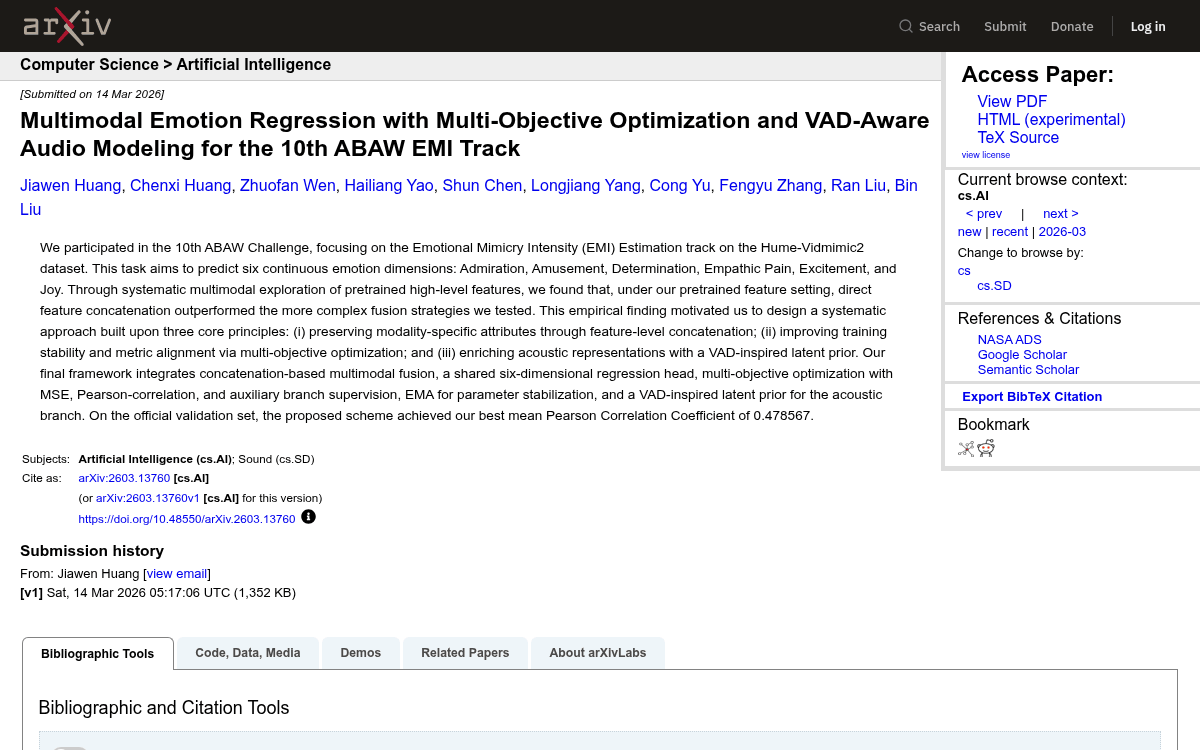
A team from the Chinese Academy of Sciences entered the Emotional Mimicry Intensity track of the 10th ABAW Challenge expecting to win on architectural cleverness. Instead, they learned that once your pretrained encoders are strong, the extra Transformers and temporal convolutions everyone piles on top can actively hurt you. Their final system, described in a new arXiv report, hits a mean Pearson correlation of 0.4786 on the official validation split by doing something almost boring: concatenating features, tuning the loss, and adding a small affect-aware side branch on the audio.
The task nobody has quite cracked
Emotional Mimicry Intensity estimation is not standard emotion recognition. The EMI Challenge uses the HUME-Vidmimic2 dataset, more than 30 hours of audiovisual recordings from 557 participants who used their webcams to mimic facial and vocal expressions from seed videos and then self-evaluated their mimicry on a 0-100 scale. Models have to regress six continuous dimensions per clip: Admiration, Amusement, Determination, Empathic Pain, Excitement, and Joy, all normalized to [0,1].
That framing makes the task genuinely hard. The signals are weak, entangled with speaker style, and asynchronous across modalities. For context, the winning ABAW-6 system reached 0.7185 on the test set using a Temporal Segment Network with language-guided contrastive learning, while the third-place team that year landed at 0.3594. Scores swing wildly based on features and fusion.
The counterintuitive finding
The authors ran a systematic sweep of fusion strategies on top of strong pretrained encoders and found that adding more architecture kept making things worse. Their ablations tell the whole story:
- Average fusion baseline: 0.4674
- Concatenation fusion: 0.4726
- Concatenation plus a temporal enhancement module: 0.4411 (a clear regression)
- Concatenation plus multi-objective loss: 0.4766
- Full system with VAD-aware audio branch: 0.4786
The temporal block, exactly the kind of TCN or bidirectional LSTM stack that the runner-up in the previous ABAW cycle used to capture macro-evolution patterns of facial expressions and local dynamics of acoustic features, cost them nearly three points of correlation. The interpretation: pretrained encoders like WavLM and ChatGLM3 already encode the temporal structure you need, so bolting another sequence model on top mostly introduces optimization noise.
What is actually in the pipeline
Feature extraction leans on off-the-shelf heavyweight models. Visual features come from a ViT trained on AffectNet and CASIA-WebFace. Audio uses WavLM-Large. For text, Whisper-Large transcribes the audio and ChatGLM3-6B extracts embeddings, with silent segments (649 of them across train and validation) replaced by placeholders to keep tensors aligned. Everything is pooled to a fixed length of 128 timesteps before hitting three lightweight linear projectors.
The text-only branch is by far the strongest single modality at 0.4648 Pearson, followed by audio at 0.3559 and vision at a nearly useless 0.0925. That is not entirely surprising given that participants often verbalize the emotion they are miming, but it explains why fusion strategies that dilute the text signal (like averaging) underperform concatenation, which preserves each modality's dimensions untouched.
The three ingredients that helped
Beyond concatenation, two additions moved the needle:
- Multi-objective loss. The final objective mixes standard MSE with a batch-level Pearson correlation loss (since Pearson is the challenge metric, optimizing MSE alone leaves points on the table), plus auxiliary six-dimensional regressors on each modality branch to prevent any single stream from collapsing.
- VAD-aware audio branch. The acoustic features are passed through a side head that predicts a three-dimensional Valence-Arousal-Dominance vector, which is then re-injected into the main audio embedding. A small regularizer pulls this latent VAD vector toward 0.5 to prevent it from drifting to extremes. Think of it as forcing the audio encoder to explicitly represent classical affect coordinates before contributing to the six-dimensional prediction.
- Exponential moving average of weights during evaluation, applied from epoch one with decay 0.999, for stable validation numbers.
Where this lands
The 0.4786 result is not going to win the competition. Prior editions have seen validation numbers cross 0.58 with three-modality blending, and the runner-up at the 8th ABAW cycle reached 0.68 on the test set using a two-stage framework with quality-guided fusion. The paper does not release code, and the report itself is a competition write-up rather than a general-purpose model.
The value here is empirical. If you are building an affective-computing pipeline on top of modern pretrained encoders, this work is a useful data point against the reflex of stacking Transformers on strong features. Preserve heterogeneity through concatenation, align your loss to your evaluation metric, and give the weakest modality (audio, here) a structured inductive bias instead of more parameters. Those choices are cheap, and in this benchmark they added up to more than adding another sequence model ever did.