
Chinese Academy of Sciences' DynVLA Teaches Self-Driving Cars to Think in Tokens
DynVLA introduces Dynamics Chain-of-Thought, compressing future world evolution into a handful of tokens so driving VLAs reason before acting without incurring image-generation overhead.
 Pro
Takeaways
- DynVLA introduces Dynamics Chain-of-Thought, replacing text or image reasoning traces with compact discrete dynamics tokens.
- A Dynamics Tokenizer decouples ego-centric and environment-centric motion using VQ codebooks and ego-action supervision.
- Training runs three stages: tokenizer pretraining, SFT on Dynamics CoT, then GRPO reinforcement fine-tuning.
- Beats textual and visual CoT baselines on NAVSIM, Bench2Drive, and a large in-house dataset.
- Learned dynamics are transferable across scenes, enabling counterfactual future rollouts for interpretability and debugging.
- Code and checkpoints are available at github.com/yaoyao-jpg/DynamicsVLA with Emu3 and Qwen backbones.
Vision-Language-Action models for self-driving have been stuck between two bad options for chain-of-thought reasoning. Textual reasoning traces are fuzzy and slow. Visual reasoning traces, where the model predicts future frames pixel by pixel, are accurate but computationally brutal. A team from the Chinese Academy of Sciences and Yinwang Intelligent Technology is proposing a third path with DynVLA, an ICML 2026 paper that compresses future world evolution into a small set of learned tokens the model emits before it decides what to do.
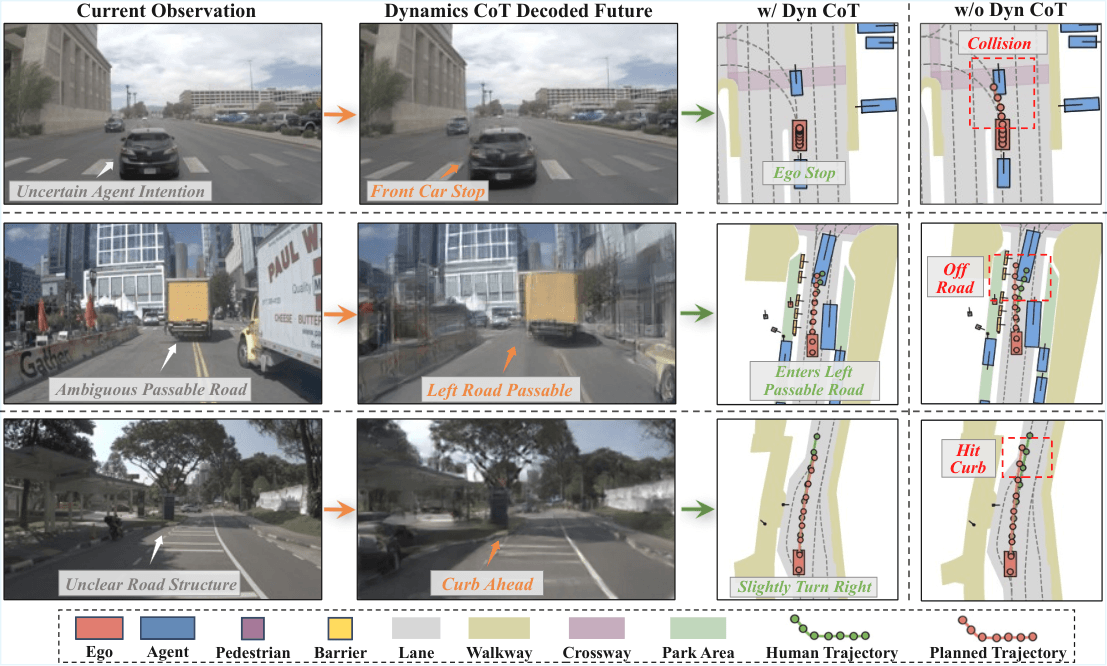
The core idea is Dynamics Chain-of-Thought. DynVLA introduces Dynamics Chain-of-Thought (Dynamics CoT) for autonomous driving Vision-Language-Action models, enabling compact and efficient reasoning over future world dynamics before action generation. Instead of writing out a sentence like "the car ahead might brake" or synthesizing a full future image, the model predicts a handful of discrete dynamics tokens that encode how the scene will evolve, then conditions its trajectory on those tokens.

Why existing chain-of-thought falls flat for driving
Driving VLAs inherit their reasoning style from language models, where writing out intermediate steps helps. But driving is a spatiotemporal problem, not a linguistic one. Textual CoT lacks fine-grained spatiotemporal understanding, and Visual CoT introduces substantial redundancy due to dense image prediction. Predicting every pixel of a future frame just to figure out that a pedestrian will step off a curb is enormous overkill, and it blows up inference latency in a system where every millisecond counts.
The authors frame the gap this way: driving needs a representation that is spatiotemporally precise, computationally cheap, and physically interpretable. A short token sequence hits all three, provided you can train a tokenizer that actually captures the right things.
Splitting the world into ego and environment
The trick in the Dynamics Tokenizer is separating what the ego vehicle is doing from what everything else is doing. The team introduces a Dynamics Tokenizer that disentangles ego-centric and environment-centric dynamics, and regularizes it with ego action supervision and cross-view consistency, enabling physically meaningful and planning-oriented dynamics representations.
Concretely, adjacent camera frames go through a dynamics encoder that produces two streams. Both streams are discretized through vector-quantized codebooks into a small set of tokens. The ego stream is regularized by the ground-truth ego action so its codes correspond to real steering and acceleration decisions. The combined tokens are then decoded to reconstruct the future image and bird's-eye-view map from the current state, which forces the tokens to actually carry the information needed to predict what happens next.
A nice consequence of this decoupling: dynamics are transferable. You can lift the tokens from one scene, inject them into another, and decode a plausible counterfactual future where a different vehicle behavior is playing out. That is the kind of interpretability you never get from a textual trace.

Three training stages, ending in GRPO
The pipeline runs in three distinct phases, and each does one job:
- Stage 1 - Tokenizer training. Learn the Dynamics Tokenizer by reconstructing future frames and BEV maps from adjacent observations. This produces the discrete dynamics codebook.
- Stage 2 - Supervised fine-tuning on Dynamics CoT. Train the VLA to emit dynamics tokens first, then action tokens. This is where the model learns to think before acting.
- Stage 3 - Reinforcement fine-tuning. Apply GRPO with a trajectory-level reward and KL regularization against the SFT checkpoint to push decision quality further.
The team performs SFT on Dynamics CoT to enable explicit reasoning over future dynamics, and further applies RFT to improve decision quality. The GRPO stage in the released code uses a driving simulator to score candidate trajectories, closing the loop between predicted dynamics and downstream planning performance.

Benchmarks and results
The authors evaluate on three settings that stress different aspects of driving. Extensive experiments on NAVSIM, Bench2Drive, and a large-scale in-house dataset demonstrate that DynVLA consistently outperforms Textual CoT and Visual CoT methods. NAVSIM is a real-world open-loop benchmark built on nuPlan data. Bench2Drive is a closed-loop CARLA benchmark that catches compounding errors that open-loop metrics miss. The in-house dataset covers harder interaction-heavy scenes.
The ablations reported on the project page tell the more interesting story. Compared against a direct-action baseline and against textual and visual CoT variants, Dynamics CoT wins on planning scores while cutting inference latency substantially versus the visual CoT baseline. Predicting a hundred or so dynamics tokens is orders of magnitude cheaper than autoregressively generating a future image.
What is actually new here
The novelty isn't "add reasoning to a driving VLA." That's been tried repeatedly. The novelty is the choice of representation for the reasoning trace:
- Discrete, learned, world-model tokens instead of natural language or pixels. This keeps the CoT budget tiny while retaining spatiotemporal fidelity.
- Explicit ego-versus-environment factorization inside the tokenizer, supervised with ego action, which grounds part of the code in real physical decisions.
- Transferable dynamics. Tokens learned in one scene can be injected in another to counterfactually roll out alternate futures, which is unusual for driving policies and useful for debugging.
- Latency-efficient inference. The reasoning tokens are short enough that you keep the benefits of chain-of-thought without the runtime hit that killed visual CoT for real deployment.
Availability and practical notes
Code is released at yaoyao-jpg/DynamicsVLA. The main branch ships an Emu3-backbone implementation, with a separate qwen branch for a Qwen backbone. Training data and pretrained checkpoints are hosted on ModelScope under ShuyaoShang/DynVLA_Training_Data, and the repo includes the full NAVSIM v1.1 devkit vendored under inference/navsim.
The hardware footprint is not trivial. The authors used 8x 48GB L20 GPUs for stages 1 and 2, and 8x 140GB H800s for the GRPO stage. If you are trying to reproduce on smaller hardware, the README suggests reducing per-device batch size and gradient accumulation for stage 3 first, since that is the heaviest step. For teams already running VLA-based planners, the more interesting move is to lift just the Dynamics Tokenizer and Dynamics CoT format into an existing stack rather than retrain from scratch.
The bigger question the paper opens up is whether "compressed world-model tokens as CoT" generalizes beyond driving. Robotics manipulation has the same tension between vague language traces and expensive video prediction. If a small dynamics codebook works there too, this could turn into a general recipe for physically grounded reasoning in embodied models.