
Chinese Academy of Sciences' CodeV-SVA Beats GPT-5 at Chip Verification
A specialized 14B model matches GPT-5 on translating natural-language specs into SystemVerilog Assertions, trained on synthetic data grounded in real open-source hardware.
 Pro
Takeaways
- CodeV-SVA specializes 8B and 14B LLMs for translating natural language into SystemVerilog Assertions.
- CodeV-SVA-14B hits 75.8% Func.@1 on NL2SVA-Human and 84.0% on NL2SVA-Machine, beating GPT-5 and DeepSeek-R1.
- Training data is synthesized by grounding LLM-generated SVAs in large-scale open-source RTL modules.
- Bidirectional NL to SVA to NL translation is used as an automated filter for semantic equivalence.
- Evaluated on a human-corrected version of NVIDIA's FVEval benchmark using Cadence JasperGold.
- Models and evaluation code are released; dataset and training code are planned.
Hardware verification is one of those quiet time-sinks that eats roughly 70% of chip design effort, and a big chunk of that goes into hand-writing SystemVerilog Assertions (SVAs) - the temporal logic checkers that formal tools use to prove an RTL design actually behaves the way the spec says. A team from the Chinese Academy of Sciences has now released CodeV-SVA, a family of specialized LLMs (8B and 14B) that translate natural-language properties into SVAs and, according to their DAC 2026 paper, match or beat GPT-5 and DeepSeek-R1 on the standard benchmarks.
Why general-purpose LLMs stumble on SVAs
Verification engineers formulate temporal logical assertions from natural-language specifications and RTL code, and employ simulation or formal verification tools such as Cadence JasperGold to ensure that the RTL implementation satisfies the specified constraints. The job requires deep expertise, and hardware verification consumes around 70% of development time in modern SoC design, yet existing industrial practices still rely on manual assertion writing that becomes increasingly untenable as systems get more complex.
Frontier LLMs have been thrown at the problem (this is the NL2SVA task), but they trip over two issues that don't show up in normal code generation:
- There is almost no high-quality training data. Real-world SVAs live inside proprietary verification suites, and the open corpus is tiny compared to what exists for Python or C++.
- You can't easily tell if a generated SVA is correct. Two SVAs can look completely different textually but be logically equivalent, and vice versa. There is no cheap unit-test analog for temporal logic.
RTL-grounded synthesis instead of textbook examples
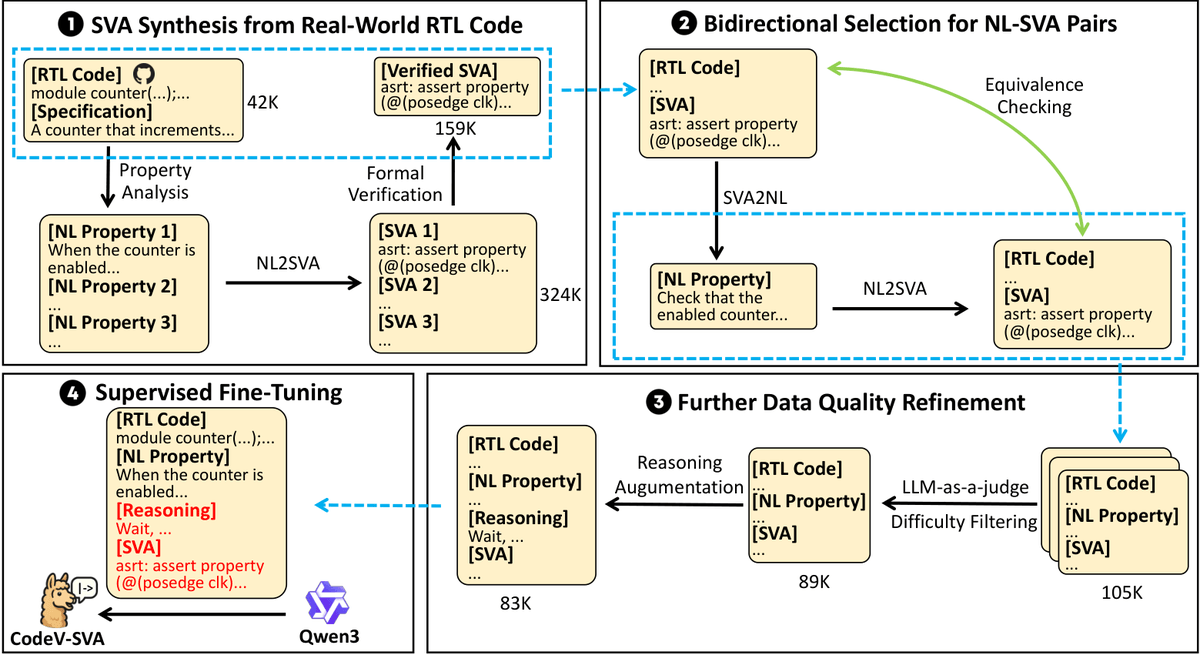
The core idea in CodeV-SVA, a family of large language models designed to translate natural-language verification properties into SystemVerilog Assertions is to stop relying on toy examples and instead ground synthesis in actual open-source hardware. The pipeline feeds large-scale open-source RTL modules to an LLM and asks it to generate the SVAs a verification engineer would plausibly write for that specific code. Because the assertions are tied to real signals, real FSMs, and real handshakes, the resulting corpus reflects the diversity of properties that appear in production designs rather than the narrow patterns you find in tutorials.

The plot above compares the lexical diversity of this RTL-grounded corpus against three baselines - Textbooks, DeepCircuitX and VERT. Higher TF-IDF distance means the samples cover more distinct vocabulary and structures. The new pipeline sits well above the alternatives as data scales up, which is exactly what you want if you're trying to train a model that generalizes to unseen designs.
Using bidirectional translation as a correctness filter
The second challenge - deciding whether a synthesized (NL, SVA) pair actually says the same thing - is where the paper's title clicks. Instead of relying on a single translation direction, the authors run bidirectional translation: they translate the natural-language description into an SVA, then translate the SVA back into natural language, and keep only pairs that survive the round trip with consistent semantics. Cases where the two directions disagree are filtered out. It is a cheap, fully automated proxy for semantic equivalence that avoids invoking a formal solver on every candidate.
Numbers that actually beat GPT-5
The team evaluated on FVEval, NVIDIA's formal-verification benchmark, but with a twist: they employ human experts to recheck the FVEval benchmark, correcting or removing erroneous tests. Correctness is measured with Func.@k, which uses JasperGold to formally verify that generated assertions are functionally equivalent to the reference.
| Model | NL2SVA-Human Func.@1 | NL2SVA-Machine Func.@1 |
|---|---|---|
| DeepSeek-R1-671B | 74.6 | 81.0 |
| GPT-5 | 71.8 | 81.8 |
| DeepSeek-V3.1-671B | 63.1 | 83.8 |
| GPT-4o | 64.1 | 68.5 |
| Qwen3-14B (base) | 61.6 | 75.3 |
| CodeV-SVA-8B | 72.0 | 83.5 |
| CodeV-SVA-14B | 75.8 | 84.0 |
A 14B specialized model beating a 671B reasoning model on the human-authored split is the headline result. Just as interesting: the 8B version already outperforms GPT-4o by a wide margin, which makes this genuinely usable on a single GPU inside an EDA pipeline where you cannot send RTL to a public API.
What is actually released
- Models on Hugging Face: CodeV-SVA-14B, an 8B variant, and an 8B no-think variant for lower-latency inference.
- Evaluation code: the SVAClient / SVAServer stack that wraps JasperGold behind an HTTP interface, plus the corrected FVEval subsets.
- Reproducible harness: a modified vLLM server for inference, Slurm scheduling scripts, and the Func.@k scoring pipeline.
The dataset itself and the data-synthesis and training code are marked as coming later in the repo's open-source plan, so full reproducibility of the training run is not yet possible. What is possible today: dropping the 14B checkpoint into a local verification flow, pointing it at your own natural-language properties, and formally checking the generated SVAs against your RTL without ever touching a hosted frontier model.
Where it fits and where it does not
NL2SVA is only one half of the assertion problem. As recent work on the pipeline points out, writing SVAs first requires extracting intended properties from specification documents in natural language, and only then translating those properties into formal syntax. CodeV-SVA handles the second half. If your specs are ambiguous, contradictory, or scattered across PDFs, you still need a property-extraction step (or a human) upstream. Similarly, models like this don't replace formal solvers - they produce candidate assertions that a tool like JasperGold still has to prove.
For teams already using assertion-based verification, the tradeoff is straightforward: a 14B open model that runs on-prem and hits parity with the best closed models on the narrow task of turning a written property into a syntactically and semantically correct SVA. That is a much smaller ask than a general Verilog copilot, and it happens to be where a lot of the manual grind actually lives.