
Chinese Academy of Sciences' APEX-Searcher Fixes How AI Agents Learn to Search
A new agentic RAG framework splits planning and execution across RL and SFT, delivering up to 13% gains on multi-hop QA benchmarks.
 Pro
Takeaways
- APEX-Searcher splits agentic RAG into RL-trained planning and SFT-trained execution to fix credit assignment.
- Introduces SEPR, a set-based F1 reward using Hungarian matching over sentence embeddings.
- Achieves +9% EM on 7B and +13.2% on 3B over the strongest agentic RAG baseline.
- Trained on Qwen2.5-3B and 7B with verl for GRPO and 360-LLaMA-Factory for SFT.
- Ablation shows an untrained planner actually hurts smaller models compared to no planning.
- Optimal setup uses 3 retrieved documents per hop and up to 5 reasoning hops.
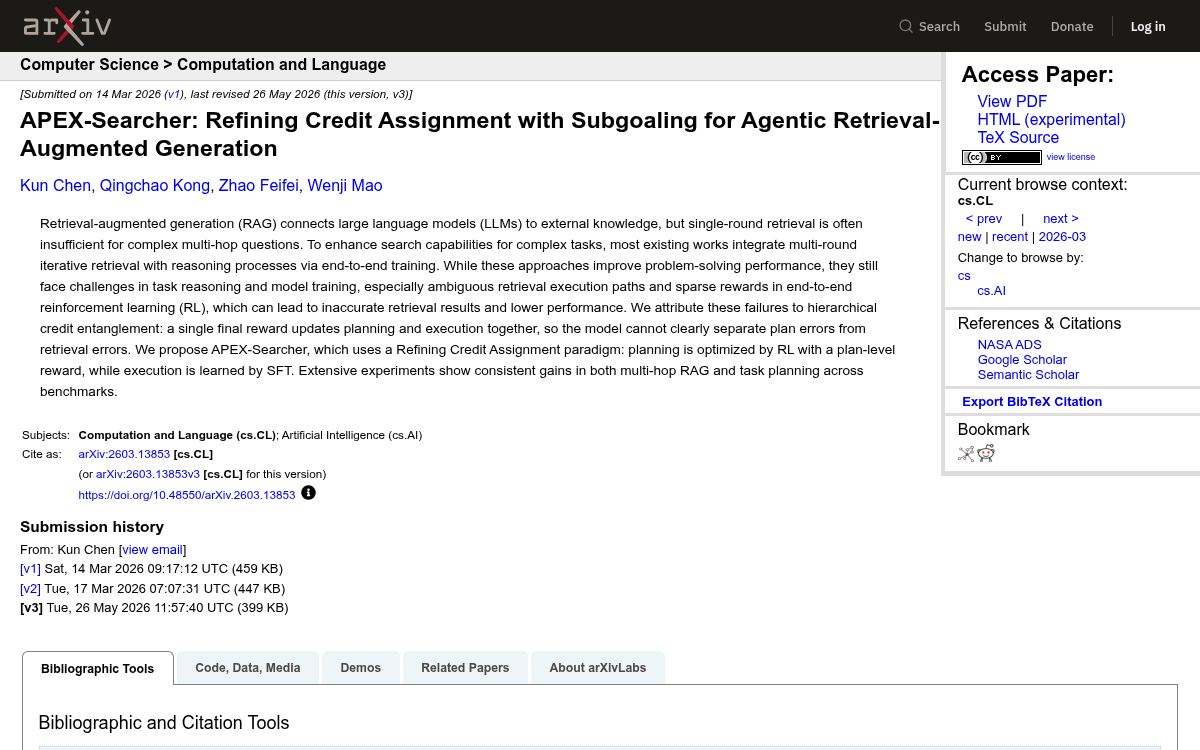
Retrieval-augmented generation works well when the answer sits in a single passage, but breaks down on multi-hop questions where a model has to chain several pieces of evidence together. A team from the Chinese Academy of Sciences has introduced APEX-Searcher, a framework that argues most current agentic RAG systems are training their models with the wrong signal, and proposes a cleaner way to split the work between a planner and an executor.
The core diagnosis is something the authors call hierarchical credit entanglement. In end-to-end agentic RAG, a single sparse final reward updates planning and execution together, so the policy gradient cannot tell whether an error comes from planning or execution. A correct plan can get punished because retrieval failed, and a broken plan can slip through because the executor happened to guess right. The result is the looping and stagnation many developers have hit when training search agents with plain RL.
Two stages, two training signals
APEX-Searcher decomposes the pipeline into an Agentic Planning stage that breaks a complex query into sub-questions, and an Iterative Sub-Task Execution stage that resolves each sub-question through multi-round retrieval. The insight is that these two jobs need different kinds of training.

Planning is treated as an open-ended reasoning task where a complex query can have many semantically equivalent decompositions, so there is no unique gold plan to imitate, which makes RL a good fit. Execution, by contrast, is more mechanical: generate a query, check if you have enough information, extract facts. Once the plan is fixed, each sub-task follows relatively regular templates with limited branching, making SFT a better fit since RL would only add unnecessary variance.
The SEPR reward
The most novel piece is the planning reward, called Set-Equivalence Plan Reward (SEPR). Instead of comparing generated plans to a gold plan token by token, SEPR treats plans as sets of sub-questions and scores them semantically. The pipeline works like this:
- Encode each sub-question in both the generated and gold plans with a sentence transformer.
- Build a cost matrix from cosine similarity and run the Hungarian algorithm to find the optimal one-to-one matching.
- Keep only pairs whose similarity exceeds a threshold of 0.8, then compute an F1 score from the cardinalities of the matched, generated, and gold sets.
The reward is order-invariant and robust to paraphrasing, which matters because there is no single correct way to decompose a question like "Who is the maternal grandfather of Antiochus X Eusebes?" This plan-level signal is fed into the GRPO algorithm, which reduces the dependence of planning learning on the executor's terminal reward.
Execution learned by imitation
For the execution agent, the team took a self-instruct approach: they sampled seed tasks from 2WikiMultiHopQA, HotpotQA, and MuSiQue training sets, generated multi-round instructions using Qwen2.5-32B-Instruct and Deepseek-v3, and filtered aggressively to remove trivial, flawed, or factually incorrect trajectories. That produced a curated set of 14,604 multi-turn retrieval instances.
At inference time, each sub-question triggers a small loop: check if the accumulated knowledge base already contains the answer, otherwise generate a query, retrieve documents, de-duplicate against earlier hops, and decide whether to continue up to H_max hops. Placeholders like #1 and #2 in later sub-questions get resolved against earlier answers before execution, which lets the planner sketch dependencies without hallucinating intermediate facts.
Numbers on multi-hop benchmarks
The authors trained on Qwen2.5-7B-Instruct and Qwen2.5-3B-Instruct using the verl framework for GRPO and 360-LLaMA-Factory for SFT. Evaluation uses Exact Match on four benchmarks. Selected results:
| Method | HotpotQA (7B) | 2Wiki (7B) | MuSiQue (7B) | Bamboogle (7B) | Avg (7B) |
|---|---|---|---|---|---|
| Standard RAG | 0.299 | 0.235 | 0.058 | 0.208 | 0.200 |
| Search-R1-Instruct | 0.370 | 0.414 | 0.146 | 0.368 | 0.324 |
| StepSearch-instruct | 0.386 | 0.366 | 0.226 | 0.400 | 0.345 |
| APEX-Searcher | 0.402 | 0.540 | 0.164 | 0.400 | 0.376 |
Compared with the strongest baseline, APEX-Searcher gives relative EM gains of 9.0% on 7B and 13.2% on 3B, with the biggest jumps on 2WikiMultiHopQA. The ablation is arguably more informative than the headline: enabling all components lifts the 3B model from 13.42 to 33.45, but adding an untrained planner alone actually drops the 3B model from 13.42 to 12.63. A bad planner is worse than no planner at all, because its errors propagate into the executor.
Where it helps and where it does not
MuSiQue is the interesting outlier. APEX-Searcher scores 0.164 on the 7B setting, behind StepSearch's 0.226. MuSiQue has longer reasoning chains and less overlap between sub-question wording and evidence, so a plan-level reward built on sentence-embedding similarity may be less discriminating there. The parameter sweep also suggests two practical defaults: accuracy improves as retrieved documents rise from 1 to 3, but beyond 3 performance plateaus or declines as noise gets introduced. Reasoning hops help monotonically up to 5.
The paper does not link a public code or model release, and the evaluation is limited to English Wikipedia-style corpora, so anyone thinking about porting this to biomedical, legal, or live web retrieval will be extrapolating. Still, the underlying idea, that credit assignment in agentic pipelines should match the shape of each sub-skill, is portable well beyond RAG. If your search agent is looping on repeated queries or collapsing to single-hop behavior, the training signal is a good place to look before the model.