
CHIdeology Workshop Forces HCI to Confront the Politics Shaping AI
A CHI 2026 workshop gathers HCI researchers to name the belief systems hiding inside design choices, alignment methods, and AI research agendas.
 Pro
Takeaways
- CHI 2026 workshop CHIdeology published proceedings treating ideology as a first-class object in HCI research.
- Position papers argue technical AI decisions encode specific worldviews about progress and desired futures.
- Slurry-as-a-Service paper critiques current pluralistic alignment framings for LLMs as flattening real value conflict.
- Policies frozen in silicon paper uses WPR method to expose politics locked into shipped technical artifacts.
- Workshop goals: disambiguate ideology, map where it appears in HCI, develop methods to work with it.
- No code, benchmarks, or models released; contribution is conceptual vocabulary for auditing system assumptions.
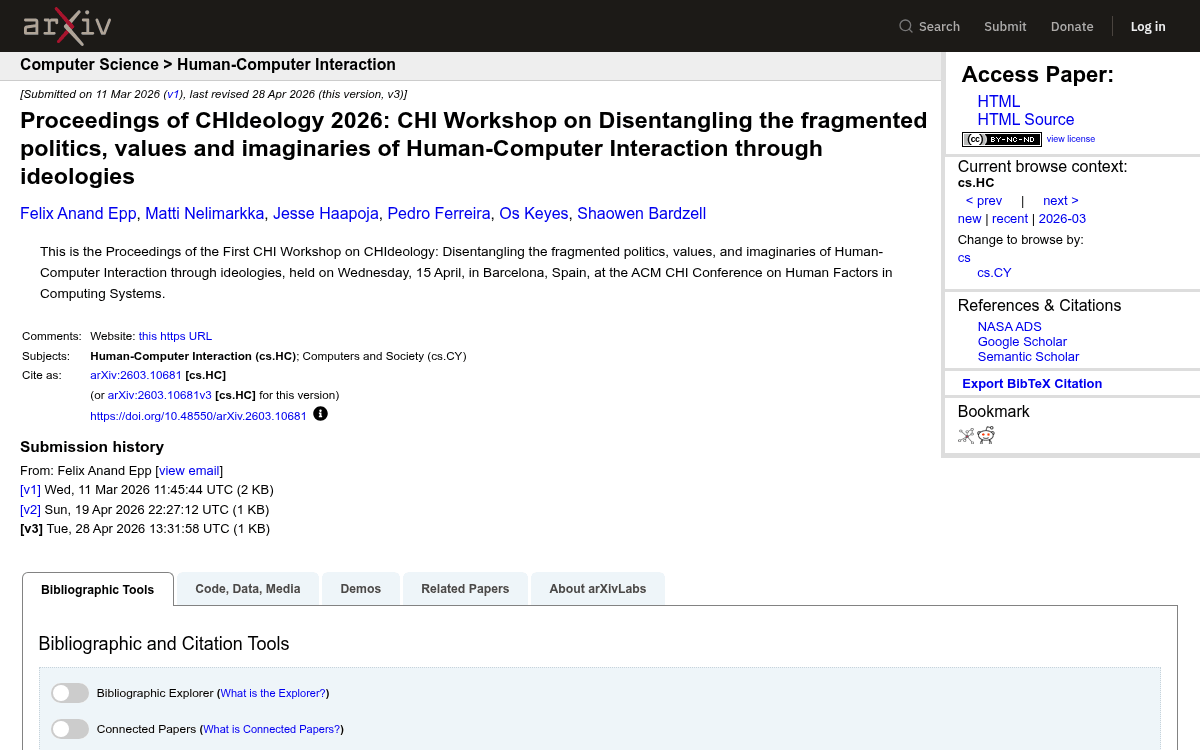
A group of human computer interaction researchers is trying to do something the field has largely avoided: put a name on the political belief systems that quietly shape which problems get solved, whose users count, and what a good interface even looks like. The CHIdeology workshop, held at ACM CHI 2026 in Barcelona, published its proceedings on arXiv as a curated set of position papers that treat ideology as a first-class object of study inside computing research.
For anyone shipping machine learning systems, this matters more than a typical HCI methods debate. Several of the papers take direct aim at how AI is framed, how alignment is operationalized, and how technical artifacts encode policy choices that later become very hard to reverse.
Why HCI is auditing its own worldview
The organizers argue that despite HCI's growing interest in ethics, fairness, and participation, the field still talks about values in a fragmented way. Individual studies critique one system or one dataset, but the underlying belief systems that produce those systems remain implicit. The workshop's stated aim is to identify and curate the ideological forces, tensions, and dilemmas in HCI to make the field's political work more transparent.
Ideology here is used in a specific technical sense. Ideologies are foundational belief systems that shape how groups perceive and interact with the world, informing more specific group attitudes and shaping how individual members of the group interpret events, construct opinions, and engage in social practices and discourse. That definition is worth pausing on: it treats ideology as infrastructure for cognition, not as a slur. A design principle like "reduce friction" or an alignment target like "maximize helpfulness" is an ideological artifact under this framing.
The AI-shaped papers in the pile
Several contributions in the proceedings speak directly to machine learning practice:
- AI: Ideologies of Computing by Andruid Kerne examines how the label "AI" itself carries a worldview about what computation is for and what counts as intelligence.
- Policies frozen in silicon by Jorgen Behrendtz and Lina Rahm uses the What's the Problem Represented to be (WPR) method to show how technical artifacts lock in specific problem-solution pairings, making certain policies effectively immutable once shipped.
- Slurry-as-a-Service: A Modest Proposal on Scalable Pluralistic Alignment by Rachel Hong, Yael Eiger, Jevan Hutson, Os Keyes and William Agnew critiques the current framing of pluralistic alignment. Pluralistic alignment has emerged as a promising approach for ensuring that large language models faithfully represent the diversity, nuance, and conflict inherent in human values, and the paper argues that the way this goal is being operationalized flattens exactly the pluralism it claims to preserve.
- Building a Sensitive Design Methodology from Political Philosophies by Anthony Maocheia-Ricci and Edith Law proposes generalizing value-sensitive design so that any political philosophy can serve as the anchor, rather than defaulting to liberal individualism.
The argument developers should care about
The core claim running through the proceedings is that technical decisions are already political, whether or not the engineers making them acknowledge it. Seemingly technical decisions about AI are deeply embedded within specific worldviews about what constitutes human progress or desired future societies. That is not a rhetorical flourish. It has practical consequences for how features get scoped, how evaluation datasets get built, and which failure modes are treated as bugs versus acceptable trade-offs.
The relationship between ideologies and technological development is no longer a matter of academic discussion, but explicitly stated and openly discussed by current corporate tech leaders as guiding their efforts, and the workshop frames political research in HCI at the level of ideologies. In other words, the industry has already turned ideology into a product roadmap. HCI is trying to build the vocabulary to describe what that roadmap actually contains.
What the workshop is and is not
The proceedings are a position-paper collection, not an empirical study. There is no benchmark, no released model, and no code repository. Submissions were 2 to 3 page position papers in ACM single-column or DIS pictorial format, and selected contributions were published on arXiv with the author's consent. The workshop itself ran three activities: disambiguating the term ideology, identifying where ideology shows up in HCI, and developing new methods for working with it.
The limits are worth stating plainly. If you are looking for an evaluation harness or a drop-in library, this is not it. The contribution is conceptual scaffolding: a shared vocabulary and a set of framing questions that can be reused when auditing a system, writing a model card, or arguing about what an alignment objective should optimize for. That kind of scaffolding tends to be undervalued until a product ships and its embedded assumptions turn into a public incident.
Where this lands
For teams building AI products, the useful move is to treat the workshop as a reading list rather than a finished framework. The extended abstract in the CHI 2026 proceedings lays out the framing, and the individual position papers on arXiv (identified by CHIdeology26 report numbers) go deeper on specific angles like alignment, disability, care ethics, and digital governance. The papers do not agree with each other, which is arguably the point: making the disagreements legible is a precondition for having a real argument about what our systems are for.