
ChemPro Exposes How Frontier AI Crumbles on High School Chemistry Reasoning
A new 4,100-question progressive chemistry benchmark shows LLMs stumble on high-school problems as soon as the wording gets structurally complex.
 Pro
Takeaways
- ChemPro is a 4,100-question progressive chemistry benchmark spanning elementary to JEE Mains difficulty.
- 52 LLMs tested, including o1, o3-mini, GPT-4o, and 45 open-source models across 7B to 70B.
- All models show a 21-point average accuracy drop from easy to competitive tiers.
- Curriculum-identical tiers still show a 13-point gap, isolating articulation complexity as the failure mode.
- Agentic framework ChemCrow matches base GPT-4o, showing tools do not fix reasoning bottlenecks.
- Benchmark published in Artificial Intelligence Chemistry under open educational licenses.
A pair of researchers, Aaditya Baranwal and Shruti Vyas, have released ChemPro, a chemistry benchmark that treats an LLM the way a school system treats a student: give it 4,100 questions arranged from elementary concepts up to competitive-exam problems, then watch where it breaks. The finding is uncomfortable. Frontier models coast through basic chemistry but crumble once problems require chained reasoning, even when the underlying concepts are the same.
Why chemistry has been the missing benchmark
Math, code, and physics have polished evaluation suites. Chemistry does not. Often called the central science, chemistry requires linguistic comprehension alongside symbolic manipulation (e.g., equations), multi-step calculations, and reasoning over reaction mechanisms, and is not bound under a single formal language. Existing chemistry benchmarks tend to target expert or research-level tasks (molecular property prediction, literature QA, agentic tool use), leaving foundational school-level reasoning under-tested.
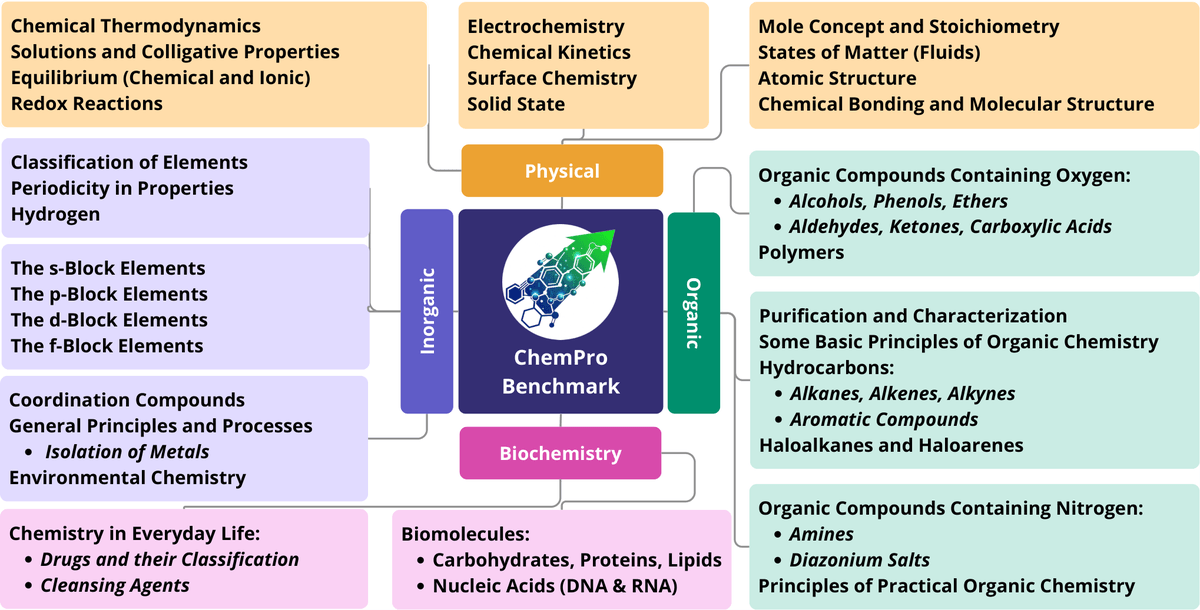
ChemPro fills that gap with a deliberately different design: multiple choice questions and numerical questions spread across fine-grained information recall, long-horizon reasoning, multi-concept questions, problem-solving with nuanced articulation, and straightforward questions in a balanced ratio, effectively covering bio-chemistry, inorganic-chemistry, organic-chemistry and physical-chemistry, carefully designed analogous to a student's academic evaluation for basic to high-school chemistry.
How the benchmark was built
The 4,100 questions are split into four tiers of increasing difficulty, each tied to a real educational source rather than an annotator's opinion. That source-alignment is the methodological hook: JEE Mains (India's competitive engineering entrance) officially follows the NCERT syllabus, so the hardest tier and the middle-hard tier cover the same concepts, they just differ in how the question is worded.

- CP_E: elementary quizzes and web sources
- CP_M: NCERT grades 9-10 textbooks
- CP_C: NCERT grades 11-12 textbooks
- CP_D: JEE Mains problems from 2020-2024
Every question was triple-checked through source verification, expert review, and AI-assisted validation. To guard against training-data leakage, the authors ran a four-pronged probe using GPT-4o (prefix completion, paraphrase testing, content modification, and reverse engineering from concepts), finding roughly 8% potential exposure across the whole set.
What 52 models actually did
The evaluation covered 45 state-of-the-art LLMs, spanning both open-source and proprietary variants, plus seven additional chemistry-specialized and Qwen3 models. Scoring uses accuracy for MCQs and both exact-match and a 10% tolerance metric for numericals, letting the benchmark distinguish conceptual understanding from arithmetic precision.
The headline pattern is a clean staircase downward. Top proprietary reasoning models like OpenAI's o1 hit 97% on the easy tier but drop to 76% on the JEE-level tier. Open 7B models fall from around 90% to the low 50s. Crucially, the drop between CP_C and CP_D averages 13 points across every model tested, even though those two tiers cover identical curriculum content. The only thing that changed was how the problem was articulated.
The real finding: articulation, not knowledge
This is the paper's sharpest claim. Failure is not about missing chemistry knowledge, it is about handling formulation-induced complexity, meaning chained reasoning steps, unit conversions, and cross-condition integration. The authors define this as "articulation complexity" and show it degrades performance regardless of architecture (Qwen, Gemma, Falcon, Phi) or scale (7B to 70B+).

Tool augmentation does not fix it either. ChemCrow, an agentic chemistry framework layered on GPT-4o, matches its base model almost exactly (97/98/84/68 versus 95/98/84/71 across the four tiers). Access to tools does not resolve the underlying reasoning bottleneck.
Where models fail by subfield
Breaking it down by chemistry subfield reveals distinct failure modes:
- Biochemistry: highest accuracy, but computationally heavy problems still trip models up
- Organic chemistry: sharpest drops on multi-step synthesis and spatial reasoning
- Physical chemistry: math setups are fine, precise numerical calculations and unit conversions are not
- Inorganic chemistry: unpredictable, suggesting fragile understanding of bonding and coordination
Why this matters for practitioners
For anyone building science-facing LLM applications, ChemPro is a diagnostic tool rather than a leaderboard trophy. Because tiers are curriculum-aligned, a model's score profile tells you specifically at what articulation depth it stops being reliable. That is more actionable than a single aggregate number. The benchmark is published in Artificial Intelligence Chemistry and built entirely from openly licensed NCERT and JEE materials, with the authors committing to release under full license compliance for research use.
The bigger takeaway is a warning: for chemistry copilots, tutoring systems, or lab automation agents, scaling up parameters or bolting on tools will not automatically make a model competent at problems a strong high-schooler solves. Robustness to reasoning depth needs to be a first-class training target, and ChemPro gives the field a way to measure it.