
ChatGPT Widens What Users Ask but Quietly Narrows What They See
A study of 200,000 ChatGPT conversations finds users ask broader questions than they Google, but get narrower answers back, and adapt accordingly.
 Pro
Takeaways
- Study of 200,000+ WildChat conversations finds 79% of ChatGPT queries are non-searchable, unlike Google-style prompts.
- Non-searchable chats span a broader knowledge space, dominated by image creation, fiction, roleplay, and editing tasks.
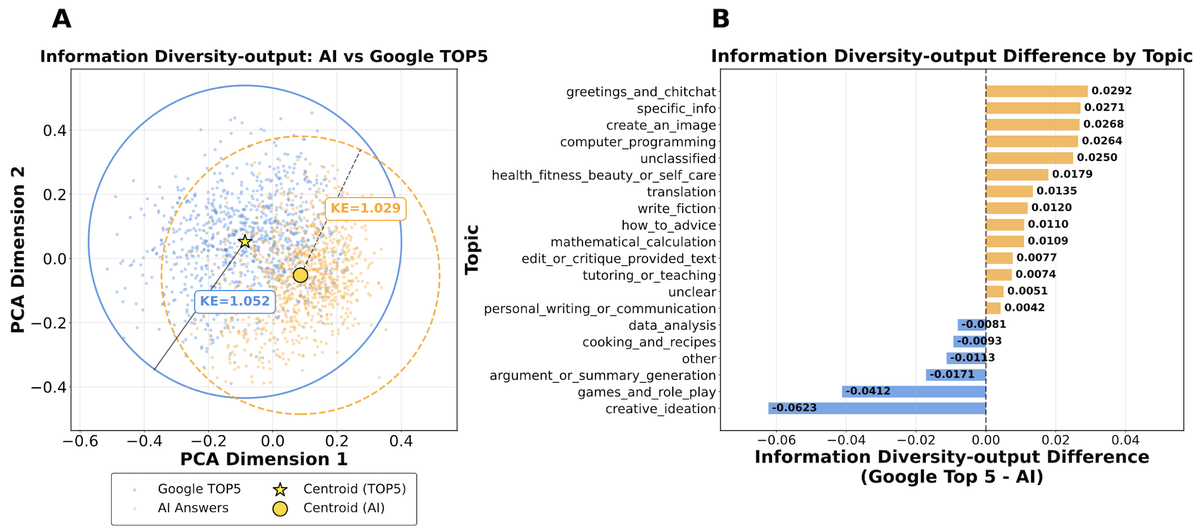
- For the same searchable questions, Google's top results are more diverse than ChatGPT answers (1.052 vs 1.027).
- Exception: on creative topics, ChatGPT outputs are substantially more diverse than Google (1.190 vs 1.114).
- User input diversity drops 4.6% from turn 0 to turn 70; narrow AI answers beget narrower follow-up questions.
- Paper by Yu, Li, Suri, Counts at arXiv:2604.10258, CHI 2026 Extended Abstracts.
A new study analyzing more than 200,000 real conversations between people and ChatGPT lands on an uncomfortable finding: the chatbot expands what users are willing to ask, yet often narrows what they end up seeing. The paper, From Searchable to Non-Searchable, was authored by Yulin Yu (Northwestern University), Yizhou Li (University of Michigan), and Siddharth Suri and Scott Counts (Microsoft Research), and appears in the CHI 2026 Extended Abstracts.
The core question is simple to state and hard to answer: when people swap Google for a chatbot, does their exposure to information get wider or thinner? The authors approach it empirically, comparing ChatGPT queries and responses against the top Google results for the same questions, using semantic embeddings as the measuring stick.
Most ChatGPT prompts would never be typed into Google
The team drew 234,839 conversations from 2023 to 2025 out of Allen AI's WildChat-4.8M, a public log of real user sessions with ChatGPT, then weekly-sampled to balance out temporal spikes. They then trained a lightweight classifier to label each query as searchable, meaning something Google could plausibly answer, or non-searchable, meaning it could not. Labels were bootstrapped with an LLM, verified by human annotators over 3,000 examples, and validated at 91% accuracy on a held-out set.
The headline number: 79% of user queries are non-searchable. Only about one in five prompts to ChatGPT resembles a traditional web search. That share is also shrinking over time, suggesting users are gradually shedding keyword habits and leaning into more open-ended, conversational inquiry.

The topics split cleanly. Searchable queries cluster around information retrieval, tourism, advice-seeking, and math. Non-searchable use is dominated by generative work: image creation, fiction writing, roleplay with chatbots, and editing. People still hit ChatGPT with Google-style queries when they want a fact, but the majority of what they use it for is production rather than retrieval.