
Chalmers Builds a Robot That Rewrites Its Path When Humans Doubt It
A Causal Bayesian Network predicts when humans will judge a navigation robot as incompetent, then rewrites its trajectory to fix the impression.
 Pro
Takeaways
- Causal Bayesian Network predicts perceived robot competence and intention from 8-second navigation trajectories.
- Beats Random Forest baseline with F1 of 0.78 for competence and 0.75 for intention.
- Counterfactual search rewrites low-competence trajectories using breadth-first minimal-edit exploration.
- User study on Prolific shows 83 percent improvement in perceived competence for corrected behaviors.
- Method stays interpretable and works on the small 2,964-sample SEAN Together dataset.
- Limits: manual causal graph, walls and pedestrians excluded, no public code release yet.
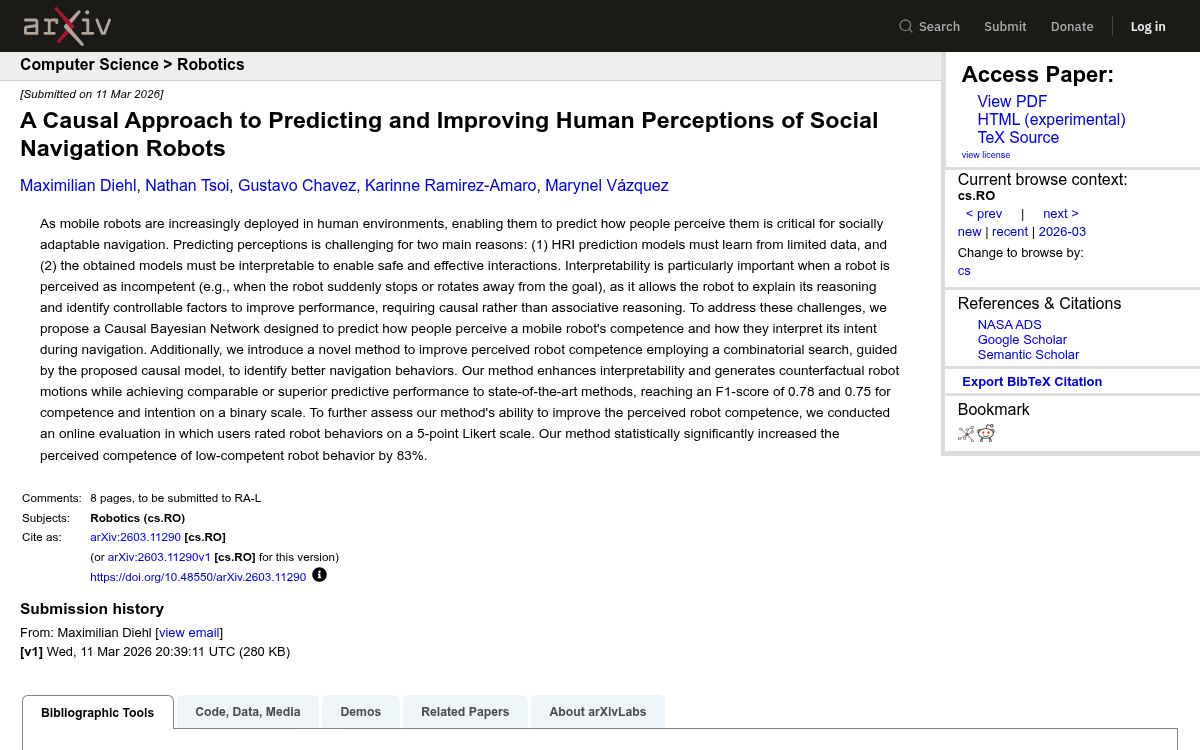
A group of researchers from Chalmers, UT Austin and Yale have built a system that lets a mobile robot predict whether a nearby human thinks it looks competent, and then rewrite its own trajectory when the answer is no. The trick is using a Causal Bayesian Network instead of the usual black-box classifier, which makes the model interpretable enough to explain why a person disliked a behavior and search for a minimal fix.
Why perception is a real robotics problem
Mobile robots are showing up in museums, warehouses and hospitals, and how competent they look matters as much as whether they actually reach the goal. When a robot is perceived as easy to understand, competent, and predictable, its likelihood of adoption increases. The catch is that measuring this normally means interrupting the interaction to make people fill out surveys, which does not scale.
Prior work has tried to predict these perceptions with supervised models, but there are two structural problems. First, HRI datasets are tiny by ML standards. The SEAN Together dataset contains 2,964 interaction samples between a mobile robot and a human in a VR environment and took months to collect. Second, ordinary classifiers only learn correlations. An associative model might suggest that high competence ratings are correlated with a human standing close to the robot, but moving the person closer may not actually improve their perceptions of the robot. If you want to intervene, you need causal reasoning.
Wiring a causal graph for robot following
The authors target the Robot-Following task from the SEAN Together dataset, where a robot guides a VR-controlled human through a warehouse and the follower rates competence and intention on a 5-point Likert scale, later binarized to low or high. Each sample is an 8-second time series of positions, orientations and goal-relative angles.
Because the dataset is too small to learn a causal graph automatically, the structure is hand-specified. The nodes are a compact set of interpretable variables: how much the robot rotated toward the goal, its total rotation over the interval, the initial angular offset, and how its distance to the goal changed. Human motion is modeled as a downstream consequence of perceived competence and intention rather than an input.

Turning trajectories into discrete states
Causal Bayesian Networks need discrete variables, but trajectories are continuous time series. The main methodological contribution is a generalized discretization step that mixes three treatments: time-series variables are grouped with K-means clustering into a number of clusters, treating each sequence as a vector, with cluster centroids defining the intervals; continuous single-valued variables get quantile discretization; and categorical variables use their unique values directly. A hyperparameter search picked ten position clusters and eleven rotation clusters, which end up capturing intuitive patterns like "approaching the goal," "holding orientation" or "rotating away."
Counterfactual search for a better trajectory
Once the network predicts that the current behavior will produce a low competence rating, a breadth-first search walks the space of parent-variable configurations to find the nearest one the model expects to be rated high. Two design choices keep it grounded:
- Transitions can only change one variable by one neighboring interval at a time, enforcing an Occam-razor style minimal edit.
- A candidate parameterization is only accepted if it was observed at least
m=5times in training data, filtering out anomalous configurations the model has no real evidence for.
The output is a target cluster centroid the robot can actually execute: a new position trajectory and rotation profile.

Numbers against a Random Forest baseline
Under leave-one-participant-out cross-validation, the causal model edges out the previously best-reported Random Forest that used navigation plus facial features. Measured by F1, the method outperformed the baseline by 0.047 for competence and 0.044 for intention, and by 0.021 and 0.029 in accuracy. Final F1 lands at 0.777 for competence and 0.751 for intention on a binary scale, using only a subset of the original feature set.
Does the fix actually feel better to humans?
Prediction accuracy is one thing, but the more interesting test is the online study on Prolific with 80 participants rating 20 videos each. When the model correctly flagged behavior as low competence, participants rated the counterfactual trajectories at 3.59 out of 5 compared to 1.96 for the originals, an 83 percent improvement, with F(1,399)=338.36, p<0.0001. Even in the harder case where the model had incorrectly labeled the original behavior as low competence, counterfactuals still improved perceived competence by 27 percent.
Where this actually helps, and where it does not
The practical hook is that this is a lightweight, interpretable module that could sit on top of a motion planner and act as a social critic. Good fits:
- Service, museum or warehouse guide robots where explainability and small-data learning matter more than raw accuracy.
- Systems that need to explain a behavior change to a user, since a CBN gives you a readable causal path.
- Research on legible motion that currently relies on hand-crafted cost functions.
The limits are honest. Pedestrians and walls were dropped from the graph to keep it learnable, which breaks the "no unobserved confounders" assumption and in one scenario steered the robot toward a wall. The causal structure is hand-designed, and the counterfactual videos reused the original follower's motion because there is no way to simulate how a real person would respond to the new trajectory. The authors flag using LLMs to propose candidate causal graphs, and porting the pipeline into a VR user study with a live follower, as next steps. The paper does not currently link a public code release.