
CEFR-Annotated WordNet Lets GPT-4o Label 110K Word Difficulty Levels
Researchers used GPT-4o to align WordNet senses with CEFR proficiency levels, releasing a 110K-instance corpus and a classifier scoring 0.81 Macro-F1.
 Pro
Takeaways
- New CEFR-annotated WordNet assigns proficiency levels to 10,644 senses across 5,645 lemmas via GPT-4o gloss alignment.
- SemCor-CEFR corpus provides 110,000+ sense-in-context annotations, ten times larger than the existing CompLex 2.0.
- Fine-tuned GPT-4.1 mini plus knowledge base classifier reaches 0.81 Macro-F1 on the six-level CEFR task.
- Models trained on the auto-annotated corpus generalize better to other genres than those trained on gold EVP data.
- All resources released openly on Zenodo under WordNet and SemCor licenses.
- Coverage limited to ~5% of WordNet; C1 and C2 senses remain the hardest to classify accurately.
WordNet is one of the most widely used lexical resources in natural language processing, but for anyone actually trying to learn English, it has a well-known problem: it splits words into too many senses, and it never tells you which of those senses a beginner should care about. A new paper attempts to fix that by grafting the Common European Framework of Reference for Languages (CEFR) proficiency scale onto WordNet, using a large language model to do the alignment work at scale.
The team behind the CEFR-Annotated WordNet released three artifacts: a version of WordNet with sense-level proficiency labels, a large sense-and-level annotated corpus derived from SemCor, and a contextual classifier that predicts a word's CEFR level from its usage. Everything is available on Zenodo.
Why WordNet trips up language learners
WordNet organizes roughly 155,000 words and 207,000 senses of nouns, verbs, adjectives, and adverbs into hierarchical semantic networks, linking them by relations like hypernymy and synonymy. That richness powers machine translation, semantic analysis, and question generation, but it was never designed for education, and its overly fine-grained sense distinctions force learners to figure out which meaning of a word fits their proficiency level.
The CEFR gives a natural fix. It defines six proficiency levels from A1 (beginner) to C2 (proficient), each anchored in what a learner should be able to understand and produce. If every WordNet sense carried a CEFR tag, a learner could ignore advanced meanings of a word and focus on the ones matching their level. The problem is that manually labeling hundreds of thousands of senses is prohibitive.
Letting an LLM do the alignment
The authors used the English Vocabulary Profile Online from Cambridge as the source of gold-standard CEFR labels, since it already annotates individual senses. The trick is transferring those labels onto WordNet's sense inventory, which uses different definitions (glosses). Their pipeline has three steps:
- For each shared word plus part-of-speech pair, extract all glosses from both WordNet and the EVP.
- For every WordNet-EVP gloss pair, ask GPT-4o (checkpoint
gpt-4o-2024-08-06) to rate semantic similarity on a seven-point scale, where 1 means exactly the same meaning and 7 means completely different. - If the score is 1 or 2, transfer the EVP CEFR level to that WordNet sense. Otherwise, skip it.
The threshold of 2 was chosen as a conservative compromise, since restricting to score 1 boosts confidence but reduces coverage, while allowing score 3 introduces false alignments from partial semantic overlap and mismatched gloss granularity.
The exhaustive sweep produced 10,995 CEFR annotations for 10,644 WordNet senses across 5,645 lemmas, with nouns making up about 44% and the B1-B2 intermediate band accounting for roughly half of all labels. The annotated WordNet covers about 80% of all single-word senses in the EVP, but only around 5% of WordNet's full sense inventory, since EVP itself is limited.
Verifying labels without a gold standard
Since WordNet has no gold CEFR levels to validate against, the authors instead built classifiers. They created the SemCor-CEFR corpus by projecting their annotations onto the widely used SemCor sense-tagged corpus, ending up with a large-scale corpus containing more than 110,000 sense and level annotations across over 5,500 WordNet senses. Then they trained models to predict a word's CEFR level from its surrounding sentence and compared them against models trained on EVP gold data.
The logic is simple: if a model trained on the automatically labeled corpus matches one trained on gold data, the automatic labels must be reasonably clean. They tested several approaches:
- ME6 Contextual baseline: BERT embeddings feeding a support vector classifier.
- Zero-shot and few-shot GPT-5: prompt the model with the CEFR scale and ask for a level.
- Fine-tuned GPT-4.1 mini: supervised fine-tuning on EVP, SemCor-CEFR, or a mix.
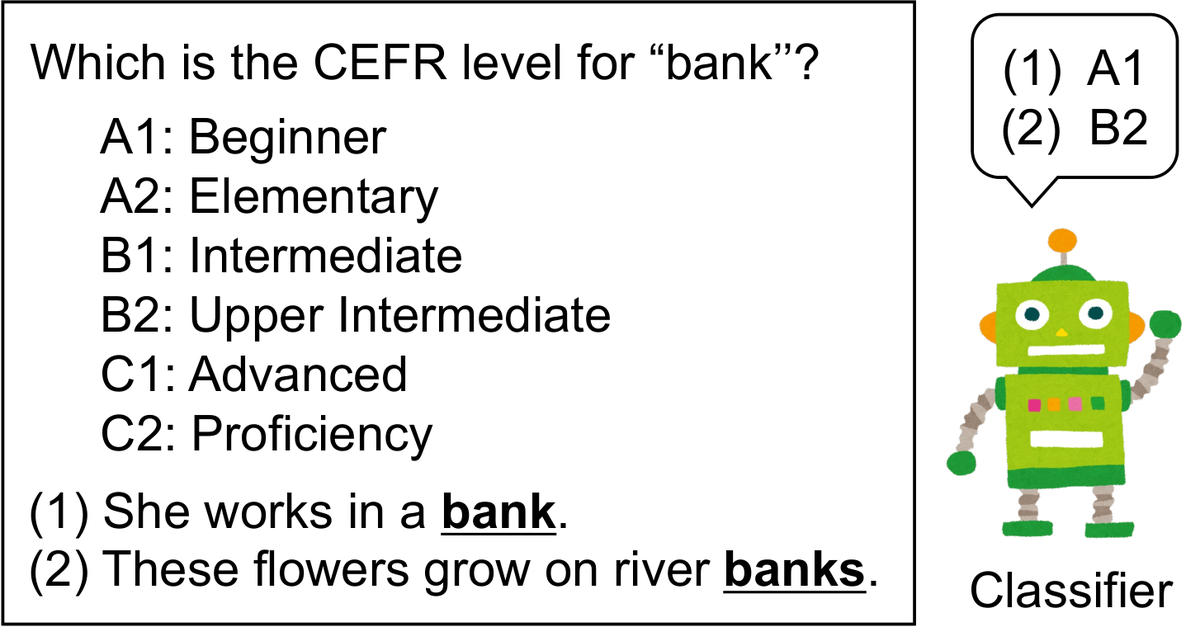
- Fine-tuned plus knowledge base: first check a lookup table of words that only have one CEFR level in EVP, then fall back to the fine-tuned model.
What the numbers show
Zero-shot GPT-5 landed at just 0.42 Macro-F1, and few-shot prompting only pushed it to 0.48, both well below the BERT baseline. Fine-tuning changed the picture dramatically. The fine-tuned model trained on SemCor-CEFR performed comparably to the model trained on gold-standard EVP data, despite being optimized on a completely different dataset, with misclassifications for C1 senses often falling into adjacent proficiency levels.
The hybrid fine-tuned model plus knowledge base trained on the mixture of both corpora hit a Macro-F1 of 0.81, with per-level F1 above 0.8 for every level except B1 and C1. That is the number to remember: a practical classifier that can label an arbitrary word in context with its CEFR difficulty.
The generalization twist
The most interesting finding sits in the discussion. When the authors ran their classifiers against the CompLex 2.0 lexical complexity dataset, which covers Europarl, Bible, and biomedical text, the EVP-only fine-tuned model correlated poorly (Spearman 0.288). The SemCor-CEFR fine-tuned model reached 0.541. This suggests that models fine-tuned solely on EVP may have learned superficial dataset-specific cues with limited transfer, while classifiers trained on the SemCor-CEFR corpus benefit from broad genre coverage plus the annotation quality. In other words, the automatically labeled corpus generalizes better than the gold one.
What you can actually do with it
For anyone building CALL (computer-assisted language learning) tools, reading-assistance apps, adaptive tutors, or LLM-based content generators that need to control vocabulary difficulty, the resources plug in directly. A reader can highlight complex words in a passage for a B1 learner, a generator can be constrained to A2 vocabulary, and a WordNet-based synonym recommender can prefer proficiency-appropriate alternatives.
The main caveats are honest ones. Coverage is only about 5% of WordNet's senses because EVP itself is bounded. C1 and C2 predictions are the weakest, with advanced senses frequently collapsed into B2. The classifiers were not manually spot-checked by CEFR experts, so the reliability evidence is indirect. And multiword expressions are excluded, which matters if you want to analyze textbooks or running text with idioms and phrasal verbs. Still, releasing the annotated WordNet, the 110K-instance SemCor-CEFR corpus, and the classifier as one package makes this a rare bit of shovel-ready infrastructure for the intersection of NLP and language pedagogy.