
Cedars-Sinai's AI Agents Match Human Experts Auditing Hospital Models for Bias
A two-agent LLM system with retrieval-augmented generation matches expert-derived fairness recommendations for clinical AI models, tested on early-onset colorectal cancer.
 Pro
Takeaways
- Two-agent LLM system audits clinical AI fairness by identifying disparities and recommending fairness metrics from literature.
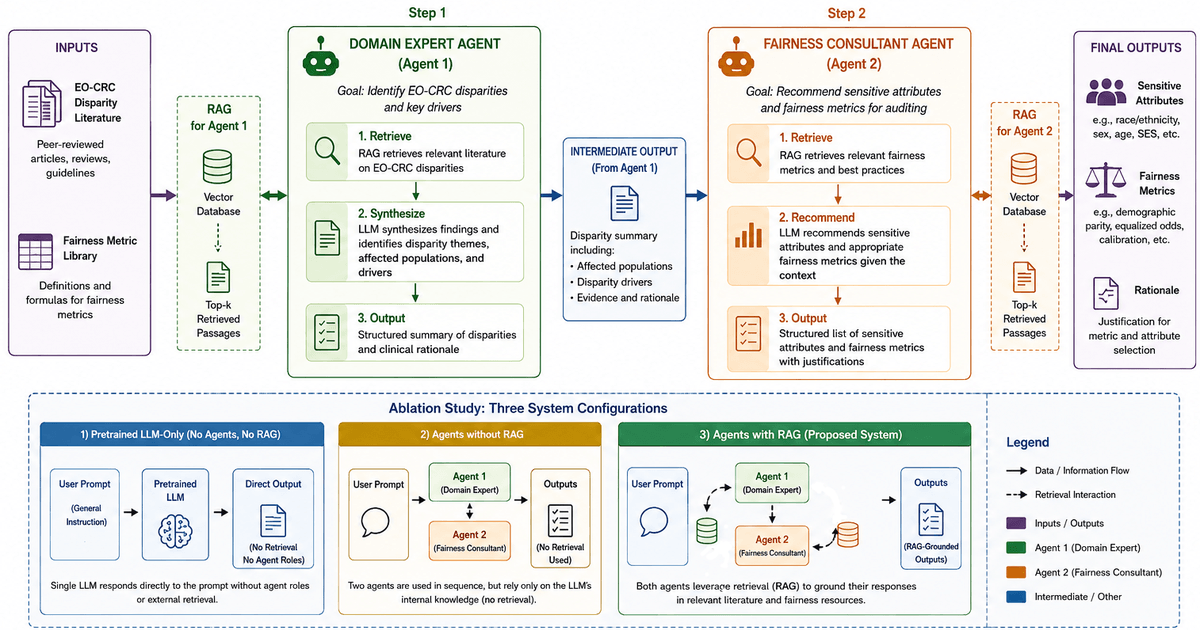
- Domain Expert Agent synthesizes disparity drivers; Fairness Consultant Agent recommends sensitive attributes and metrics as JSON.
- Tested on early-onset colorectal cancer using 39 curated articles and a fairness metric library.
- Ablation across Llama 3.1 8B, GPT-OSS 20B, and GPT-OSS 120B, three conditions, 100 runs each.
- Agent with RAG beat baselines on disparity identification across all model scales, similarity up to 0.830.
- Retrieval gains shrink for fairness metric selection at larger scales, where parametric knowledge suffices.
Clinical AI is moving faster than the humans meant to audit it. Roughly seven in ten U.S. hospitals now run predictive machine learning models inside their electronic health records, yet the cross-disciplinary teams needed to check those models for subgroup bias are scarce. A new study from Cedars-Sinai researchers asks whether a pair of coordinated language model agents can help close that gap, and reports that a retrieval-grounded agent can generate fairness audit recommendations that closely match those written by clinical and fairness experts.
The paper targets early-onset colorectal cancer (EO-CRC), a disease with well-documented demographic disparities. Incidence in adults aged 20 to 49 has been rising by roughly 3% per year, and Black and Hispanic patients, along with those from lower socioeconomic backgrounds, are more likely to face delayed diagnosis, more advanced disease at presentation, and worse survival. Any triage or referral model deployed here can either narrow those gaps or silently widen them.
The expertise bottleneck
The authors frame the core issue as an audit capacity problem. Deciding which fairness metrics are clinically appropriate, such as prioritizing sensitivity for cancer screening versus specificity for birth-outcome prediction, requires domain judgment that generic automation tools lack. Manual review by cross-disciplinary teams is slow, and unmonitored models can drift for months before anyone notices. That is the void the agentic system is designed to fill.
Two agents, one JSON pipeline
The architecture is deliberately simple. A