
CEA LIST's OGSS Teaches AI to Explore Chess Without Catastrophic Blunders
OGSS teaches chess agents to predict dangerous moves before making them, slashing blunder rates while keeping exploration wide open
 Pro
Takeaways
- OGSS is a new framework that adds a learned blunder-prediction model on top of an imitation-learned chess policy to filter risky moves at inference time.
- The blunder model is trained offline from Stockfish evaluations, so no expensive oracle is needed during live play.
- OGSS achieves the lowest blunder rate among all tested methods when exploration ratio exceeds 0.3 -- the hardest operating regime.
- Unlike hard action pruning or SafeDAgger, OGSS soft-weights candidate moves rather than eliminating them, preserving exploration capacity.
- The architecture is domain-agnostic: any setting with an oracle that can label dangerous actions can use this approach.
- The paper is a preprint; no code or model weights have been released yet.
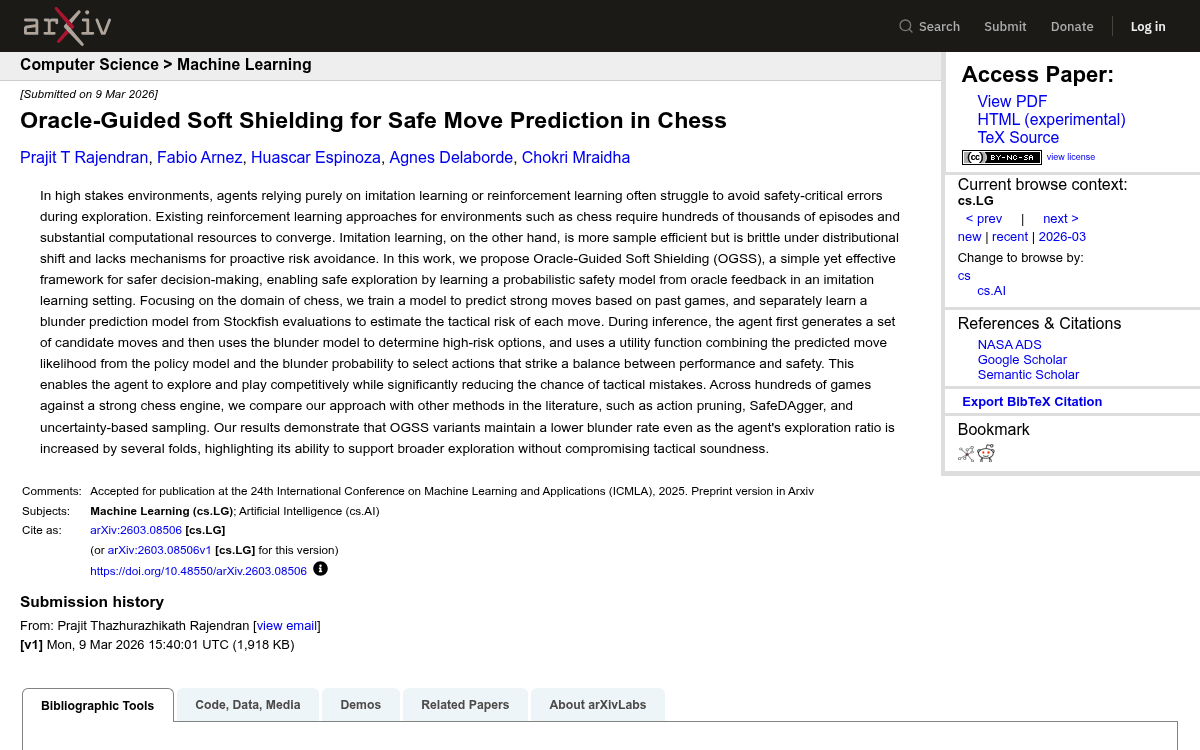
Training an AI to play chess well is one thing. Training it to play chess safely -- meaning it avoids catastrophic one-move mistakes even when exploring unfamiliar positions -- is a much harder problem. A new paper from researchers at CEA LIST and Université Paris-Saclay tackles this head-on with Oracle-Guided Soft Shielding (OGSS), a lightweight framework that wraps a blunder-prediction model around a standard imitation-learned chess policy to filter out tactically dangerous moves at inference time.
The exploration-safety trap
Every agent that learns from data eventually has to venture beyond what it has seen before. In chess, that means playing moves that weren't in the training set. The problem is that both dominant training paradigms handle this poorly in different ways.
- Reinforcement learning (RL): learns by trial and error, but existing RL approaches for environments such as chess require hundreds of thousands of episodes and substantial computational resources to converge.
- Imitation learning (IL): learns by copying expert moves from historical games. Much cheaper, but imitation learning is brittle under distributional shift and lacks mechanisms for proactive risk avoidance. Distributional shift here means: the board positions the agent encounters during a real game start to diverge from the positions in its training data, and small errors compound into disasters.
The result is a dilemma. Let the agent explore and it blunders. Keep it conservative and it stagnates. Intelligent agents deployed in safety-critical environments must make decisions that are not only effective but also safe under uncertainty -- in safety-critical settings like healthcare or industrial robotics, a single poor decision can lead to catastrophic consequences. Chess is a clean, measurable proxy for exactly this class of problem.
A shield that learns from Stockfish
OGSS is a framework for safer decision-making that enables safe exploration by learning a probabilistic safety model from oracle feedback in an imitation learning setting. The "oracle" here is Stockfish, the world's strongest open-source chess engine, which is used offline to label moves as blunders or not -- it is not called during live play.
The system is built from two separate models trained in parallel:
- Policy model: a standard imitation-learned model trained on historical games to predict strong moves.
- Blunder prediction model: trained on Stockfish evaluations to estimate, for any candidate move, the probability that it is a tactical mistake.

During inference, the agent first generates a set of candidate moves and then uses the blunder model to determine high-risk options, and uses a utility function combining the predicted move likelihood from the policy model and the blunder probability to select actions that strike a balance between performance and safety. Think of it as a two-stage filter: the policy model proposes, the blunder model vetos.
A key design choice is that relying on a high-cost or non-interpretable oracle like Stockfish during real-time execution is impractical in many real-world settings, so OGSS bakes the oracle's knowledge into a learned model at training time. The approach learns a blunder prediction model from expert labels, enabling automated, proactive risk assessment during inference -- this eliminates the need for ongoing human supervision, improving scalability.
Three variants, one goal
The paper tests three OGSS variants against a set of baselines. The baselines include:
- Action pruning: hard-filters any move with blunder probability above 50%, then picks randomly from what remains.
- Entropy filtering: filters out moves where the predictive entropy is higher than a particular threshold -- here, risk is approximated via uncertainty instead of oracle supervision.
- SafeDAgger: addresses safety concerns by constraining the novice to act only when it is sufficiently close to the expert. Stockfish acts as the safety arbiter during training.
- Temperature sampling: lower temperatures make the agent more confident and greedy, favoring high-probability moves, while higher temperatures flatten the distribution, encouraging more exploration -- allowing a tunable balance between exploitation and exploration.
The OGSS variants differ in how they combine the policy and blunder scores -- ranging from soft re-ranking of the top-K candidates to a full utility-weighted selection. The key distinction from hard pruning is that OGSS never completely eliminates a move; it down-weights risky ones, preserving the ability to explore.
What the numbers show
Across hundreds of games against a strong chess engine, the approach was compared with action pruning, SafeDAgger, and uncertainty-based sampling. The headline result is that OGSS variants maintain a lower blunder rate even as the agent's exploration ratio is increased by several folds, highlighting its ability to support broader exploration without compromising tactical soundness.
Among all methods with exploration ratio above 0.3, OGSS (top-5 + blunder shield) achieves the lowest blunder rate. That is the critical operating regime -- high exploration is where all other methods degrade fastest, and where OGSS holds its ground.

The real insight: safety as a learned prior
The deeper contribution here is not the chess result itself -- it is the framing. Most safe-RL approaches treat safety as a constraint imposed on the reward function, which requires redesigning the training loop. OGSS treats safety as a learned inference-time filter. You train your policy however you like, then attach a blunder model on top. This is modular and cheap.
While the experiments focus on chess, the core architecture is modality-agnostic and applicable to any domain where high-quality oracles can provide feedback about risky behavior. That is a broad claim, but a credible one: anywhere you have a domain expert (a simulator, a rule engine, a human annotator) who can label actions as dangerous, you can train a blunder-equivalent model and plug it into this framework.
Limitations to keep in mind
The approach has real constraints worth noting:
- It requires a high-quality oracle at training time. Stockfish is free and fast, but in other domains the equivalent oracle may be expensive or unavailable.
- The blunder model is only as good as its training distribution. If the agent explores into positions very far from its training data, the blunder estimates may be unreliable -- the same distributional shift problem that plagues the policy model.
- The paper benchmarks against a strong chess engine, but does not report Elo ratings or win rates directly, making it harder to gauge absolute playing strength.
- No code or model weights have been publicly released alongside the preprint.
For teams working on safe decision-making in structured domains -- think robotic planning, autonomous vehicle maneuver selection, or clinical decision support -- OGSS offers a practical template: use your best available oracle to build a risk model offline, then let that model act as a soft safety layer at deployment time. The chess framing makes the ideas concrete and the results measurable, which is exactly what this area of research needs more of.