
CDM Cuts Medical AI's Prediction Errors by 30% Without Adversarial Training
A new diffusion-based approach predicts full distributions of counterfactual patient outcomes under sequential treatments, beating transformer and RNN baselines under heavy confounding.
Takeaways
- Causal Diffusion Model (CDM) applies denoising diffusion to counterfactual outcome prediction in longitudinal data.
- Produces full probabilistic distributions of future outcomes rather than point estimates, capturing uncertainty.
- Uses Relational Self-Attention borrowed from video understanding, plus residual layers and cosine noise scheduling.
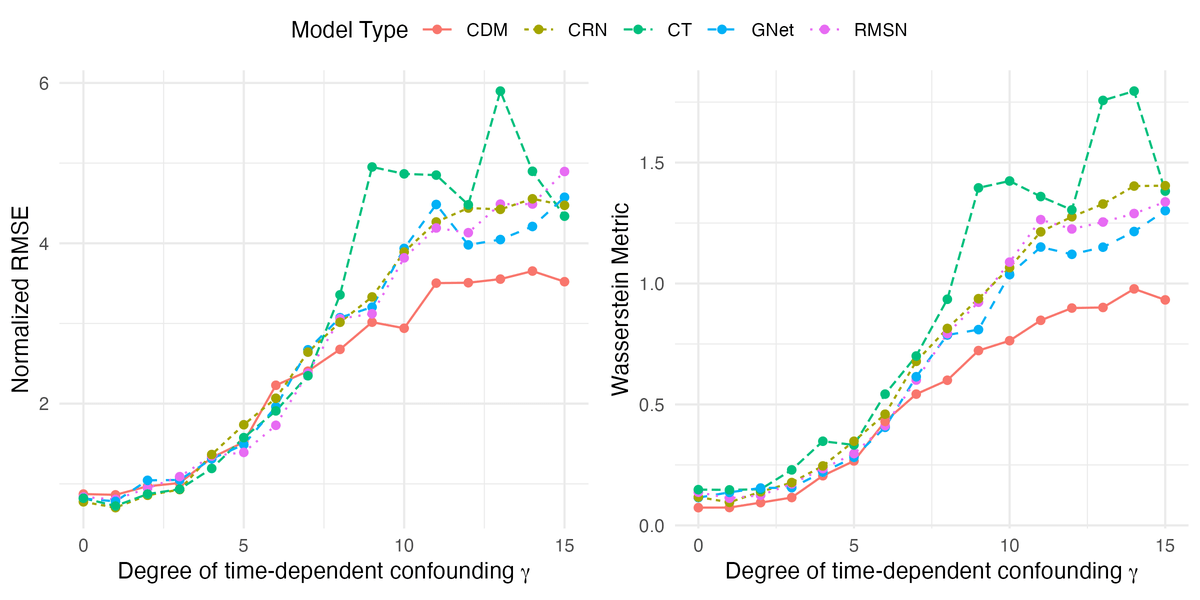
- Achieves 15-30 percent lower 1-Wasserstein distance than R-MSN, CRN, GNet, and Causal Transformer baselines.
- Wins on point-estimate RMSE too under heavy time-varying confounding (gamma ≥ 8).
- Skips inverse-probability weighting and adversarial balancing entirely; conditioning alone handles confounding.
Predicting how a patient would respond under a different sequence of treatments is one of the hardest problems in medical machine learning. A new method called the Causal Diffusion Model (CDM) adapts the denoising machinery behind image generators to produce entire probability distributions of counterfactual trajectories, rather than a single expected value.
On a widely used tumor-growth simulator, CDM cuts distributional error (measured by 1-Wasserstein distance) by 15 to 30 percent compared to the previous state of the art, while matching or beating point-estimate accuracy in high-confounding regimes.
Why counterfactuals in time series are so painful
You only ever observe one timeline per patient. If a clinician gave chemo at week 3, you never see what would have happened without it. Prior deep learning approaches like R-MSN (a sequence-to-sequence LSTM using propensity score weighting), CRN (an encoder-decoder RNN with domain adversarial training), and the Causal Transformer, which uses separate transformer subnetworks for covariates, treatments, and outcomes with cross-attention, all try to fix this by producing point estimates of expected outcomes.
Two things break that setup in practice:
- Time-varying confounding. Treatments depend on the patient's evolving state. Sicker patients get more aggressive therapy, and that state also drives future outcomes, biasing any naive predictor.
- No uncertainty. A point estimate cannot answer questions like "what is the probability blood pressure stays in a safe range under plan X?" Existing methods bolt on Monte Carlo dropout at inference to fake uncertainty, but that is a coarse approximation.
The CDM authors argue you should model the entire conditional distribution of future outcomes directly, and diffusion is a natural tool for that job.