
CauKer Matches Real-Data AI Training With 20x Less Time Series Data
Researchers show time series foundation models can match real-data pretraining quality using only algorithmically generated synthetic sequences, with clean scaling laws to boot.
 Pro
Takeaways
- CauKer is a synthetic time series generation algorithm that enables training classification foundation models without any real-world data.
- Models pretrained on CauKer data nearly match real-data baselines using up to 20x fewer samples, with less than 0.1% accuracy drop for Mantis on UCR.
- CauKer fuses Gaussian Process kernel composition with Structural Causal Models to produce sequences with both realistic temporal patterns and discriminative cluster structure.
- Unlike real-world datasets, CauKer data produces clean, predictable scaling laws across dataset sizes (10K–10M) and model sizes (1M–783M parameters).
- The approach also transfers to forecasting: Chronos pretrained on 0.5B CauKer timepoints nearly matches models trained on 84B real-world timepoints.
- Code is open-source on GitHub; paper presented at FMSD @ ICML 2025.
Training a time series foundation model is expensive. You need large, carefully curated collections of real-world sequences, and even then you often run into data scarcity, licensing headaches, and the risk of leaking test data into your pretraining corpus. A new research paper from a team spanning Université Paris Cité, Huawei Noah's Ark Lab, and Inria proposes a way around all of that: skip the real data entirely and generate everything from scratch.
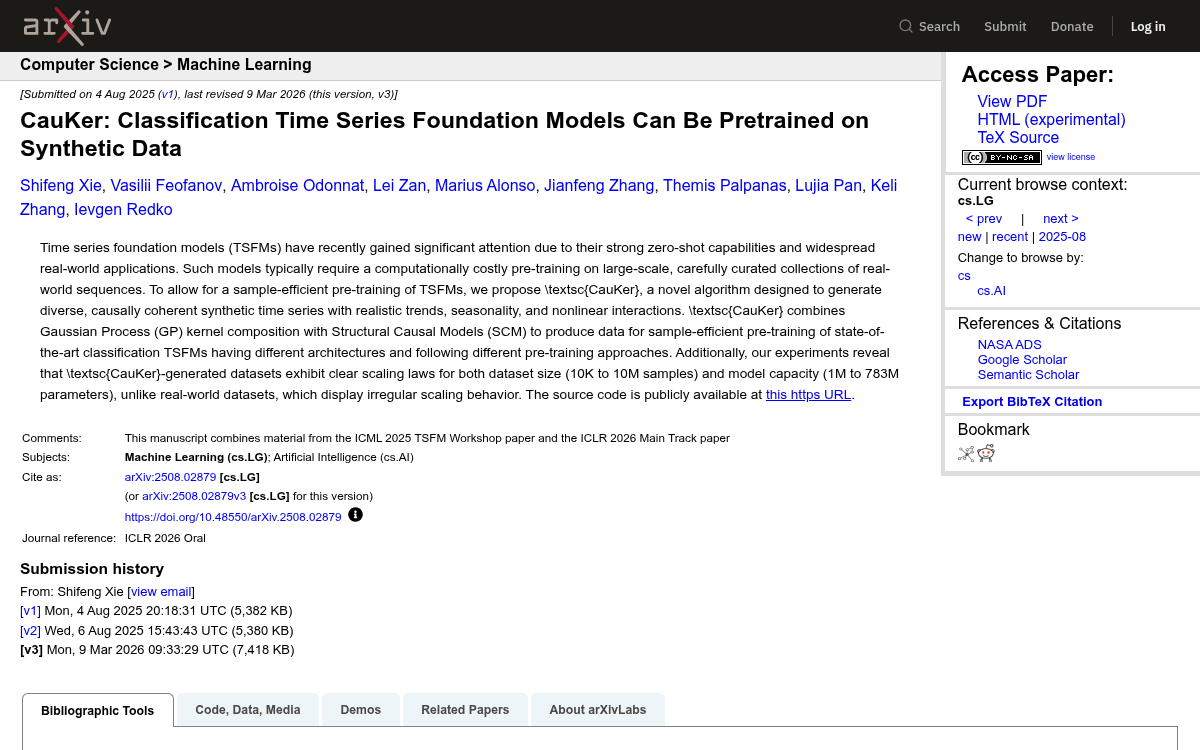
The paper introduces CauKer (short for Causal-Kernel generation), a synthetic data generation algorithm specifically designed for pretraining time series classification foundation models. The core claim is striking: models pretrained only on CauKer-generated data can nearly match the performance of models pretrained on real-world corpora that are up to 20 times larger.
Why real data is a problem for classification
The time series foundation model space has exploded recently, with models like Chronos, MOMENT, and Mantis achieving strong zero-shot performance across diverse domains. These models are usually trained on large-scale pretraining dataset collections gathered from different application domains, with recent works using as many as 300 billion timepoints. But there is a catch specific to classification: unlike forecasting, which has rich public corpora, time series classification lacks diverse and rich pretraining corpora.
Existing workarounds have their own problems. Real-world classification benchmarks like UCR and UEA are heterogeneous and imbalanced, which turns out to actively hurt scaling. Classification accuracy on UCR datasets does not monotonically increase with the size of training data when trained on subsets of the UEA dataset, likely due to domain mismatch between UEA and UCR, further exacerbated by the lack of diversity within the real-world time series of UEA. In other words, throwing more real data at the problem does not reliably help.
Two ingredients, one pipeline
CauKer's key insight is that synthetic data for classification needs to satisfy two distinct requirements simultaneously: the sequences must look like real time series (seasonality, trends, periodicity), and they must form meaningful clusters that a model can learn to separate. Prior work only solved one half of this.
- Forecasting-oriented generators like KernelSynth (used in Chronos) produce smooth, realistic-looking sequences via Gaussian Process (GP) kernel composition, but they use zero-mean priors that strip out the level information a classifier needs.
- Tabular SCM generators like the one in TabPFN produce rich nonlinear dependencies between samples, but they discard all temporal structure like seasonality and trends.
CauKer fuses both approaches. By unifying kernel composition with a Structural Causal Model (SCM) processing, CauKer inherits the periodic structure of Gaussian processes while simultaneously injecting causal semantics through directed edges. A Structural Causal Model (SCM) is a directed acyclic graph (DAG) where each node represents a variable and each edge encodes how one variable causally influences another, here applied to time series nodes rather than scalar variables.

How it works, step by step
The algorithm proceeds in five stages for each generated sample:
- Kernel bank sampling: Randomly draw one or more covariance kernels from a bank of 36 options (RBF, periodic, rational quadratic, dot product, etc.).
- Kernel composition: Combine the sampled kernels using random additive and multiplicative operations to form a composite GP prior.
- Root node generation: Sample time series from the composite GP, using non-zero mean functions (linear, exponential, or anomaly spikes) as root nodes in the causal graph. This is the critical difference from forecasting generators, which use zero means.
- Causal graph propagation: Build a random DAG and propagate root signals through it, applying a randomly chosen nonlinear activation (ReLU, sigmoid, sine, modulo, Leaky ReLU) at each edge.
- Output selection: Pick a subset of graph nodes as the final observed time series.
The SCM layer adds almost no computational cost. More than 99% of the time attributed to the generator itself is spent in GP kernel sampling, while constructing the SCM graph and propagating signals through it contributes less than 1% of the total cost. In fact, CauKer is slightly faster than the KernelSynth baseline it builds on, generating 1,000 sequences of length 512 in about 122 seconds versus 182 seconds for KernelSynth.

Clean scaling laws, finally
One of the paper's most interesting findings is about scaling behavior. In language and vision, it is well established that more data and bigger models reliably improve performance. For time series, this has been murky. Models trained on real-world UEA data do not exhibit consistent performance gains with increasing model size, reinforcing the notion of limited data diversity or domain mismatch. Conversely, models trained on CauKer-generated datasets consistently demonstrate increased accuracy as model size grows.
The researchers tested this across a wide range: dataset sizes from 10K to 10M samples, and model capacities from 1M to 783M parameters (using MOMENT's Small, Base, and Large variants). CauKer-generated datasets exhibit clear scaling laws for both dataset size and model capacity, unlike real-world datasets, which display irregular scaling behavior. This matters because predictable scaling is what lets you plan compute budgets and confidently invest in larger models.
Matching real-data performance with far less data
The headline result is sample efficiency. The team pretrained two well-known classification TSFMs, Mantis (8M parameters, contrastive learning) and MOMENT (77M parameters, masked reconstruction), on CauKer data and compared them against their original checkpoints trained on large real-world corpora.
| Model | Pretraining set | Size | UCR acc. (%) |
|---|---|---|---|
| Mantis | CauKer | 100K | 78.55 |
| Mantis | Original real-data corpus | 1.89M | 78.66 |
| MOMENT | CauKer | 10M | 77.49 |
| MOMENT | Time Series Pile | 13M | 78.85 |
The performances of Mantis and MOMENT can be almost matched by pretraining them on synthetic datasets that are approximately 20x and 1.3x smaller than the original pretraining datasets used by each of the papers. The accuracy drop in the case of Mantis is less than 0.1%, while for MOMENT it barely exceeds 1%. Crucially, the CauKer-pretrained models never saw any UCR data during pretraining, making their evaluation strictly out-of-distribution, while the original checkpoints had access to UCR training splits.
It even transfers to forecasting
As a bonus experiment, the authors pretrained Chronos (in four sizes: tiny, mini, small, base) on 0.5 billion CauKer-generated timepoints, compared to the official Chronos checkpoints trained on 84 billion timepoints from a mixed real-and-synthetic corpus. Despite pretraining on approximately 160x fewer observations, the Chronos models trained on CauKer lag the official checkpoints by only approximately 2-3% in zero-shot MASE. This was achieved without any task-specific modifications to the CauKer pipeline.
Where it falls short
The method is not universally better. Domain-wise analysis on UCR shows that CauKer pretraining underperforms on spectroscopy datasets by about 5.5%, likely because those datasets tend to be very small (under 50 samples), which amplifies the advantage of models that saw UCR training splits during pretraining. The paper also only evaluates univariate inputs, and the current experiments cover just two model architectures. Multivariate pretraining is flagged as future work, though the authors note that different nodes of the same SCM can be interpreted as channels of a multivariate series.
Code and reproducibility
The paper was presented at the FMSD workshop at ICML 2025. The source code is publicly available on GitHub, including the full CauKer generation pipeline and pseudocode. The experiments use publicly available model checkpoints for Mantis and MOMENT, and evaluate on the standard UCR benchmark (128 datasets) as well as the WOODS out-of-distribution benchmark (17 datasets). The clean scaling law results and the near-parity with real-data pretraining suggest that for practitioners building or fine-tuning time series classifiers, CauKer offers a practical path to generating unlimited, diverse, license-free pretraining data on demand.