
CATFA-Net Beats U-Net and Transformers on Medical Image Segmentation
A new hybrid encoder architecture pairs ConvNeXt with a lightweight transformer variant to push medical segmentation accuracy while cutting GPU memory usage.
 Pro
Takeaways
- CATFA-Net is a hybrid ConvNeXt plus transformer architecture for medical image segmentation, released with PyTorch code.
- Sets new state-of-the-art Dice scores on GLaS (94.48%) and ISIC 2018 (91.55%) across five benchmarks.
- New Context Addition Self-Attention cuts complexity from O(N squared) to O(N squared / R) via spatial reduction.
- Drops positional encodings in favor of a depthwise fully convolutional module for implicit spatial structure.
- Small variant uses 3.7x less GPU memory than UCTransNet while beating it by 2 percent IoU.
- Cross-dataset test on unseen TNBC data confirms stronger generalization than transformer-heavy baselines.
Medical image segmentation has been stuck in a familiar tug of war. Convolutional networks like U-Net capture crisp local textures but miss the bigger picture across an image, while transformers see globally at the cost of data and GPU memory. A new architecture called CATFA-Net tries to fix both problems at once, and its authors report new state-of-the-art Dice scores on two widely used medical benchmarks.
Convolutional blocks excel at dense prediction, but their inability to capture long-range dependencies has capped their ceiling. Transformers plug that gap, though not for free. Hybrid encoders bring their own baggage: limited inductive bias, high computational overhead, and shaky robustness to data variability. CATFA-Net is a re-engineered hybrid designed to keep the accuracy gains from attention while trimming the compute bill enough for realistic clinical hardware.
A two-armed encoder that talks to itself
The architecture uses a dual-branch encoder feeding a lightweight convolutional decoder. One branch is a ConvNeXt backbone that handles fine-grained local features. The other is a new Hierarchical Context Addition Transformer (H-CAT) branch that models long-range relationships between image regions. At every stage, the two branches exchange information through a fusion module rather than being concatenated only at the end.

The transformer branch replaces standard multi-head self-attention with what the authors call Context Addition Self-Attention. Standard attention has quadratic complexity in the number of tokens, which becomes brutal on high-resolution medical scans. CATFA-Net attacks this in two ways:
- A Context Attention Pre-attention (CAP) module concatenates the key and query tensors and passes them through 1x1 convolutions with a GELU activation, so the key representation carries cross-image similarity information before attention is computed.
- A spatial reduction block downsamples the key and value tensors, dropping complexity from O(N squared) to O(N squared / R), where R is a stage-wise reduction ratio set to {8, 4, 2, 1} across the four encoder stages.
Positional encodings, a common source of headaches when input resolution changes, are dropped entirely. Instead the block uses a depthwise fully convolutional network (d-FCN) that leans on a 3x3 depthwise convolution to inject spatial structure implicitly. Ablating this choice against Swin Transformer style positional encoding showed a Dice drop of 0.8 percent at 224x224 and 1.3 percent at 512x512 when positional encoding was enabled, the opposite of what you would want.
Fusing convolution and attention without losing information
The interesting glue between the two branches is the Cross-Channel Trans-Convolutional Fusion Attention (CCTFA) module. It runs two operations in parallel: a cross-channel attention that treats the transformer output as queries and the ConvNeXt output as keys, softmaxed and multiplied against a globally-pooled value tensor from the transformer arm, plus a spatial attention pathway that cleans noise from the ConvNeXt features and injects positional context. The outputs are summed, so both channel-wise global cues and spatial details survive downsampling.

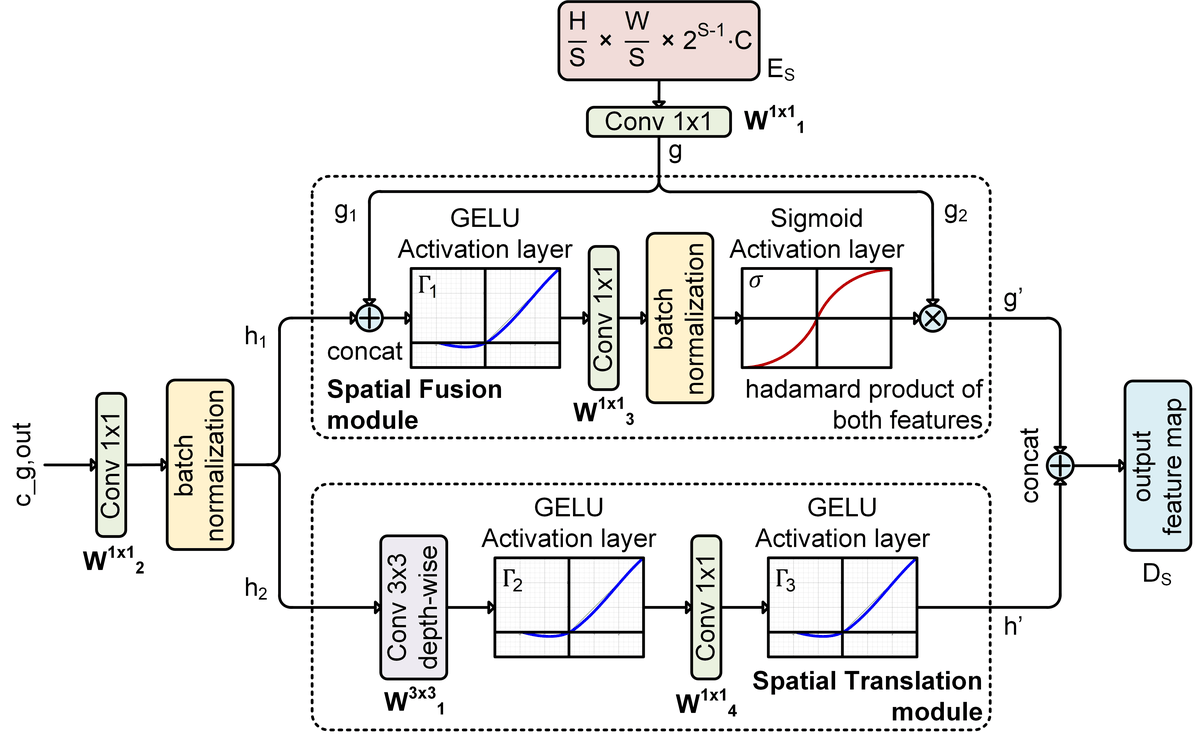
On the decoder side, skip connections pass through a Spatial Attention Fusion Gate (SAFG) that suppresses background responses before they hit the upsampling blocks. The decoder blocks themselves are a variant called Conv-G-NeXt, which swaps Layer Normalization for Batch Normalization and reintroduces a GELU activation after the final 1x1 convolution. Small changes, but the ablations show BN over LN was worth 0.6 Dice points on GLaS, and adding the extra GELU another 0.8 points.
The benchmark numbers
The team evaluated two variants, CATFA-Net-S (ConvNeXt-T plus a smaller H-CAT) and CATFA-Net-L (ConvNeXt-B plus a deeper H-CAT), against twelve baselines including U-Net, U-Net++, nnUNet, TransUNet, SwinUNet, UCTransNet, and FCT. Evaluations on five public datasets (GLaS, DS Bowl 2018, REFUGE, CVC Clinic DB, and ISIC 2018) show CATFA-Net leading across the board, with new state-of-the-art Dice scores on GLaS at 94.48 percent and ISIC 2018 at 91.55 percent.
| Dataset | Task | CATFA-Net-L Dice | Best prior baseline |
|---|---|---|---|
| GLaS | Gland segmentation | 94.48% | FCT at 93.30% |
| ISIC 2018 | Skin lesion | 91.55% | TransUNet at 90.64% |
| CVC Clinic DB | Polyp | 95.30% | UCTransNet at 94.17% |
| DSB 2018 | Nuclei | 92.14% | UCTransNet at 92.23% |
| REFUGE | Optic disc/cup | 90.55% | SwinUNet at 89.25% |
The improvements were validated with one-tailed Wilcoxon signed-rank tests across 10 random-seed runs, with p-values under 0.01 for most comparisons. A cross-dataset test, training on GLaS and evaluating on the unseen TNBC dataset, showed CATFA-Net-L pulling ahead by roughly 2 Dice points over the strongest prior method, which matters more than in-distribution wins when you think about deployment.
Small model, big memory savings
The efficiency story is where the smaller variant earns its keep. CATFA-Net-S outperforms UCTransNet and FCT by roughly 2 and 1.6 percent IoU respectively while using 3.7x and 2.6x less GPU memory. Training clocks in around 4 seconds per epoch on a Tesla V100, comparable to a plain U-Net. The larger CATFA-Net-L variant is heavier at over 150M parameters and takes about 9 seconds per epoch, though it still uses roughly 1.5x less memory than UCTransNet.
Where it falls short
The authors are honest about the limits:
- The large variant is still resource-heavy for edge deployment or embedded imaging hardware.
- Performance is bound to annotated data, which remains scarce in medical imaging.
- Cross-domain drops still happen. Dice fell from 94 percent on GLaS to 78 percent when transferring to TNBC, better than baselines but far from clinical-grade transferability.
- Shared failure modes with all baselines on acquisition artifacts, such as shadow regions in the DSB 2018 samples that every model misclassified as nuclei.
All experiments were run on a single NVIDIA Tesla V100 with 32 GB, trained with AdamW at learning rate 1e-4, batch size 8, generalized Dice loss, and 50 epochs. The team has released a PyTorch implementation, which makes it straightforward to plug the CAT block, CCTFA fusion, or SAFG gate as drop-in modules into existing U-Net style pipelines even if you don't want the full architecture.