
Catalyst4D Carries 3D Edits Through Time 4x Better Than Rivals
A new framework propagates single-frame 3D Gaussian edits across time using anchor-based motion guidance and color uncertainty refinement.
 Pro
Takeaways
- Catalyst4D transfers single-frame 3D Gaussian edits to full dynamic 4D scenes with spatial and temporal coherence.
- Anchor-based Motion Guidance uses optimal transport via Sinkhorn to match region-level anchors between original and edited clouds.
- Color Uncertainty-guided Appearance Refinement fixes flickering by warping the reliable first frame using Gaussian-driven optical flow.
- Beats Instruct 4D-to-4D, CTRL-D, and Instruct-4DGS on CLIP, VBench, EditScore, and VE-Bench across three datasets.
- Trains in about 50 minutes on a single A100, compatible with existing 3D editors like DreamCatalyst and DGE.
- Accepted at CVPR 2026; code coming soon at the project page.
Editing static 3D scenes has gotten remarkably good, but the moment things start moving, the wheels come off. A new CVPR 2026 paper called Catalyst4D takes aim at that gap, proposing a way to take a high-quality edit made on a single frame of a dynamic scene and propagate it consistently through time without the flickering, drift, and bleed-through that plague current approaches.
The setup is simple to describe: give the system a 4D Gaussian Splatting scene (essentially a moving 3D point cloud reconstruction of a video), edit the first frame using any existing 3D editor, and let Catalyst4D carry the edit forward across every timestep and viewpoint. The framework propagates single-frame 3D edits to dynamic sequences and works for both precise local modifications and global style transfer.
Why 4D editing keeps breaking
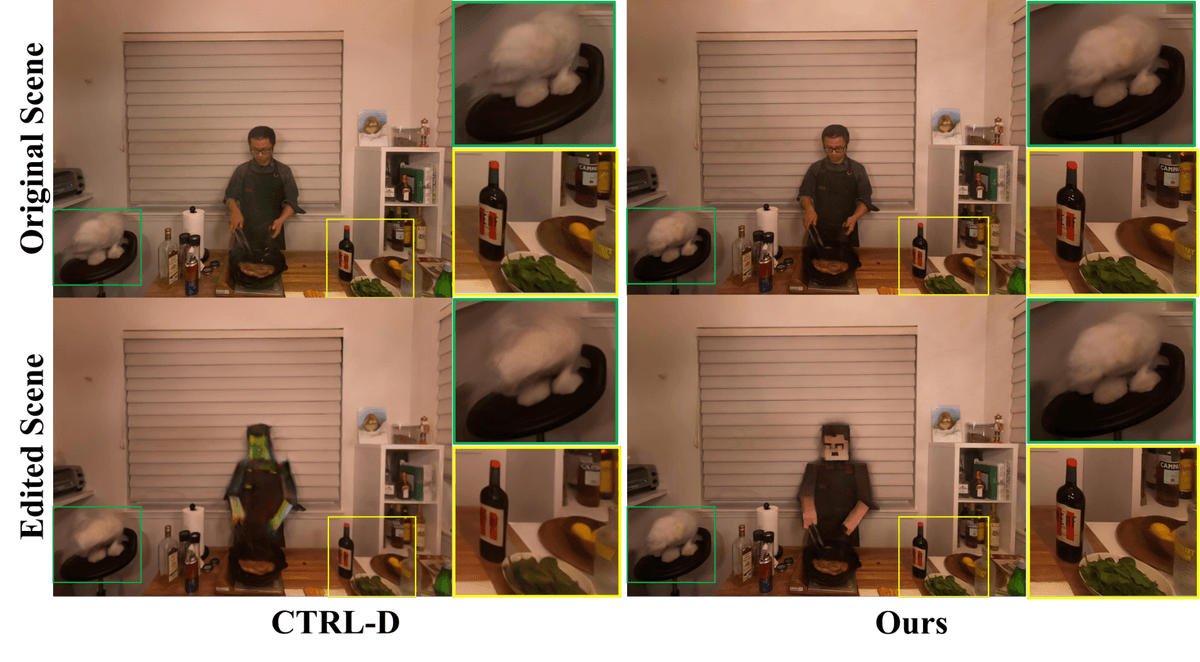
Most existing dynamic editing pipelines cheat by working in 2D. Methods like Control4D, Instruct 4D-to-4D, CTRL-D, and Instruct-4DGS adapt pre-trained 2D diffusion models to 4D representations, using edited 2D frames or Score Distillation Sampling to supervise the 4D scene. The problem is that 2D edits have no idea about geometry, so temporal flickering and unintended changes to background objects are common.
The obvious alternative would be to reuse the deformation field that a 4D Gaussian model already learned during reconstruction. That fails too. The deformation network was trained only on the original geometry, so once you clone, split, or prune Gaussians during editing, it has no motion prior for the newly introduced points and generalizes poorly to edited configurations. Catalyst4D sidesteps this by decoupling the spatial edit from the temporal propagation entirely.
Anchors instead of point-wise matching
The core trick is a module the authors call Anchor-based Motion Guidance (AMG). Instead of trying to match every edited Gaussian to an original Gaussian (which is noisy and unstable when the edit changes local density), AMG builds a sparse set of region-level anchors on both the original and edited point clouds.

The anchor construction itself is clever. The system computes a minimum bounding sphere around the dynamic object, samples lines through it, and keeps an anchor wherever a line consistently intersects a local neighborhood of Gaussians inside a thin cylinder. This filters out sparse noise and yields anchors that are structurally representative rather than density-dependent. Then a soft correspondence matrix between anchor sets is computed using unbalanced optimal transport solved via the Sinkhorn algorithm, which handles the fact that the edited cloud may have very different point counts and topology from the original.
Once anchors are matched, the deformation of every edited Gaussian is computed as a weighted blend of the deformations of the original Gaussians attached to its corresponding source anchor. Weights combine each source Gaussian's opacity with its Mahalanobis distance to the target. This is where the geometry-awareness pays off: motion signals from the hand region no longer leak into the torso the way they do with naive k-nearest-neighbor matching.
Fixing colors that flicker
The second module, Color Uncertainty-guided Appearance Refinement (CUAR), cleans up appearance artifacts that show up when previously occluded Gaussians become visible later in the sequence. Those Gaussians never received direct color supervision during editing, so they tend to flicker.
CUAR estimates a per-Gaussian color uncertainty by measuring how much each Gaussian's spherical harmonics color varies across time and view. High-uncertainty regions are flagged with an artifact mask. Then, using Gaussian-driven optical flow, the reliably-edited first frame is warped forward to serve as pseudo ground-truth supervision. A foreground L1+SSIM loss corrects the flagged regions while a background L1 loss freezes everything else in place, avoiding the global inconsistencies that diffusion-based post-hoc correction tends to introduce.
The numbers
The team benchmarks on three standard dynamic scene datasets: the multi-camera DyNeRF and MeetRoom datasets, plus the monocular HyperNeRF dataset, comparing against Instruct 4D-to-4D, CTRL-D, and Instruct-4DGS. On CLIP similarity (semantic alignment with the edit prompt) and VBench temporal consistency, Catalyst4D wins across all three scenes. Training takes about 50 minutes on a single A100, versus 2 hours on 2 GPUs for Instruct 4D-to-4D.

The more interesting numbers come from the supplementary material, where the authors argue that CLIP and VBench are too coarse for fine-grained 4D editing and evaluate on two newer perceptual metrics:
- EditScore (instruction-following and visual fidelity): Catalyst4D scores 7.375, versus 5.618 for the next-best method (Instruct-4DGS).
- VE-Bench (local temporal consistency): 1.080, versus 0.256 for Instruct-4DGS and 0.163 for CTRL-D, roughly a 4x margin.
Ablations confirm both modules matter. Removing AMG drops CLIP similarity from 0.252 to 0.245 and makes hand-motion signals leak into unrelated body parts. Removing CUAR produces visible flickering on surfaces like armor plates and flowers that get uncovered mid-sequence.
Where it breaks
Catalyst4D inherits the weaknesses of its upstream components. Since it does not retrain the deformation network or re-optimize Gaussian density, its output quality is bounded by the underlying 4D reconstruction. On noisier reconstructions (the authors show a D-NeRF trex scene) background Gaussians can drift into the edited foreground and cause artifacts. It also depends on the initial 3D edit being spatially consistent to begin with.
The framework itself is a wrapper around existing 3D editors rather than an editor itself. Experiments plug in DreamCatalyst, DGE, and SGSST as first-frame editors, and use Swift4D and 4DGS as the underlying 4D representations. Any improvement upstream flows straight through.
Availability
Code is listed as "Coming Soon" on the project page. For now, the paper and video demos are the main resources. Given the modular design, once released it should be straightforward to swap in newer 3D editing baselines or 4D reconstructors as they arrive, since Catalyst4D operates as a propagation layer on top of them rather than a monolithic replacement.