
Case Western's AMI Cuts Wearable Sensor Usage by 48% Without Losing Accuracy
A new framework called AMI lets wearable medical devices skip redundant sensor readings and idle unused modalities, cutting sensor usage nearly in half while lifting accuracy.
 Pro
Takeaways
- AMI is an end-to-end framework that jointly learns which sensors to activate and how to infer from partial data.
- It combines Gumbel-Sigmoid modality gating, patch-wise Sigma-Delta sensing, and a cross-modal transformer.
- Cuts sensor usage 48.8% on average while beating prior SOTA by 1.9% across three biomedical datasets.
- Reports 31.9% lower latency and 24.8% lower energy versus continuous multimodal baselines.
- Hits 99.12% on MHEALTH activity recognition using only 38% of sensing on average.
- Designed for closed-loop wearables and implantables that trigger therapeutic actions from predicted states.
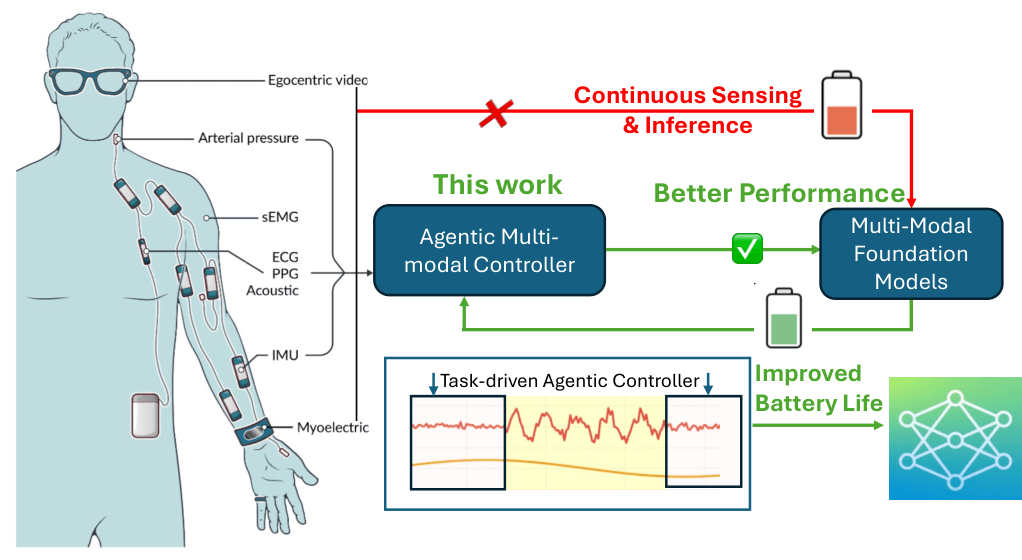
Wearable medical devices have a battery problem. Strap an ECG, PPG, EMG, and IMU onto a patient and the device barely makes it through a workday, a serious limitation for anything meant to run continuously in the background. A new paper from researchers at Case Western Reserve University and USC argues the fix is a smarter model rather than a bigger battery: one that decides, on the fly, which sensors are worth turning on and which samples are worth processing.
Their framework, called Adaptive Multimodal Intelligence (AMI), treats sensing itself as a learned behavior. Across MHEALTH, HMC Sleep, and WESAD datasets, it reduces sensor usage by 48.8% while improving state-of-the-art accuracy by 1.9% on average.
Why continuous multimodal monitoring is a losing battle
Modern medical wearables fuse several biosignals to make robust predictions about activity, sleep stage, or stress. The catch is power. Continuous acquisition of ECG, PPG, EMG, and IMU streams rapidly drains wearable batteries, often limiting operation to under 10 hours, while existing systems overlook the high temporal redundancy present in physiological signals.
That redundancy is the key insight. A resting heart trace looks nearly identical from one second to the next, and an accelerometer glued to a sleeping patient reports mostly the same numbers for hours. Sampling those streams at full rate wastes energy on data that carries almost no new information.

Learning when to sense, not just how to infer
AMI is built around a simple bet: if the model can predict what a redundant signal will look like, it does not need to actually measure it. The framework jointly learns when to sense and how to infer, and it integrates three components:
- A lightweight Agentic Modality Controller that uses differentiable Gumbel-Sigmoid gating to dynamically select active sensors based on model confidence and task relevance.
- A